Practical advice
Contains affiliate links
A bird-feeding station cleaning schedule
Daily checks and a weekly cleaning rota for hanging feeders, poles, hooks and the ground under a UK bird-feeding station.
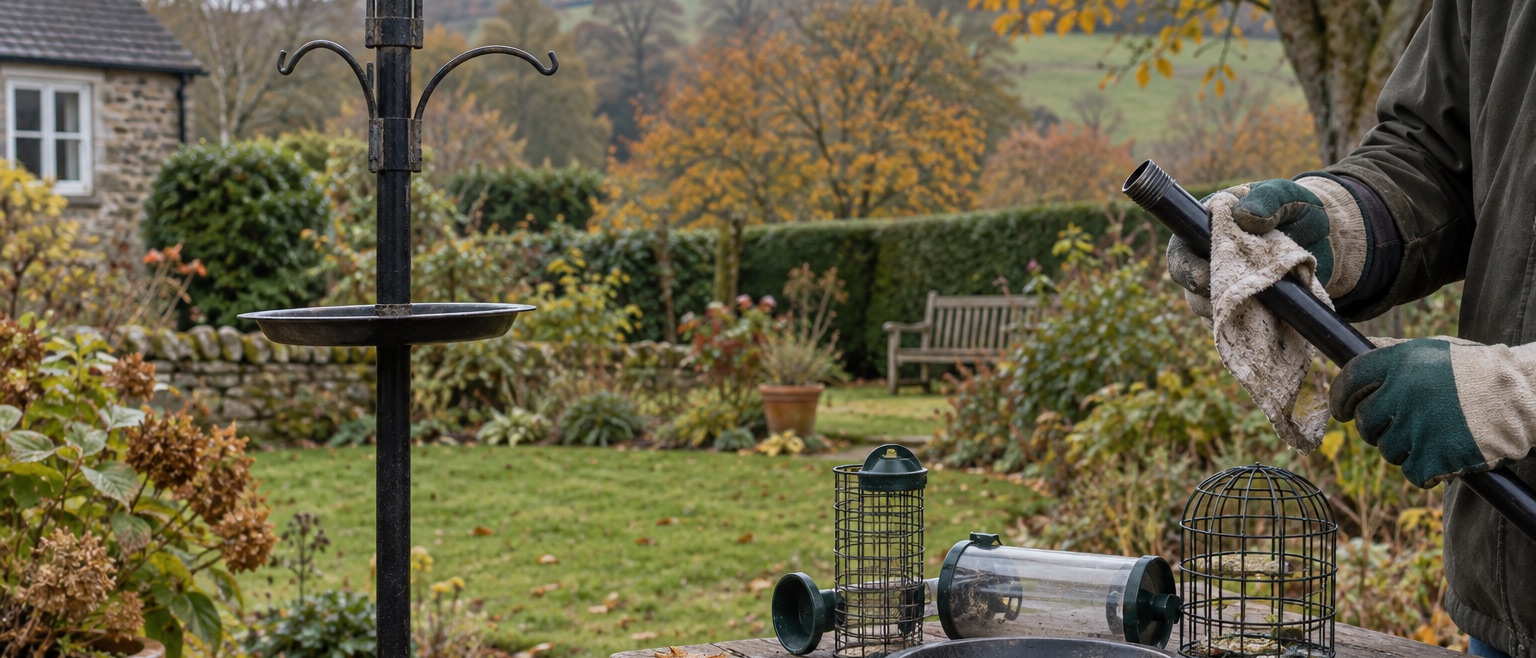
Keep small food portions moving through each feeder.
Remove ground debris before it attracts pests.
Inspect pole stability, hooks and rust as part of the clean.
A feeding station makes several feeders easier to hang, but it does not make them self-cleaning. Inspect the setup whenever you visit, clear spilled food promptly and give every feeder a full clean at least weekly. Wash the station's bird-contact areas and check hooks, joints and ground condition in the same session.
This is a rota for hanging feeders and their support pole, not an invitation to add an open tray of seed. The RSPB's September 2026 guidance advises against flat feeding surfaces and recommends cleaning and moving feeders weekly. Our bird-table and station cleaning guide explains why the older table format needs reconsideration.
The simple rota
| When | Station task |
|---|---|
| Every visit | Check each food supply for dampness, inspect ports and remove obvious spills and droppings |
| At least weekly | Empty, dismantle, wash, disinfect, rinse and dry every feeder; clean perches, hooks, baffle and pole contact points |
| After wind or rain | Check stability, fallen food, loose hooks and whether a feeder has filled with water |
| Before seasonal restart | Start with empty, fully clean equipment rather than last season's food or dirty fittings |
Current RSPB advice also limits seed and peanuts to 1 November–30 April. During the May–October pause, keep the station empty and maintained; do not use a full hopper simply because the pole is already installed. See when to start feeding again.
Clean in a sensible order
- Take down all feeders and discard old food. Use gloves and work outdoors with a dedicated kit.
- Clean the feeders by type: tube, squirrel-proof or camera. Do not assume a spray over the outside reaches the food chamber.
- Wipe hooks, arms, baffle and pole sections where birds perch or contamination collects. Check for loose joints and rust.
- Clear food and droppings beneath the station. On paving, sweep and wash the patch; on soil, remove contaminated surface material and consider moving the station. Our ground-cleaning guide gives surface-specific steps.
- Let everything dry, reassemble and check pole stability before rehanging. Space feeders rather than clustering every hook around a single busy point.
Make the workload realistic
If you cannot clean five hanging feeders weekly, hang fewer. Two manageable feeders with food used promptly are more practical than a decorative station packed with slow-turnover containers. The station-placement guide helps choose a position you can reach in winter, while how much food to offer helps limit waste.
Frequently asked questions
Do I need to wash the pole every week?
Clean bird-contact areas, hooks, baffles and visibly contaminated pole sections during the weekly session. The pole does not need the same immersion treatment as a removable food tube, but do not ignore droppings or grime on reachable fittings.
Can I leave a station in place when feeding is paused?
Yes, if it remains structurally sound and empty. Remove old food, clean the fittings and keep the area beneath free of leftovers.
Helpful products
For a practical station-care kit
Use labelled cleaner only on suitable emptied, washable feeder parts. A dedicated dustpan and brush helps clear accessible hard ground; it does not replace the full clean of each feeder.
Inspired Bird Feeder Cleaner and Sanitiser
A ready-to-use 500ml trigger spray sold specifically for cleaning feeders, bowls and feeding-station equipment.
Best as the cleaning solution in a regular feeder-hygiene kit. Drawback: it must be used exactly as directed and rinsed thoroughly.
Spear & Jackson dustpan and hand brush set
A deep outdoor dustpan with a reinforced front edge and a wooden-handled brush with stiff bassine bristles for collecting seed husks and light garden debris.
Best for sweeping hard surfaces beneath a feeder. Drawback: it is not suitable for disinfecting soil, grass or planted areas.