Specialist buying guide
Best window bird feeders
The safest ways to feed birds at a window, including a compact suction feeder and hanging-feeder brackets.
Our recommendations
The shortlist
Recommended feeder
RSPB Flutter Butter wall and window feeder
A hooded feeder that fixes to glass or a wall and takes a proprietary Flutter Butter refill pod.
Our preferred direct-to-glass option because it avoids a flat seed tray. Drawback: it requires proprietary refills and feeds one bird at a time.
| Option | Why consider it | Keep in mind |
|---|---|---|
| RSPB Flutter Butter | Hooded single access point | Proprietary refill pods |
| Window-mounted bracket | Suspends an ordinary feeder | Load and suction need checking |
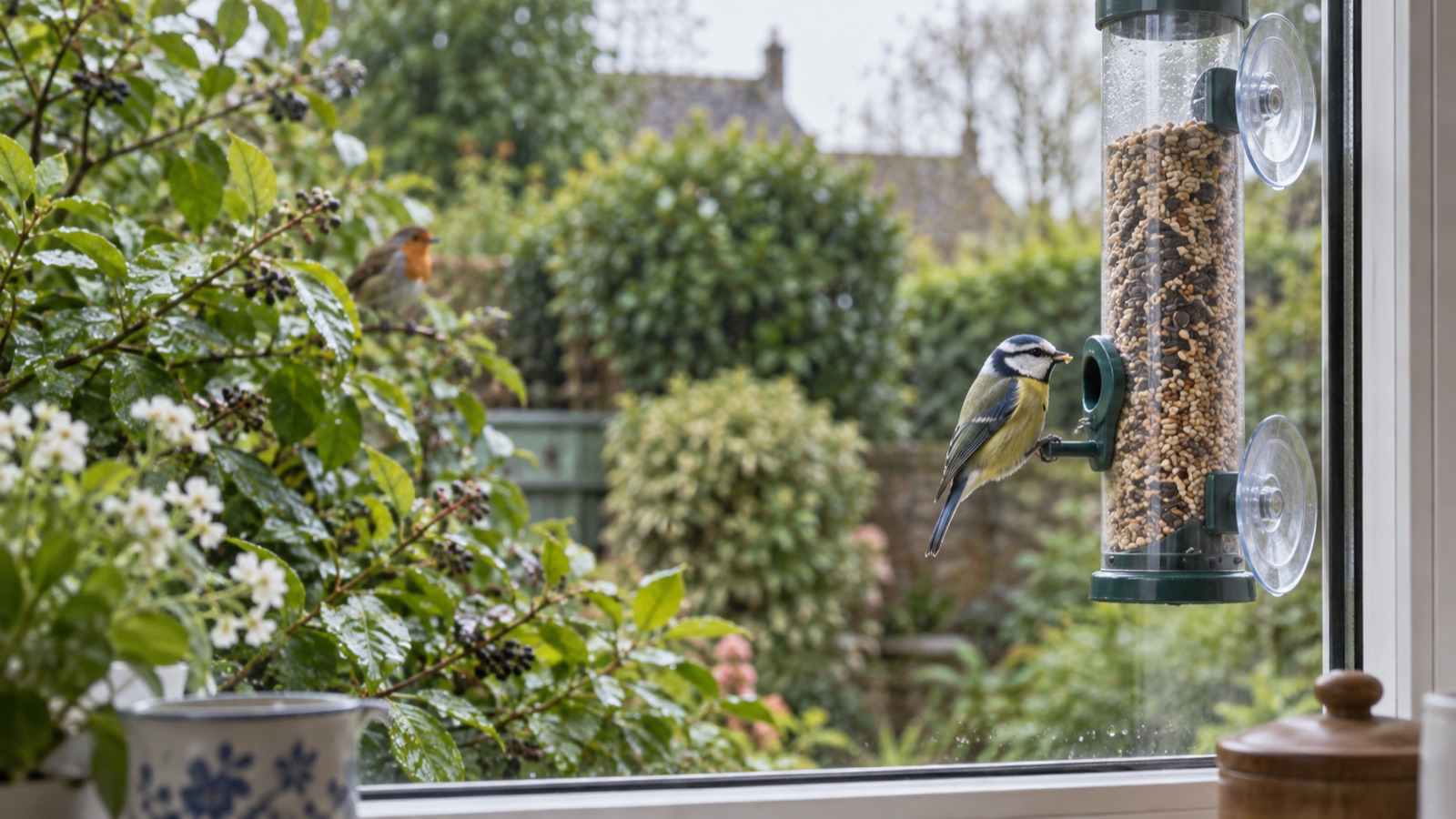
Most window feeders are open trays, but current RSPB guidance advises avoiding flat feeding surfaces because frequent cleaning does not remove their additional disease risk. Two better approaches are a hooded RSPB Flutter Butter wall/window feeder or a properly rated window bracket that suspends an ordinary hanging feeder away from the glass.
Before fitting anything to glass
Window strikes are a separate welfare risk. Reflections can look like open sky or vegetation, and a clear route through a building can appear passable. Review the BTO’s current window-strike guidance, assess reflections at different times and follow its placement and mitigation advice. Attaching a feeder does not automatically make a pane safe.
Only use clean, smooth, sound glazing. Follow the fixing maker’s preparation, load and inspection instructions. Suction cups age, collect dirt and react to weather; check them before every refill and after abrupt temperature changes. Never mount above a place where a falling feeder could injure someone or be difficult to recover.
Pick one: RSPB Flutter Butter wall and window feeder
This hooded feeder can be attached with suction cups or screws. It presents a single access point and takes a proprietary Flutter Butter refill pod, rather than spreading loose seed over a flat tray. Limiting simultaneous feeding is a relevant benefit when current guidance also favours several small stations over crowding at one.
Why it stands out: it offers a hooded, non-tray design with one controlled feeding point. Drawback: it uses proprietary refill pods, and any food choice must follow current seasonal guidance. The suction cups also need regular inspection. RSPB product details.
Pick two: a window-mounted hanging-feeder bracket
A window bracket uses suction mounts to hold an arm or hook away from the pane. This allows a conventional hanging tube or mesh feeder to be used without adding a flat feeding tray. Only consider a bracket with a clearly published load limit and fitting instructions, and remember to include the weight of the food as well as the feeder itself.
Why consider it: you can choose a hanging feeder that comes apart easily for cleaning. Drawback: both the bracket and feeder need checking, and the projecting arm places more leverage on the suction cups than a compact feeder mounted close to the glass.
Why there are no tray picks
Clear acrylic trays are popular because they offer an open view and look easy to wash. That convenience does not remove the extra contact and contamination risk of a flat feeding surface, so we have not included tray-style feeders. Do not improvise a seed shelf beneath either option.
Capacity, food and the May–November restriction
The RSPB currently advises not offering seeds or peanuts from May through November. At other times, offer only what is consumed within one or two days, clean at least weekly and keep food dry. A window location can create condensation or weather exposure that is easy to overlook from indoors. Inspect the actual food, not just the roof.
Move feeding positions regularly where the fixing method allows, clear debris below and prefer several small stations to one crowded point. The wall-mounted screw option may be secure but less movable; factor that into the hygiene plan before drilling.
A safe setup checklist
- Read current RSPB feeding and BTO window-strike guidance.
- Reject flat feeding surfaces.
- Examine the pane for reflections and through-views.
- Confirm clean, undamaged glass and the fixing’s rated load.
- Use a non-tray feeder and small food quantity.
- Inspect suction, feeder, food and surrounding ground at every visit.
- Clean outside at least weekly and dry completely.
For a hanging feeder to use with a suitable bracket, compare the general easy-clean options. If cleaning access is the deciding feature, use the cleanability shortlist.
Direct suction or bracket: which arrangement is better?
Choose the Flutter Butter unit when its proprietary food format is appropriate under current guidance and a compact single access point suits the window. Choose a bracket when you want to use a conventional hanging feeder and the bracket has clear load, projection and fitting instructions. Neither option is suitable when the pane, cleaning access or collision risk is doubtful.
A bracket can make weekly cleaning simpler because the hanging feeder lifts off separately. The trade-off is mechanical: a loaded feeder sits away from the glass and applies leverage to the suction mounts. Never judge the safe load by appearance; follow the bracket maker's stated limit.
Cleaning a window-mounted setup
Work outside where possible. Remove leftovers, dismantle the food-contact parts, wash in hot soapy water and use an animal-safe disinfectant or mild 5% bleach where appropriate. Rinse and dry fully. Clean the fixing separately according to its material instructions; detergent residue on the pane can also weaken suction. Clean debris below and wash hands and forearms.
At least weekly is the minimum routine. Condensation, contamination or poor suction can demand earlier action. Do not let proximity behind a kitchen window tempt cleaning in a food-preparation sink.
What to look for from indoors
A close view should be used to monitor food condition and bird behaviour, not to create a crowded spectacle. Watch for birds repeatedly striking or braking sharply at the pane, territorial attacks on reflections and routes that line up with another window. Revisit BTO advice if the light or surrounding vegetation changes.
FAQs
Why not recommend a transparent seed tray?
Because current RSPB guidance says to avoid flat feeding surfaces, including window trays, due to additional disease-transmission risk. Ease of wiping does not remove that risk.
Can any hanging feeder go on a window bracket?
No. The combined filled weight, dimensions, movement in wind and bracket instructions must all be compatible.
Is suction permanent?
No. Treat every suction mounting as an item that needs inspection and maintenance, not a permanent structural fixing.
Can seeds be used from May to November?
Current RSPB advice is not to feed seeds or peanuts in that period. Consult the live guidance rather than assuming a window location is an exception.
Preparing suction cups properly
Use the exact preparation method supplied with the fixing. The general checks are straightforward: the pane must be smooth, undamaged and free from grease or loose dirt; cups must be supple, clean and undamaged; and the assembly must seat without twisting. Do not add household adhesives, oils or improvised tapes unless the maker specifies them.
Load the mount only after it is secure, and begin with the smallest permitted food quantity. Recheck from outside where safe, because an indoor view can hide a partially lifted edge. Weather-facing panes need closer inspection after frost, strong sun, wind or heavy rain.
Load, projection and weather
A direct Flutter Butter mount keeps the load close to the pane. A bracket projects a hanging feeder outwards, creating leverage and movement. This does not make brackets unsuitable, but it makes a published load rating and clear installation instructions essential.
Account for the feeder’s filled mass, not its empty mass. A swinging feeder can touch the glass or frame even when the bracket itself remains attached. If the assembly cannot remain separated during ordinary wind, choose a ground-independent pole or other appropriate hanging point instead.
Renters and reversible installation
Suction mounting avoids drilling, but it is not automatically damage-free. Dirt, trapped moisture or repeated movement may mark finishes around a window, and access from an upper floor may be unsafe. Renters should check their agreement and avoid screw mounting without permission. Reversibility does not justify fitting where weekly outside cleaning is impractical.
When no window option is suitable
Reject window mounting where the glass is textured, cracked, coated in a way that conflicts with suction instructions, high above an inaccessible area, or exposed to loads the fixing does not cover. Also reject it when reflections or through-views cannot be mitigated under BTO guidance, when a feeder would obstruct opening or escape, or when falling parts could endanger people.
A view from indoors is not more important than collision risk or maintainability. A hanging feeder elsewhere in the garden may be the responsible choice.
Visibility without disturbance
Keep indoor movement and lighting in mind. Sudden close activity may deter birds, while internal lights and reflections change what the pane presents. Curtains, plants and room layout can alter through-views over time. Reassess rather than assuming a once-safe setup remains unchanged.
Common errors
- Mounting a flat tray because it appears easy to wipe.
- Filling before suction has been checked under load.
- Ignoring the hanging feeder’s movement on a bracket.
- Cleaning food parts while leaving dirty cups and glass untouched.
- Installing too high to remove safely every week.
- Treating close viewing as evidence that collision risk has been solved.
- Using proprietary refill products without checking current seasonal advice.