
Specialist buying guide
Best squirrel-proof bird feeders
Compare caged and weight-activated feeder designs, their positioning needs and the compromises behind realistic squirrel resistance.
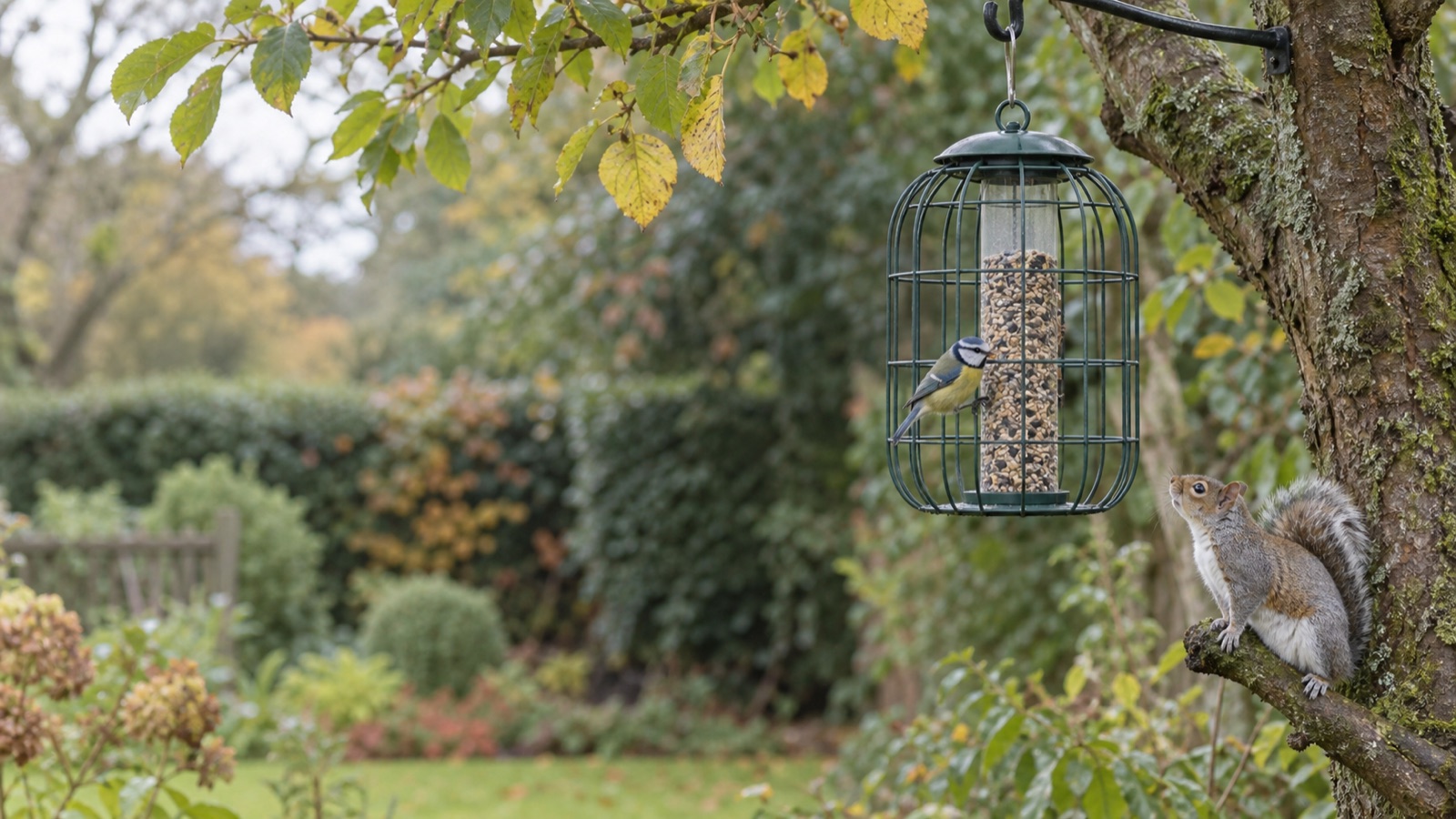
Our recommendations
The shortlist
Recommended feeder
Brome Squirrel Buster Mini
A compact four-port feeder with a weight-operated shroud that closes access when a squirrel lands on it.
Best compact mechanism. Drawback: nearby launch points defeat the principle and the trigger cannot be tuned.
Recommended feeder
Brome Squirrel Buster Plus
Brome’s largest feeder uses an adjustable weight-operated shroud, chew-resistant fittings and a ventilated 2.8L seed tube that dismantles by hand.
Best adjustable, high-capacity mechanism. Drawback: its size, weight and price are excessive for many gardens.
Recommended feeder
RSPB Ultimate seed feeder and guardian (small)
An easy-clean seed feeder enclosed by a metal guardian that limits physical access to the feeding ports.
Best guarded-cage approach. Drawback: the cage adds more joints to clean and cannot exclude every larger visitor.
| Feeder | How it works | Keep in mind |
|---|---|---|
| Brome Mini | Non-adjustable moving shroud | Requires clear hanging space |
| Brome Squirrel Buster Plus | Adjustable weight-operated shroud | Large and expensive |
| RSPB Ultimate + guardian | Fixed outer cage | Adds surfaces to clean |
No feeder can be promised as completely squirrel-proof in every garden. The useful goal is to make access harder without compromising hygiene or safe access for birds.
Quick picks
The Brome Squirrel Buster Mini is the compact weight-operated choice. The Squirrel Buster Plus adds adjustable sensitivity and a much larger reservoir, while the RSPB Ultimate seed feeder with guardian uses a fixed cage instead of a moving trigger.
Before buying: the 2026 hygiene rules still apply
Squirrel resistance does not outrank disease prevention. The RSPB currently advises against offering seeds or peanuts between May and November. Outside that period, offer only one or two days’ food, keep it dry, clean at least weekly, remove debris, move positions and split activity between several small stations. Avoid flat trays and tables. Check current RSPB guidance.
Three mechanisms, three compromises
Brome Squirrel Buster Mini
This approximately 550ml, 454g feeder has four ports. Excess weight lowers a shroud over them; the sensitivity is not adjustable. It comes apart by hand, avoiding a tool-dependent routine.
Why it stands out: its compact size and weight-operated shroud suit a hanging point with generous clearance. Drawback: a squirrel reaching from a branch may avoid loading the shroud, and the fixed sensitivity cannot be tuned for particular birds. Narrow areas around the mechanism may require a bottle brush. Manufacturer specification.
Brome Squirrel Buster Plus
The Plus holds about 2.8L and measures roughly 71cm with its hanger. Excess weight lowers a shroud over the ports, while an adjustable spring lets you change how much weight triggers it. The feeder dismantles by hand and uses a ventilated seed tube.
Why it stands out: the adjustable trigger is more flexible than the Mini’s fixed setting, and the large body suits a genuinely busy winter station. Drawback: it is bulky, heavy and expensive. Do not fill the reservoir completely unless birds can empty the food within one or two days, and keep the shroud track clean. Manufacturer specification.
RSPB Ultimate seed feeder and guardian
This combines an easy-clean seed tube with an outer guardian. The cage creates distance between larger animals and the ports without springs or calibration.
Why it stands out: the fixed guard is simple to understand and the feeder inside can be dismantled. Drawback: the cage adds more joints to clean, may make some birds cautious and cannot guarantee that every larger bird will be kept out. RSPB product details.
Positioning is part of the product
Watch the whole route before ordering. Fence tops, flexible branches, walls, drainpipes and other hooks can bypass a mechanism. A fixed cage must not touch a surface through which an animal can reach. A moving shroud must remain free to travel. Follow the maker’s clearance, mounting and fill limits rather than improvising.
Bird access and food flow
A guard’s openings favour some body sizes but do not establish an absolute species boundary. A weight mechanism reacts to load, not identity. Watch whether intended visitors can perch naturally and whether damp food bridges above the ports. Never enlarge openings or disable springs in a way that can create sharp or trapping edges.
Cleaning and common failure points
At least weekly, empty leftovers, dismantle outside, wash in hot soapy water, disinfect appropriately, rinse and dry fully. Inspect cage junctions, shroud tracks and ports. Seed packed around a moving part can stop it closing; corrosion, distortion or an incorrect reassembly can do the same. Clear the ground so spill does not remain a reward.
For a diagnosis-first plan covering repositioning and baffles, read how to stop squirrels eating bird food. For less specialised choices, return to the main feeder guide.
Realistic expectations
Squirrels learn and gardens change. Combine clearance, a suitable mechanism, small fills and spill control, then reassess. “Squirrel-proof” is a search term, not a guarantee.
Cage or weight-activated feeder?
Choose a cage when the physical gap and reach are the relevant constraints and you accept that some birds may hesitate. Choose a weight-operated design where a squirrel is likely to load the feeder in the intended way. Choose neither until the feeder can be positioned clear of routes that bypass the protection.
Capacity comes last. The Plus may hold about 2.8L, but you should still add only what birds can eat within one or two days. Even the Mini’s 550ml capacity may be more than a quiet station needs.
Baffles and spill control still matter
A pole baffle can interrupt a climbing route when it is fitted at the correct height and cannot be bypassed from the side. A hanging dome can obstruct an approach but should not crowd birds or overload a hook. Follow the component’s instructions; improvised sharp, sticky or trapping deterrents are unacceptable.
Do not add a flat catch tray. Although it may retain dropped seed, current RSPB guidance advises against flat feeding surfaces. Instead, address leaking ports, reduce fills and clear the ground. Our practical squirrel plan covers the station rather than the product.
What to inspect at every refill
Check that the shroud or port moves and returns without sticking. Look for compacted seed, frayed hangers, distorted cage wires and contact with branches. Confirm that food is dry and that no more than a two-day quantity remains. Inspect the ground for a secondary feeding point created by spill.
FAQs
Which option suits a smaller garden?
The compact Brome Mini is the easiest of these three to accommodate, but it still needs a clear hanging position. If nearby branches or fences give squirrels a side route, improve the location before buying a specialist feeder.
Can I adjust the Mini for particular birds?
The Mini has a fixed, non-adjustable mechanism. It responds to weight, so it cannot be tuned precisely for a particular species.
Does a guardian solve disease risk?
No. It controls physical access, not microbial transmission. Weekly cleaning, dry short-duration fills, multiple moved stations and seasonal restrictions still apply.
What if squirrels damage a plastic feeder?
Remove a feeder with cracks, sharp edges or loose components. Do not leave a damaged product in service while waiting for replacement parts.
Diagnose the route before choosing the mechanism
Separate four routes: climbing the support, jumping from the side, descending along a hanger, and feeding from spill below. A pole baffle addresses the first; clearance addresses the second; a suitable overhead guard may address the third; measured fills and ground care address the fourth. A specialist feeder is useful only when its trigger sits on the remaining route.
Observe branch movement as well as its resting position. A thin branch outside the stated clearance can bend under weight. Check fences, sheds, drainpipes and adjacent hooks from a squirrel’s likely approach height, not just from where a person stands.
Cage and guardian mechanisms
A cage relies on the size of its openings and the distance to the inner ports. This may favour smaller visitors, although reach and behaviour vary, and food spilled outside the cage bypasses it. The RSPB Ultimate and guardian is our pick here because the inner feeder can still be dismantled for cleaning.
The compromise is cleaning. Remove the inner unit rather than trying to wash through bars, brush cage intersections, and inspect for distortion. Do not bend openings to create a homemade size threshold.
Moving shrouds and closing ports
The Brome Mini uses a shroud that moves over four ports under excess weight. Because the cited Mini is non-adjustable, there is no responsible promise that it can be calibrated to a named species. Its simpler compact body suits a clear hanging point, but a nearby branch can allow side access without loading the feeder correctly.
The Plus applies weight control through one adjustable shroud. The shroud must move freely after cleaning, and the ventilated tube does not remove the need to check seed after wet weather.
Buyer scenarios
A small garden with a single clear hook: the Mini is the proportionate starting point if the clear radius is real. A busy winter station where adjustable sensitivity matters: the Plus may justify its bulk, but fill only for short turnover. Persistent larger-bird access without a reliable weight route: a guardian may be the clearer physical approach. A feeder touching a tree or fence: reposition before buying any mechanism.
A quiet garden used only occasionally: none of the large specialist options may be appropriate. A simpler easy-clean feeder, small fill and better siting can be more manageable.
Why common defences fail
A baffle fails when a branch bridges it or it is fitted where a squirrel can jump past. A shroud fails when the animal does not place weight on it or when packed seed impedes travel. A cage fails when food accumulates outside or bars become distorted. A closing port fails when dirt, damage or incorrect reassembly prevents movement. All fail when a flat catcher supplies food below.
Maintenance log
At every refill, note the food condition, any spill and whether each moving part returns freely. Complete the full outside wash, appropriate disinfection, rinse and drying every week. A simple dated note can help you spot a mechanism that repeatedly sticks or a position that repeatedly becomes wet.
Further questions
Are heavier feeders harder for squirrels to move?
Total feeder weight is not the same as squirrel resistance. The relevant question is how the specified mechanism reacts and whether the mounting remains sound.
Can sensitivity be altered with extra weights?
Only where a manufacturer explicitly provides an approved adjustment. The Mini is non-adjustable, so do not improvise changes.
Will changing seed stop squirrels?
This guide does not recommend manipulating wildlife through unsupported food substitutions. Use suitable seasonal food and address routes, spill and mechanism instead.