
Practical advice
Contains affiliate links
How to clean a squirrel-proof bird feeder
Clean the inner food tube and the outer cage or moving shroud of a squirrel-proof bird feeder without trapping residue or damaging its mechanism.
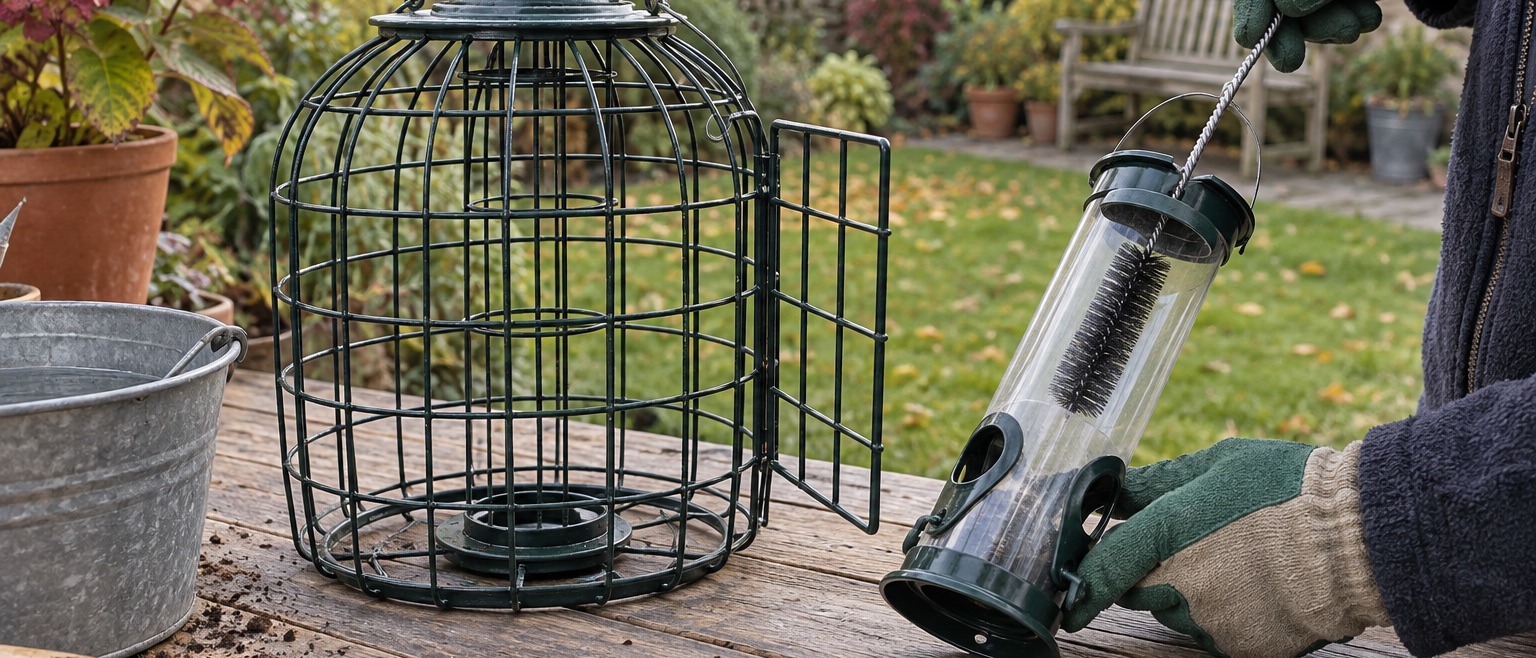
Do not force springs, latches or sealed moving parts.
Reach trapped husks between the cage and inner feeder.
Retire a guard that sticks open or leaves sharp edges.
A squirrel-proof feeder still needs the same weekly full clean as an ordinary feeder. Its cage, closing ports or weight-activated sleeve can actually add places for husks and droppings to lodge. Empty the food, separate only maker-removable parts, clean the inner feeder and outer guard, then test the mechanism empty before using it again.
The RSPB's bird-feeding guidance recommends cleaning and moving feeders weekly. For the washing and disinfection sequence, follow the BTO hygiene advice and the cleaner's current label.
First, identify the mechanism
| Design | Extra area to clean | Check before rehanging |
|---|---|---|
| Fixed outer cage | Gap between cage and tube, cage floor and latch | Cage is securely latched and has no bent sharp wires |
| Sliding weight-activated shroud | Tracks, sleeve edges and covered ports | Shroud drops and returns freely without sticking |
| Spring-loaded perch or port | Food dust around moving joint | Closing action still works and the spring is protected as instructed |
| Pole baffle plus ordinary feeder | Baffle underside and pole contact point | Baffle has not trapped residue or loosened |
Do not soak a spring assembly, battery unit or sealed joint unless the manufacturer expressly allows it. If you cannot find the exact manual, clean all accessible surfaces and ask the maker before pulling a spring housing apart.
The cleaning sequence
- Remove the feeder after birds have left. Wear gloves and empty the food completely, including seed behind the ports.
- Open the guard and remove the inner feeder according to the model instructions. Photograph the latch and spring position first.
- Wash the inner tube, base and ports with hot soapy water and a dedicated long brush. Clear the drainage holes.
- Wash the cage, shroud or baffle separately. Brush joints and undersides where droppings collect; do not leave sharp wires or loose screws.
- Disinfect suitable washable surfaces as labelled, then rinse and air-dry fully. Our disinfectant guide explains the order.
- Reassemble and move the shroud or latch through its full travel while the feeder is empty. If it jams, birds could be shut out or exposed to a damaged edge.
For a general tube-cleaning method, see how to clean a tube feeder. If squirrels are still reaching the food, the answer may be positioning or a baffle, not a more complicated cage.
When cleaning reveals a bigger problem
Rust at a hinge, a broken latch or a bent cage wire is not just cosmetic if it creates a sharp edge or prevents a door closing. Look for an exact replacement part, or replace the feeder if you cannot restore a safe, cleanable assembly. Do not oil or spray a food-contact mechanism unless its maker specifies a bird-safe procedure.
Frequently asked questions
Can the whole cage go in a bucket?
Only if the exact manual allows immersion and there are no sealed, electronic or corrosion-sensitive parts. Dismantling and washing accessible sections outdoors is the default.
Does a squirrel-proof design need less cleaning?
No. The guard restricts access for larger animals; it does not stop damp food, droppings or seed dust accumulating.
Helpful products
Tools for the hidden surfaces
Use a long brush to reach the inner tube and a labelled cleaner on washable parts. The exact feeder manual determines which cage, spring or shroud components may be removed or wetted.
Jacobi Jayne long bird feeder cleaning brush
A long-handled natural-bristle brush made for reaching inside bottle-shaped and tubular bird feeders.
Best for cleaning the length of feeder tubes. Drawback: a smaller detail brush may still be useful around ports and threads.
Inspired Bird Feeder Cleaner and Sanitiser
A ready-to-use 500ml trigger spray sold specifically for cleaning feeders, bowls and feeding-station equipment.
Best as the cleaning solution in a regular feeder-hygiene kit. Drawback: it must be used exactly as directed and rinsed thoroughly.