Feeding routine
How much bird food should you put out?
Use bird activity, food condition and the weather to offer a small fresh portion without leaving a feeder full for days.
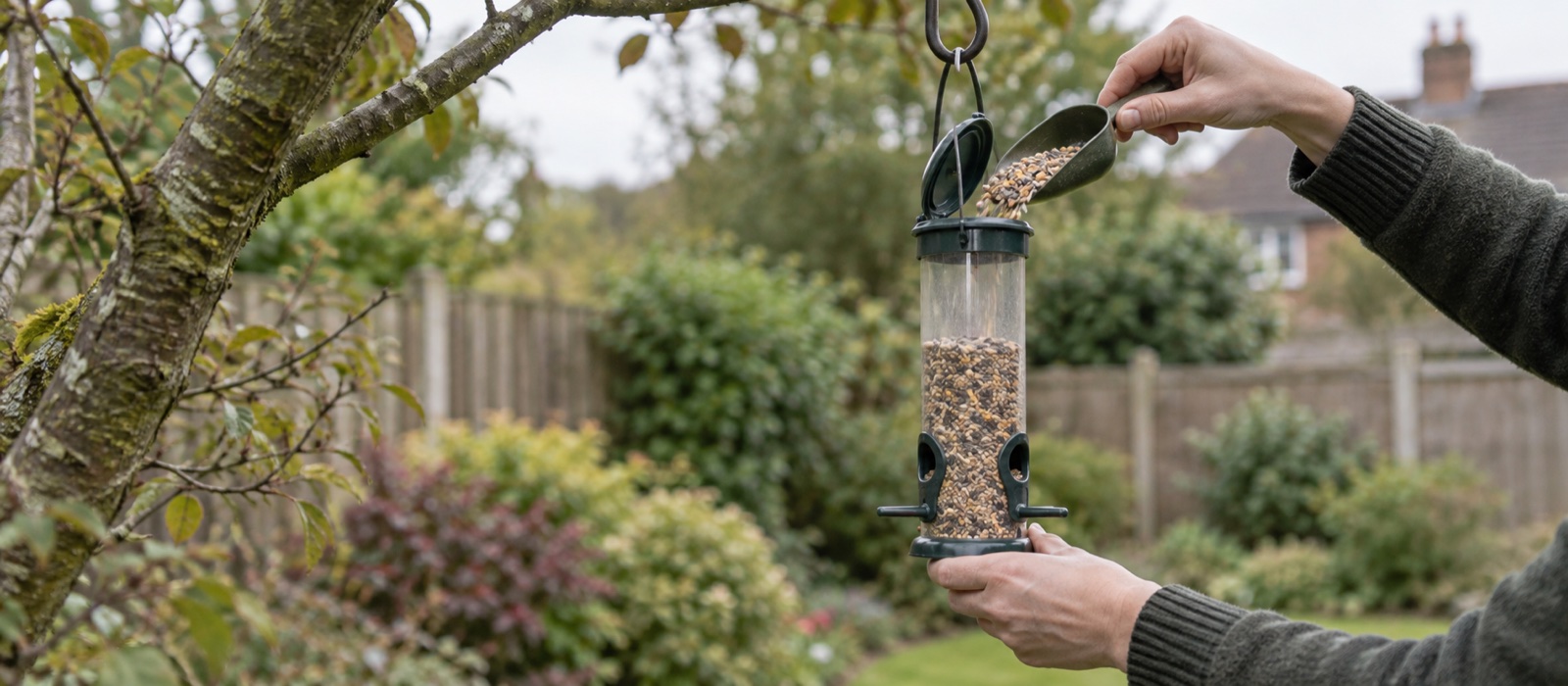
Begin with a small portion and note what remains the following day.
Reduce the next fill if food is left, wet, clumped or scattered below.
Empty old food before refilling and clean the feeder at least weekly.
Put out enough bird food to last one or two days, not enough to keep a feeder full for a week. The right amount changes with the birds visiting your garden, the food, the weather and the season, so the most reliable guide is what remains at the next check.
This is the practical meaning of feeding “little and often”. The BTO’s current hygiene advice says uneaten food should be removed after 24–48 hours and fresh food should not be added on top of old. The RSPB feeding guide gives the same one-to-two-day turnover as the aim.
A sensible starting routine
For a new or recently quiet feeder, add only enough food to cover the feeding ports and leave most of the reservoir empty. Check it at roughly the same time the following day.
- Almost all gone and the remaining food is dry: offer a similar amount again.
- Empty early, with several birds still visiting: increase the next portion a little.
- A noticeable amount remains after 24 hours: reduce the next fill.
- Food remains after 48 hours: discard it, clean as needed and restart with much less.
- Food is damp, clumped, dirty or smells unusual: discard it immediately rather than waiting.
You do not need laboratory scales. A small scoop or measuring cup helps you repeat a portion, but its useful measure is “the amount this garden clears promptly”, not a universal number of grams.
Why a full feeder is often too much
A tall tube can look better when it is full, yet unused capacity is harmless. Excess food sits outdoors through temperature changes, condensation and driven rain. Older material can also remain trapped below a fresh top-up where you cannot see it.
Smaller fills make changes easier to spot. You can see whether a new food is popular, whether one ingredient is being rejected and whether the feeder is dispensing too freely. You also lose less if the fill gets wet.
If a large feeder regularly holds more than two days’ demand, partly fill it or move to a smaller model. Our guide to large-capacity bird feeders explains when extra volume is genuinely useful and when it simply creates more food to manage.
Adjust the amount to the weather
During cold winter weather, more birds may visit and clear food quickly. Watch the feeder rather than assuming demand will rise by a fixed amount. If it empties early over several days, increase the portion gradually while keeping the one-to-two-day limit.
In mild, wet or windy weather, demand may fall and food may spoil faster. Reduce fills before prolonged rain and inspect the feeder afterwards. A roof or rain guard can reduce direct exposure, but it cannot prevent every route for moisture.
If seed becomes wet, follow our guide to wet or mouldy bird seed instead of adding a dry layer on top.
Different foods need different checks
Seed and peanuts
Current RSPB and BTO guidance recommends offering seeds and peanuts from 1 November to 30 April, then pausing them from 1 May to 31 October. During the feeding period, use a contained feeder and judge the next portion by the amount left after a day.
With a seed mix, look beneath the feeder too. A tube may appear to empty while birds are throwing out ingredients they do not want. More of the same mix will increase waste rather than satisfy demand. A better match may be a simpler food or a mix with fewer rejected ingredients.
Whole peanuts belong in a suitable rigid-mesh feeder. Do not loosen the food or offer a larger open portion simply to make it disappear faster.
Fat products
Offer fat balls and suet without plastic netting and in a suitable holder. Start with the smallest practical number the feeder can hold securely. Replace rather than add to old pieces, and remove soft, rancid, mouldy or heavily soiled food.
Fat products can deteriorate in warm weather. Being permitted more flexibly than seed under current seasonal advice does not mean they should remain outside regardless of temperature or condition.
Dried mealworms
Dried mealworms are best offered in a small contained portion. They are lightweight, so a bowl that looks modest can still hold more than visiting birds will clear. Protect them from rain, remove leftovers promptly and wash the feeding surface regularly.
What if lots of birds arrive at once?
Do not respond automatically with one oversized, permanently full station. Concentrating many birds around the same food can increase contact and contamination.
Where your garden allows it, the BTO recommends spreading suitable foods between separate locations and rotating feeding positions. Several controlled portions can be easier to monitor than one deep reservoir, although every feeder still needs cleaning and the ground below each station needs attention.
Keep the stored supply separate
Take only the day’s portion outside. Keep the main supply indoors in a clean, sealed container in a cool, dry place with little temperature variation. Do not return food from an outdoor feeder to the storage box.
Empty and clean the container before repeatedly burying older food beneath new bags. Our bird-food storage guide compares manageable containers without treating any of them as guaranteed protection against rodents.
When to reduce or stop altogether
Stop feeding rather than merely reducing the portion if you see birds that appear sick, recurring rodent activity, mouldy food or contamination you cannot manage. Clean the equipment and follow current official guidance before restarting.
The seasonal pause also applies even when birds are clearing seed quickly. Our guide to when to stop feeding garden birds brings the different stop-feeding triggers together.
Frequently asked questions
How much bird food should I put out per day?
There is no reliable universal gram amount. Begin with a modest portion, check what remains after 24 hours and adjust the next fill so the food is normally cleared within a day or two.
Should I fill every feeding port?
No. Birds can use a partly filled tube as long as food reaches the active ports and remains fresh. Empty space is preferable to several days of unused food.
How often should I refill a feeder?
Check it daily when in use, but refill according to demand. Empty old food rather than topping it up, and complete a thorough clean at least weekly.
Do birds become dependent on a fixed daily amount?
Garden food is supplementary. Visiting birds also use natural food and other sites, and demand changes. Concentrate on freshness, hygiene and current seasonal advice rather than maintaining an arbitrary full reservoir.
Should I put out extra before going away?
No. A feeder left overfilled cannot be checked for damp, contamination or spoilage. Empty and clean it instead if nobody can maintain it properly.
Helpful products
Two ways to make small portions easier
A pour container suits a modest working supply, while a larger box with a scoop is more practical for winter storage. Neither tells you how much your birds need—the amount left in the feeder does that.
DEAYOU 2.8L bird-seed pour container
Best for: Keeping and pouring a modest working quantity without lifting a bulk bag
A 2.8L clear plastic dry-food container with a three-sided locking lid, silicone seal, handle, measuring cup and pour spout.
What stands out
- 2.8L clear body
- Locking lid and pour spout
- Measuring cup included
Keep in mind
- Too small for bulk storage
- Store it indoors rather than beside the feeder
- 2.8L
- Pour spout
- Measuring cup
Henry Wag Store-Fresh food box
Best for: Keeping a winter supply indoors and taking out one measured portion
A 7.5kg-capacity dry-food box with a foam seal, snap-lock lid, wide opening and included measuring scoop.
What stands out
- Wide opening
- Snap-lock lid
- Measuring scoop included
Keep in mind
- Stated capacity varies with seed density
- Not guaranteed rodent-proof
- 7.5kg stated
- Included scoop
- Foam seal