Practical advice
Contains affiliate links
How to reduce bird collisions with windows
Make risky windows visible to birds with closely spaced external markings, then check reflections and garden placement.
Identify the glass and time of day involved.
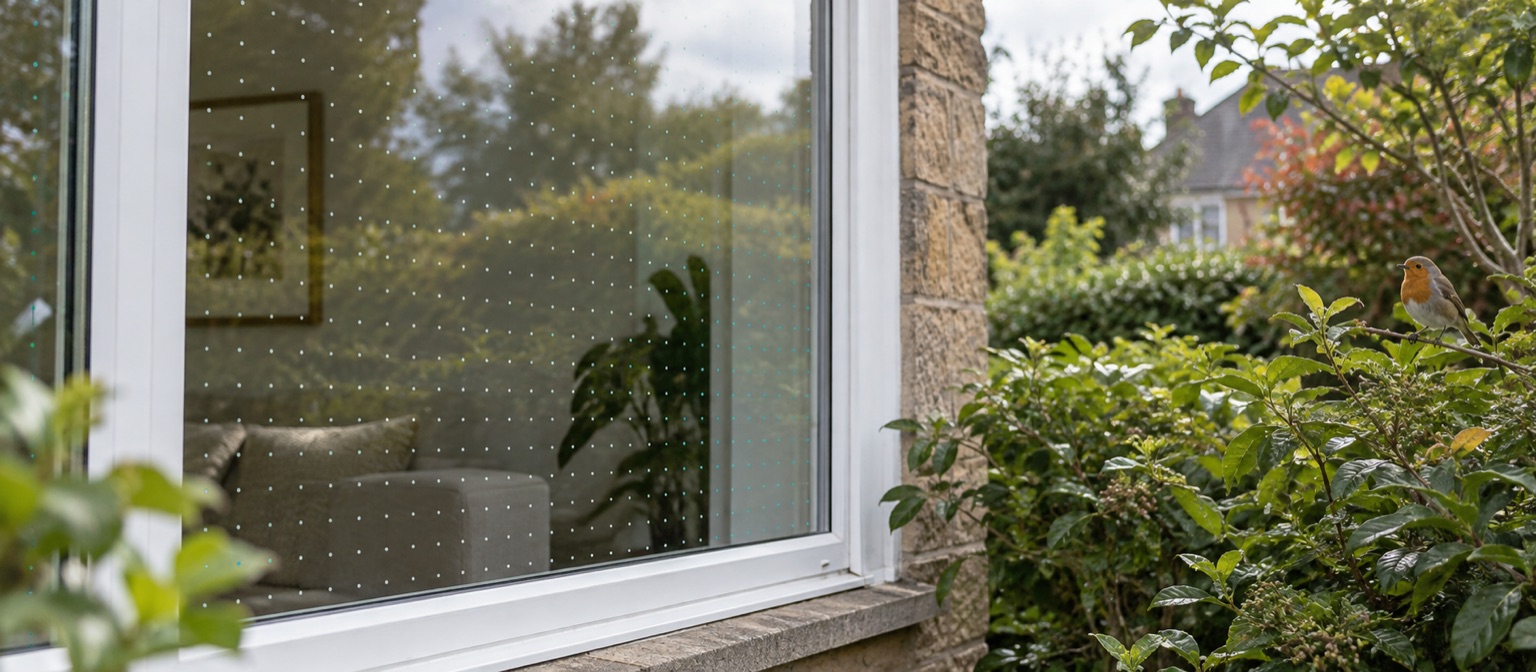
Apply a dense, visible pattern outside the pane.
Reassess the site after another strike.
To reduce bird collisions with windows, make the outside of the entire risky pane visible with a closely spaced pattern. Birds may see reflected sky or trees, or try to fly through glazing to habitat beyond. One decorative sticker or an inside curtain may not interrupt those exterior reflections enough. Start with the window that has actually had a strike, but check nearby glass doors and corner windows too.
The American Bird Conservancy's home guidance recommends exterior decals in a sufficiently dense pattern; its current guidance favours roughly 5 cm (2 inches) between pattern elements as a conservative design target. The RSPB's sticker listing warns that one sticker per window is unlikely to deter birds. Do not interpret the five stickers in one pack as complete coverage for a typical wide pane.
Why does this window look like a flight path?
Watch the glass at the time collisions happen. Trees or bright sky may be reflected on a sunny pane; a bird may see through two aligned windows or a glazed corner. A feeder, bath or shrub can concentrate flight close to that hazard. You do not need to remove all planting, but you do need to change what the bird sees at the glass.
| Pattern or measure | What to check | Limitation |
|---|---|---|
| External dots or small decals | Repeat across the full pane at close spacing | Sparse decoration leaves a flight-sized gap |
| External tape or film | Durable outdoor suitability and clear coverage | Must be installed as specified |
| External screen | Secure fit and safe clearance from glass | Needs proper maintenance and installation |
| Blinds or curtains | May change the view through glass | Often leave exterior reflections untouched |
If you rent or live in a listed or managed building, check permission before applying a permanent film or fixing a screen. A removable external marking approach may be easier, but do not use a temporary product that peels off and leaves the pane effectively clear.
How to mark the glass
- Clean and dry the outer surface as the marking product instructs.
- Measure the whole pane, including the corners. Sketch a repeating grid with no large untreated area; for conservative protection use about 5 cm spacing between visible elements.
- Apply markings that remain visible from outside in both bright and overcast conditions. Follow the exact product's dimensions and outdoor-use instructions.
- Step back and view the pane from bird approach directions. If broad open-looking areas remain, add coverage.
- Recheck after weathering and clean the markings without removing the pattern.
An RSPB sticker set may suit a small glazed area or form part of a larger pattern; for broad glazing, a purpose-designed dot film or repeated tape pattern may be more practical. This is one of the rare garden-bird problems where coverage matters more than brand.
Move birds away from a risky approach too
Review positions of water, feeders and vegetation near the pane. Our bath placement guide, balcony guide and small urban garden plan help avoid drawing birds into a clear flight line towards glass. Do not rely on relocation alone where the pane still reflects habitat. If you find an injured bird, consult the RSPB's current injured-bird advice and seek specialist help as appropriate.
Frequently asked questions
Do bird-shaped silhouettes work?
Only as part of a dense pattern. A single silhouette is simply an object a bird may try to fly around. Treat the whole risky pane.
Do the stickers go inside or outside?
Outside is the reliable default because reflections occur on the outer glass. Check the manufacturer's instructions and building restrictions before applying them.
Is pecking at a reflection the same as a collision?
No. Repeated territorial pecking at a reflection differs from a high-speed impact. Observe the behaviour first; both indicate that the glass's appearance matters, but the response may differ. The BTO describes window strikes and reflection behaviour.
Helpful products
An option for marking a small pane
These RSPB stickers are not a one-pack fix for a large window. Measure the pane and use enough markings, or choose a suitable full-pane treatment, to leave no broad clear gaps.
RSPB garden-birds window stickers
A five-sticker set for marking glass. Use enough sets or another dense marking method to cover the whole risky pane; a single sticker is not sufficient.
For smaller panes or as part of a full external marking pattern. Check that the finished spacing is close enough across the entire glass.
WindowAlert Modern Dots — 30 exterior decals
Thirty UV-reflective dots intended for the outside of glass. The pack is an alternative marking format, not a reason to leave large unmarked gaps.
Measure the glass first and use enough packs to achieve a close pattern across the entire risky pane; one pack may not be enough for a large window.