Practical advice
Where to put a nest box in your garden
Choose a sheltered, quiet position with the right height, direction, flight path and fixing for the intended bird.
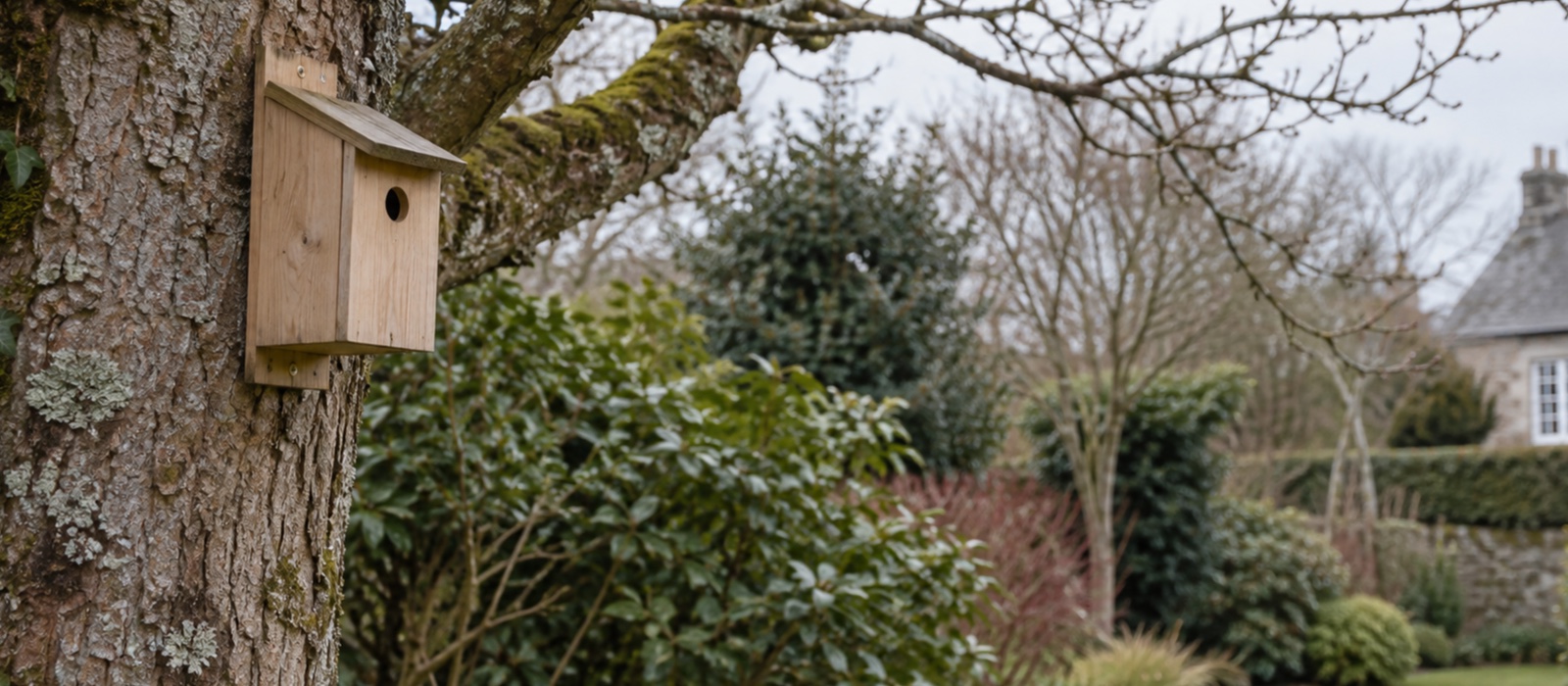
Match the height and surroundings to the intended species.
Keep boxes away from feeders, busy paths and easy predator routes.
Use secure fixings that suit the tree, wall and weight of the box.
The best place for a nest box is quiet, sheltered and easy for the intended bird to approach. There is no universal height or compass direction: a blue-tit box on a tree, an open-front robin box in ivy and a swift box beneath high eaves have very different requirements.
Before reaching for a drill, watch the site through a full day. Notice where direct sun falls, which way heavy rain arrives, how cats move through the garden and whether people regularly pass beneath the position.
Small-hole boxes: start at one to three metres
The BTO's positioning guidance gives roughly one to three metres above ground for small-hole boxes. That is high enough to reduce casual disturbance while remaining plausible for many tits and sparrows.
Height alone does not provide safety. A box at two metres beside a shed roof, fence top or strong horizontal branch may be easy for a cat or squirrel to approach. Look at the complete route, not just the distance from the ground.
Face away from strong sun and rain
In many UK gardens, a north- or east-facing entrance avoids the fiercest afternoon sun and prevailing south-westerly rain. It is a useful rule of thumb, not an absolute instruction. A shaded south-facing wall may be cooler than an east-facing box on an exposed post.
The entrance should tilt very slightly downward so rain is less likely to run inside. Never allow the box itself to hang loosely; the forward angle should come from stable installation.
Leave a clear flight path
Birds need an unobstructed route to the entrance. Remove only small obstructions outside the breeding season and avoid putting the box behind dangling cables, loose netting or rapidly growing climbers.
A perch is unnecessary. The birds can land at the entrance, while a perch may offer leverage to predators. Likewise, a branch immediately beneath the hole is not helpful even if it makes the box look natural.
Keep the nest site away from feeders
Feeders concentrate birds and can attract squirrels, corvids and cats. Put the box in a quieter part of the garden rather than immediately above or beside your feeding station.
Avoid doors, seating areas, children's play spaces and frequently used paths. Repeated disturbance can make an otherwise well-built box unattractive. Do not place a box where droppings or nesting debris will fall onto a neighbour's property or a public route.
Adapt the position for the bird
Robins
Place an open-front robin box lower down in thick ivy, a climbing shrub or a quiet open-fronted shed. The surroundings should conceal the broad opening without blocking access. See our recommended robin boxes.
House sparrows
A sparrow terrace usually belongs high on a sheltered wall, often below the eaves. The structure is wide and can be heavy, so use appropriate masonry or structural fixings. Several separate chambers suit their colony nesting.
Swifts
Swift boxes need a high wall position—guidance commonly uses at least five metres—with open space in front and below. Installation at this height requires competent equipment and secure anchoring. Our swift-box guide explains the choice.
Fix a box safely to a tree
Avoid nails and screws driven into a living tree where possible. Use a tree-safe adjustable fixing recommended by the box manufacturer and protect the bark from rubbing. Check it outside the nesting season as the trunk grows, loosening or changing the fixing before it constricts the tree.
Do not leave wire to cut into bark, and do not suspend a nest box so it swings in wind. A stable wall or post may be better where tree-safe mounting cannot be achieved.
Fix a box safely to a wall
Use corrosion-resistant fixings rated for the box's filled weight and the actual substrate. Brick, timber cladding, render and external insulation require different solutions. Check for pipes and electrical cables before drilling.
Large sparrow terraces and swift boxes may need professional installation. Never overreach from a ladder or window. The safest position for birds is not useful if reaching it puts a person at risk.
Space boxes sensibly
Do not crowd boxes for the same territorial species together. The BTO advises avoiding similar boxes close to one another, although house sparrows and swifts can nest in colonies when each pair has a suitable separate chamber or box.
If you have several box types, use different parts of the property and preserve a quiet approach for each. More boxes do not automatically mean more successful nests.
Leave the box alone once birds show interest
Complete all fixing, levelling and entrance protection before occupation. If birds begin visiting with nesting material, step back. Do not move the box to improve your view or prune vegetation around it.
Wild birds, eggs and active nests are protected by law. Observe from a distance and postpone maintenance until you are certain the box is no longer in use.