Practical advice
Where to put a bird bath in your garden
Choose a safer, cooler and easier-to-maintain position that birds can approach with confidence.
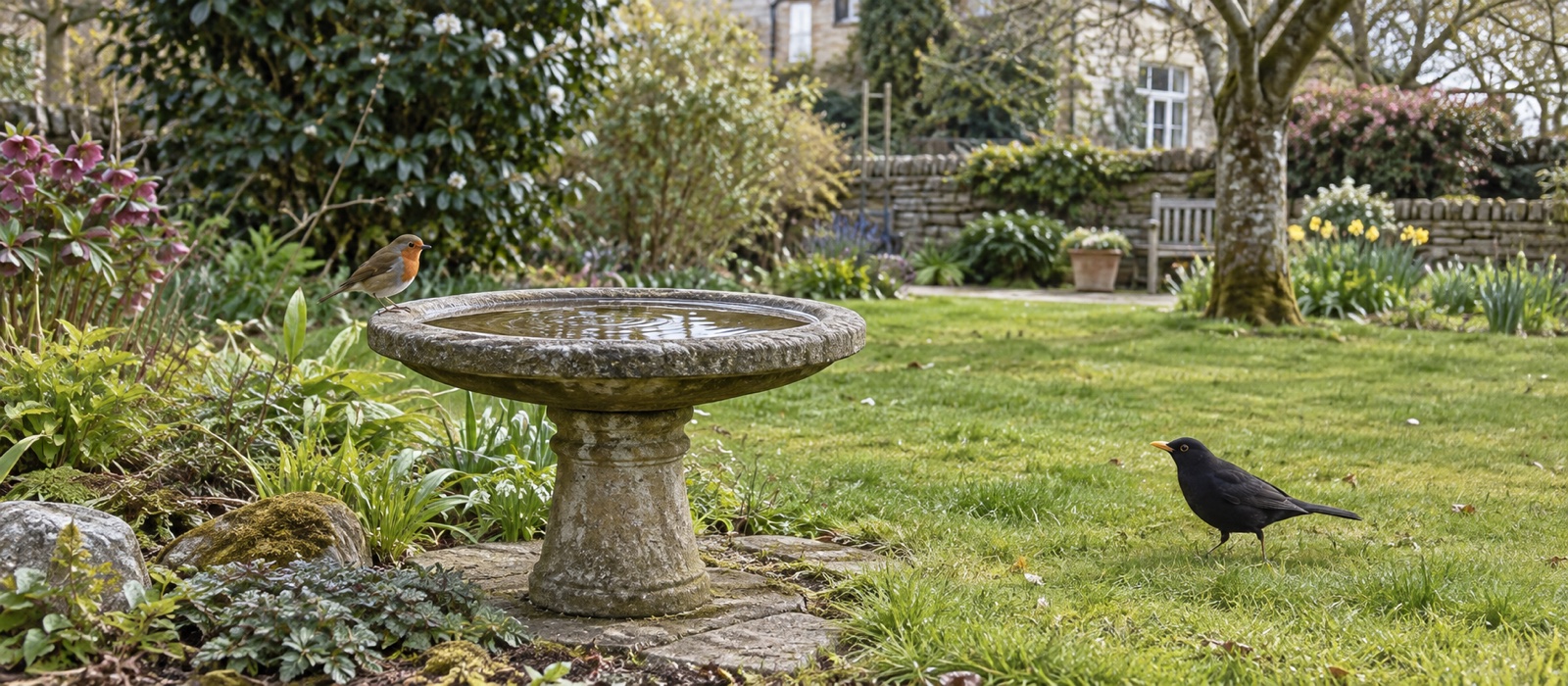
Keep the immediate area open so cats cannot wait unseen.
Place useful cover nearby, not directly over the bath.
Choose a level spot you can reach easily every day.
The best position for a bird bath balances two needs. Birds want enough open space to spot danger, but they also benefit from a shrub or tree close enough to reach if they are startled. For you, the bath needs to be easy to empty, clean and refill every day.
That usually means an open, level area with cover a short flight away—not a bowl hidden beneath a dense shrub. Watch the garden from a bird's height before choosing. A position that looks pleasantly secluded to us can give a cat an ideal ambush point.
Start with clear sightlines
Bathing birds are distracted and their wet feathers can make take-off less efficient for a moment. Give them a clear view around the rim so they can see people, cats and other threats approaching.
The RSPB's bird-bath guide recommends a position where birds have all-round visibility. Avoid squeezing a bath into the corner between a shed and fence, or burying it within low, thick foliage.
Open does not have to mean exposed. A sparse border edge, patio corner or lawn position can work if the view is clear and a useful perch is nearby.
Keep escape cover close, but not too close
A small tree, hedge or shrub gives birds somewhere to pause before approaching and somewhere to retreat. Aim for cover within a short flight rather than branches touching the bath.
Dense cover immediately beside a low bowl can conceal a stalking cat. Trim back plants if they form a tunnel to the water, and look for regular cat routes along fences and walls. If cats frequently use the garden, a well-positioned pedestal may be preferable to a ground-level bowl, although no height removes the need for vigilance.
Overhanging branches create another problem: leaves, blossom, berries and droppings fall into the water. Moving the bath a little beyond the canopy can reduce the cleaning burden without taking away the nearby refuge.
Light shade is often easiest
A position with light shade during the hottest part of the day can slow evaporation and keep the water more comfortable. Full shade beneath dense growth is less attractive if it reduces visibility or fills the bowl with debris.
Observe how sunlight moves across the garden. A spot that is cool in the morning may be in fierce afternoon sun. During hot weather, check the level more often wherever the bath stands.
A solar fountain complicates the choice because its panel needs light. Models with a separate panel let you keep the bowl in partial shade while placing the panel in a brighter spot. See our solar bird bath fountain comparison for the practical trade-offs.
Put the bath on a level, stable base
A pedestal should not rock when a larger bird lands on the rim. Set it on paving or compact, level ground and use any pegs or ballast supplied by the manufacturer. Recheck it after heavy rain, frost or gardening work.
Low bowls also need a firm base. Uneven ground can make one side unexpectedly deep, while long grass may hide the approach of a cat. A broad paving slab can create a tidy level area, provided it does not become dangerously hot or slippery.
For hanging baths, the outdoor bracket must support the weight of the bowl, water, stones and a landing bird. Keep the bath away from walls and windows so it cannot swing into them. Our guide to the best hanging bird baths covers fixings and wind exposure.
Make daily maintenance convenient
The Wildlife Trusts advises topping up water daily and cleaning the bath weekly. Choose a place you can reach in poor weather without leaning over a deep border or carrying dirty water through the house.
Leave enough room to lift or tip the bowl safely. If it is very heavy, use a removable inner dish that remains stable in normal use. Keep a dedicated outdoor brush and gloves nearby, but out of reach of children and pets.
Convenience is not a minor detail. The most beautiful position is a poor choice if it makes fresh water and weekly cleaning difficult. Our bird bath cleaning guide sets out the routine.
Think about nearby windows
Glass can reflect sky and vegetation, making it difficult for birds to recognise as a barrier. Do not create a fast, unobstructed flight line from the bath towards a large reflective window.
If a window is close, use effective external markings or screening across the relevant glass rather than a few widely spaced stickers. Watch how birds leave the bath and adjust the position if they repeatedly fly towards a reflection.
Avoid contaminated runoff and chemicals
Do not place a bath beneath a roof edge where gutter overflow, moss treatment or roof-cleaning chemicals could wash into it. Keep it away from areas recently treated with pesticides, weedkillers, paint or timber preservatives.
Sprinklers can also carry lawn products and soil into the bowl. Empty the bath before nearby garden work and wash it thoroughly before putting it back.
Use plain clean water. Never add disinfectant to water that birds can access, and never add salt, glycerine or antifreeze in winter.
Adjust the position if birds ignore it
Birds may take time to accept a new feature, so leave a suitable bath in place for a while rather than moving it every day. Check that the water is shallow, the rim offers grip and the approach feels open.
If there is still no interest, watch for disturbance from pets, doors, paths or machinery. A move of one or two metres can improve sightlines without making the bath unfamiliar. Our guide to bird bath depth will help you rule out a bowl that is simply too deep.
A quick position checklist
- Clear view around the water
- Shrub or tree within a short flight
- No dense cat cover beside the rim
- Level, stable base or properly rated hook
- Some shade during the hottest part of the day
- No contaminated roof or garden runoff
- Safe distance and flight angle from reflective glass
- Easy access for daily water changes and weekly cleaning
Once those needs are met, choose the position you can maintain most consistently. A simple dish in the right place is more useful than an elaborate feature that is awkward to look after.