
Bird food guide
Best wild bird food for UK gardens
Choose wild bird food by visiting species, season, feeder fit and realistic turnover. Compare small seed, suet and dried-mealworm packs.
Our recommendations
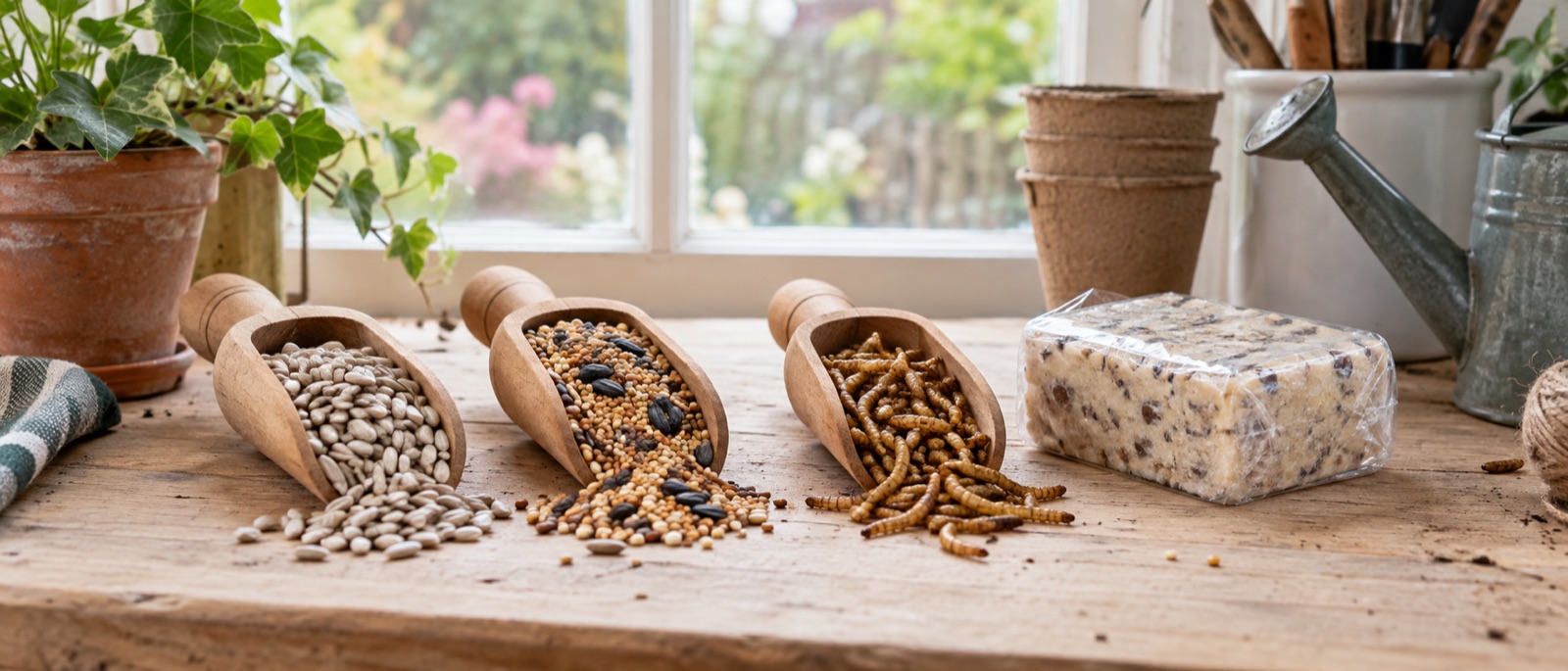
Four useful food formats
Start with a manageable pack, check the current label and choose the right feeder before ordering more.
RSPB sunflower hearts (900g)
A small 900g bag of husk-free sunflower kernels, suited to testing demand before buying a larger pack.
Best small starter pack. Drawback: it costs more per kilogram than bulk bags and still needs dry indoor storage.
Extra Select No Wheat bird food (1kg)
A 1kg wheat-free mix containing listed ingredients such as sunflower hearts, niger seed and peanut granules.
Best small wheat-free mix. Drawback: it contains peanut pieces and a small bag may not suit a busy winter feeding station.
RSPB mealworm suet cakes (3 × 280g)
Three individually wrapped mealworm suet cakes for trying the block format without buying a large box.
Best smaller block pack. Drawback: the recipe includes peanuts and seeds, so check ingredients and current feeding guidance.
RSPB dried mealworms (500g)
A 500g pack of dried mealworms in a resealable pouch, offering a clear weight for comparison and portion planning.
Best clearly weighed mid-size pack. Drawback: the pouch is less rigid than a tub and still needs protection from moisture and pests.
This guide compares everyday food choices. If you are preparing specifically for freezing weather, our high-energy winter food guide goes further into cold-weather formats.
Which wild bird food should you choose?
| What you want to achieve | Food to consider | What to check first |
|---|---|---|
| Try seed without a carpet of husks | Sunflower hearts | A contained seed feeder and November–April timing |
| Cater for several seed-eating visitors | A clearly labelled seed mix | Small ingredients, port fit and what birds reject |
| Offer a separate fat food | A suet cake or net-free fat ball | A rigid holder, freshness and heat resistance |
| Help insect-eating visitors | Live or dried mealworms | Small portions and a way to clear leftovers |
| Offer winter food to thrushes | Fresh apple or pear | A suitable holder, no mould and access away from cats |
These are complementary foods, not a prescription to put out everything at once. A garden with two blue tits does not need the same shopping basket as one with a busy sparrow flock.
Our first choice for seed: RSPB sunflower hearts 900g
Husk-free hearts make it easier to see whether food is actually being eaten. The 900g bag is manageable for a first purchase, and avoids committing to a large opened sack before you know the appetite of your visitors.
Hearts are still seeds. Offer them during the current November–April feeding window, not throughout summer because the bag describes a broad range of birds. Use a seed tube that dismantles, with ports small enough to limit spillage. Read our sunflower-hearts guide if you are comparing tub and bulk sizes.
Their main limitation is simple: husk-free does not mean immune to damp, contamination or rejection. Reduce the portion if food remains, and never bury old hearts under a fresh fill.
A small mixed-seed option: Extra Select No Wheat 1kg
This wheat-free blend is useful when whole wheat is being discarded from an existing mix. The listed sunflower hearts, nyjer and peanut granules give several different particles in a small bag.
The mix is not nut-free and is not a special robin food. Tiny seed may also leak from broad ports. The seed-mix comparison covers a mid-sized alternative and when a bulk pack might genuinely make sense.
Try one recipe at a time. If you change the food, feeder and position together, you will struggle to tell which change made a difference.
For a different format: RSPB mealworm suet cakes
The three-cake pack provides a modest way to try a block holder without buying a box of ten. It is a fat-based food containing mealworms and other ingredients, not a block of pure insects.
Choose it for birds able to cling and feed from the cage. A cake holder does not automatically solve feeding for a blackbird that stays on the lawn. Check the block against the holder's internal dimensions; its weight alone does not tell you whether it fits. See the suet-block food comparison and separate holder guide.
For insect eaters: RSPB dried mealworms 500g
The weighed resealable pouch is easier to compare with other weighed packs than a tub sold only by volume. It suits someone who wants to portion food regularly without starting with a bulk sack.
Dried mealworms need particular care once soaked. Prepare only what you will offer, do not return damp leftovers to the pouch, and clear uneaten food by dusk. The live-versus-dried comparison explains the practical differences without treating either as a complete diet.
Buy the size you will use, not the largest discount
Work out roughly how long your last small pack lasted before ordering more. Compare price per kilogram only between products with a stated net weight; a five-litre tub cannot be converted accurately without a weight.
A bulk purchase requires dry indoor storage and predictable use. If birds repeatedly leave one ingredient, a cheaper mix can become the more expensive choice after waste. A smaller bag also leaves room to change course when the season changes.
A manageable feeding routine
Follow current RSPB seasonal advice: pause seed and peanuts from 1 May to 31 October; small mealworm and fat/suet portions may continue, subject to spoilage. Avoid flat tables and shared food trays. Clean equipment weekly, move feeding positions and remove waste underneath.
The winter feeding routine and quantity guide help turn the shopping decision into a routine you can maintain. Fresh water and natural food-bearing plants matter too; buying more bags is not the only way to help.
Frequently asked questions
What is the best all-round wild bird food?
Sunflower hearts are a useful winter seed choice for many feeder visitors, but no one food suits every species. Match a modest supplementary food to the birds using your garden.
Is cheap bird food always bad?
No. A clear, fresh recipe that birds eat can be good value. A cheap bag full of discarded grain is not; neither is an expensive bag that sits damp in a feeder.
Should I choose a mix with suet and mealworms added?
It can be convenient in winter, but it remains a seed mix if seed is its main format. Added suet does not turn the bag into an exception to the summer seed pause.