Practical advice
Contains affiliate links
Best berry-producing shrubs for garden birds
Compare hawthorn, holly, guelder rose, dog rose and other fruiting choices for UK gardens, with space and pruning checks.
Check mature size, sun and soil before buying.
Leave some fruit and avoid indiscriminate pruning.
Keep fallen fruit away from unsafe feeding spots.
For berry-producing shrubs that help garden birds, start with hawthorn, guelder rose, dog rose and a suitable holly. If you have room for a small tree, rowan or crab apple adds another fruiting layer. Birds may take fruit at different times, and a plant's usefulness depends on whether it can grow, flower and set fruit in your particular garden—not on a promise that birds will immediately arrive.
The RHS garden-birds guide names hawthorn, holly, rose, rowan and crab apple among useful garden choices. Fruit also matters indirectly: flowers support insects earlier in the year and dense growth offers refuge. This page focuses on fruiting plants; our broader native-plant guide covers shelter and seeds as well.
The useful choices, side by side
| Plant | Why consider it | Check before planting |
|---|---|---|
| Hawthorn | Haws, spring blossom and thorny cover | Needs room to become a dense shrub or hedge |
| Guelder rose | Red berries and a substantial shrub layer | Check space, moisture and local growing conditions |
| Dog rose | Hips and sprawling, protective stems | Thorny; can obstruct a path if untrained |
| Holly | Evergreen cover and berries on suitable female plants | Berrying depends on pollination; check cultivar and nearby pollen source |
| Rowan | Clusters of fruit on a small tree | Match eventual height to the garden |
| Crab apple | Spring blossom and autumn fruit | Needs a suitable root area, even in compact forms |
These are plant choices, not guaranteed bird-attractors. Fruit set can vary with weather, pollination and pruning. Avoid promising that any shrub alone will feed birds all winter; different birds and local conditions change what gets eaten.
A hedge can be better than one specimen
If your garden has a long boundary, a mix gives cover even when one species is not fruiting. The Woodland Trust hedge mix we show below has hazel, dogwood, hawthorn, crab apple and dog rose in its standard 15-sapling pack. It is a planting project requiring ground preparation, watering and future management. Read how to create a bird-friendly hedge first.
For a courtyard or rented garden, a single shrub in an adequately sized container may be more realistic. Container plants need more attention to watering and root space, and some hedge species are a poor fit. See bird-friendly gardening in a rented home for portable options.
Let it flower and fruit
Repeated close clipping can sacrifice flowers and the fruit that follows. The RHS recommends berrying shrubs and hedges and suggests leaving some fruiting growth rather than making every boundary uniformly neat. Prune only after checking for active nests. If the hedge must be managed, consider doing sections in different years so some fruiting wood remains, provided that approach suits the plant and boundary.
Fallen fruit can attract birds, but it can also build up in a place where cats wait or where people walk. Keep water and any supplementary feeding away from ambush points and remove spoiled accumulations. If you already offer food, follow current seasonal feeding advice rather than assuming berries replace every other need.
Which birds might use the fruit?
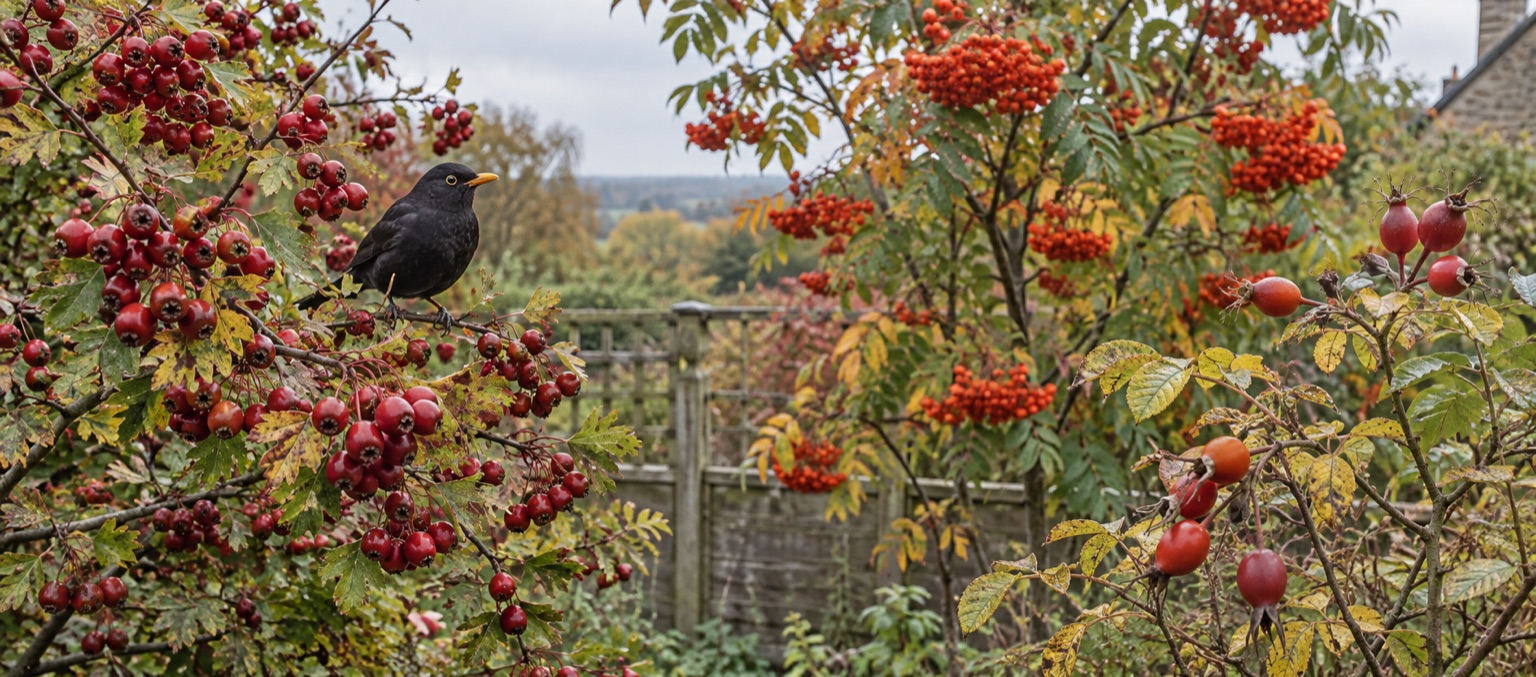
Blackbirds and other thrushes often take fruit; redwings and fieldfares may appear in winter where local fruit is available. A blackbird may forage under a shrub as well as on it. Visit patterns differ by place and season, so a quiet shrub does not mean it is useless: its flowers, insects and cover can still matter.
Frequently asked questions
Are all berries on a garden shrub safe for people or pets?
No. A plant useful to birds is not automatically safe for a child, cat or dog to eat. Check the exact species and cultivar with a reliable plant-safety source before placing it where pets browse.
Should I strip fruit to keep a hedge tidy?
If bird habitat is the aim, leave some fruiting growth. Remove damaged or hazardous stems as needed, but do not cut an occupied nest and do not assume every shrub should be pruned on the same schedule.
Helpful products
A mixed boundary option
The Woodland Trust mix includes hawthorn, crab apple and dog rose among its five species. It is for a real in-ground hedge, not a small pot; check the selected pack at the retailer before ordering.
Woodland Trust standard hedge mix — 15 saplings
The specified pack combines hazel, dogwood, hawthorn, crab apple and dog rose, giving a boundary a range of flowers, fruit and cover as it matures.
For a suitable in-ground boundary with room for a hedge; this is not a balcony or container pack. Confirm the mix and site suitability before ordering.
F&G Supplies mixed native hedge — 10 bare-root plants
A smaller mixed bare-root hedge pack. The listing names hawthorn, blackthorn and other possible native species, but the exact mix may vary.
For a suitable in-ground boundary, not pots or a balcony. Check the supplied species, delivery timing and eventual hedge size before ordering.