
Practical advice
Contains affiliate links
When should you replace a bird feeder?
A practical checklist for deciding whether a damaged, mould-prone or hard-to-clean bird feeder can be repaired or should be replaced.
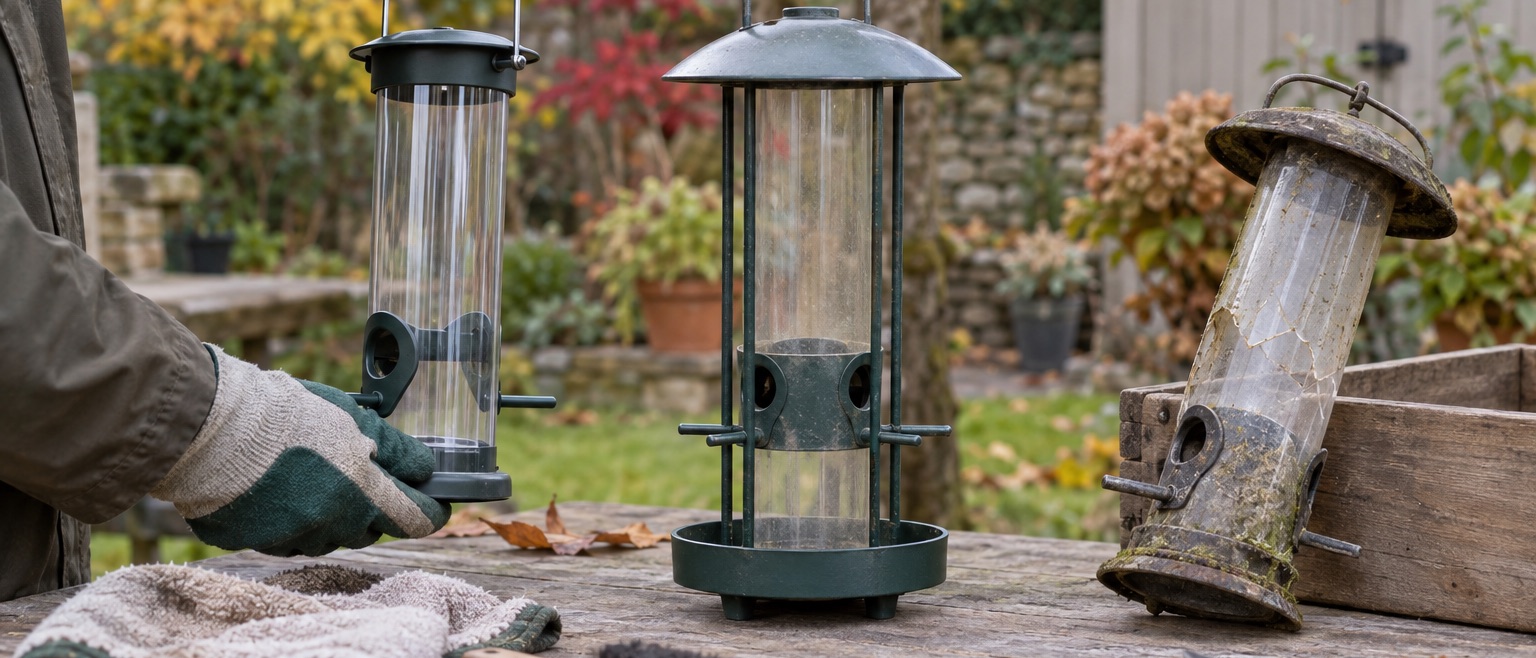
Empty and inspect the feeder before judging it.
Look for exact maker-supported parts first.
Choose the next feeder by cleaning access, not capacity alone.
There is no useful fixed lifespan for every bird feeder. Replace it when it cannot be hung securely, cleaned thoroughly or kept dry between refills. Age alone is not the test: a modular feeder with one available part may be worth keeping, while a nearly new but cracked base may need immediate replacement.
The BTO's hygiene advice centres on equipment you can wash, disinfect, rinse and dry. The RSPB's current guidance requires weekly cleaning and moving feeders. A design that defeats that routine is a poor long-term fit even if it looks attractive.
The replace-now checklist
| Problem | Repair first? | Replace when… |
|---|---|---|
| Broken base or hanger | Look for an exact maker-approved part | It cannot lock or support a full feeder safely |
| Sharp edge, cracked port or cage wire | Replace the exact component if supported | A bird could contact the damaged edge |
| Trapped food in sealed joints | Try the maker's intended disassembly | You cannot remove and clean the residue |
| Recurrent damp or mouldy food | Check cap, drainage, siting and fill size | A damaged body or seal still admits water |
| Deep rust, flaking coating or rotten timber | Exact component replacement may help | Food-contact or load-bearing surfaces remain compromised |
| Brittle plastic or multiple failures | Usually not economical to patch | Several parts are failing together |
If you find sick birds near the feeder, stop feeding and follow the current official advice. Buying a new feeder does not remove the need for a pause, site cleaning and assessment. See our first-response guide.
Repair, replace a part or buy a new feeder?
Repair a minor exterior issue only when the feeder remains secure and fully washable. Replace a part when the maker sells an exact base, lid, port or hanger; our parts guide shows how to check compatibility. Replace the whole feeder when the core body is damaged or the repair would trap grime. Avoid glue, wire or coatings on food-contact joints as a shortcut.
For wood, use the wooden-feeder repair guide. For corrosion, use the rust assessment. Both put safety and cleanability before appearance.
What should the replacement do better?
Choose a size that will turn food over in a day or two, a removable base, accessible ports, good drainage and a reliable hanger. Look for model-specific spares and check whether you can complete the weekly clean without special tools. More capacity is not automatically better: food left at the bottom of a big tube can spoil.
Our easy-clean feeder comparison and general feeder guide help narrow the format. Current RSPB advice also advises against flat feeding surfaces and limits seed/peanuts to 1 November–30 April; see when to restart before filling a new feeder.
Frequently asked questions
Should I replace a feeder every year?
Not if it remains sound, cleanable and dry. Inspect it at every weekly clean and replace only when the condition warrants it.
Is a discoloured plastic tube automatically finished?
Not necessarily. The issue is whether it is cracked, brittle, rough or holding embedded grime you cannot remove. If the body still cleans thoroughly and fittings are secure, it may remain usable.
Can I give away a damaged feeder?
Do not pass on equipment with unsafe edges, weak hangers or uncleanable food-contact areas. Check local recycling options for its materials instead.
Helpful products
Three easier-to-maintain replacement routes
These differ in size and dismantling method. Confirm the exact current model and choose a feeder you can empty, reach and clean every week; do not buy a larger reservoir than your garden will use promptly.
RSPB Classic easy-clean seed feeder (small)
A simple 500ml, two-port feeder with a polycarbonate tube and plastic fittings that come apart without tools.
Best straightforward alternative. Drawback: RSPB warns that squirrels and parakeets may damage the plastic parts.
Jacobi Jayne Ring-Pull feeder
Its twist base and removable pin release the component parts, making the main feeding areas easier to reach during cleaning.
Best tool-free modular design. Drawback: its conventional ports do not prevent squirrel access on their own.
Kingsyard six-port easy-clean tube feeder
A hard-plastic six-port tube feeder with tool-free removable base and perches, drainage holes and a stated two-pound capacity.
Best removable-base multi-port option. Drawback: two pounds is a large fill and should be reduced wherever turnover is slow.