Practical advice
How often should you clean bird feeders?
The weekly cleaning rule, the warning signs that mean cleaning sooner and an easy routine for several feeders.
Inspect food, ports, drainage and the ground whenever you visit.
Empty, dismantle, wash, disinfect, rinse and dry at least weekly.
Damp food, droppings, pests or illness override the calendar.
The RSPB recommends giving bird feeders a thorough clean at least once a week. Think of seven days as the longest normal interval, not a date to wait for when seed becomes wet or the feeder is visibly dirty.
Its current healthy-feeding guidance and the BTO hygiene guide both emphasise regular cleaning, fresh food and attention to the area beneath a feeder.
A simple cleaning schedule
Whenever you visit or refill
Check whether the food is dry and fresh, ports are flowing, drainage is clear and fixings are sound. Look beneath the feeder for old food or droppings. Empty old food before adding a new one-to-two-day quantity rather than topping it up.
This inspection takes very little time, but it can reveal a problem before the weekly clean is due. Clear new waste using the surface-specific steps in how to clean underneath bird feeders.
At least once a week
Carry out the complete routine outdoors:
- Put on waterproof gloves and discard all leftover food.
- Dismantle every manufacturer-removable part.
- Wash away dirt and debris with hot soapy water.
- Disinfect appropriately, following the product instructions.
- Rinse every part with fresh water.
- Leave everything to air-dry completely.
- Clean beneath the feeder and wash your hands and forearms.
Our guide to cleaning and disinfecting bird feeders explains each step.
Immediately when something is wrong
Do not wait for the weekly date if you find damp or mouldy food, droppings on feeding surfaces, pest contamination, blocked ports, an unpleasant smell or a sticking mechanism. Empty the feeder and clean it straight away. If the fill has spoiled, discard wet or mouldy seed safely rather than trying to rescue it.
When should you clean more often?
After wet weather
Wind-driven rain and condensation can spoil a fill well before seven days. Inspect after prolonged rain and clean immediately if food is damp, clumped or sitting against a wet base. See how to keep bird seed dry for prevention.
During busy periods
More birds mean more contact, waste and droppings. If a feeder is heavily used, shorten the interval rather than installing one oversized reservoir. Several small stations can spread activity, but each one still needs its own inspection and cleaning date.
With complicated feeders
Guardian cages, mesh, sliding shrouds and closing ports create extra joins where residue can collect. They do not always need cleaning on a different calendar, but the weekly job may take longer and visible debris may require earlier attention.
When food is slow to turn over
If seed remains after two days, the answer is a smaller fill rather than a longer wait. Old food at the bottom of a topped-up tube can become difficult to see, so empty it before every refill.
What if you see a sick or dead bird?
Stop feeding, empty bird baths and follow the latest RSPB and BTO disease guidance. Do not assume that cleaning more frequently is enough. Official recommendations currently differ on the length of the pause and may change, so check their live advice before restarting.
Report suspected disease through the official route they provide, and do not handle sick or dead birds with bare hands. Our guide to when to stop feeding garden birds covers the other situations that call for a pause.
A workable routine for several feeders
Give each station a short name and record the date of its last full clean. Choose one fixed day each week, but bring a feeder forward whenever an inspection finds a problem.
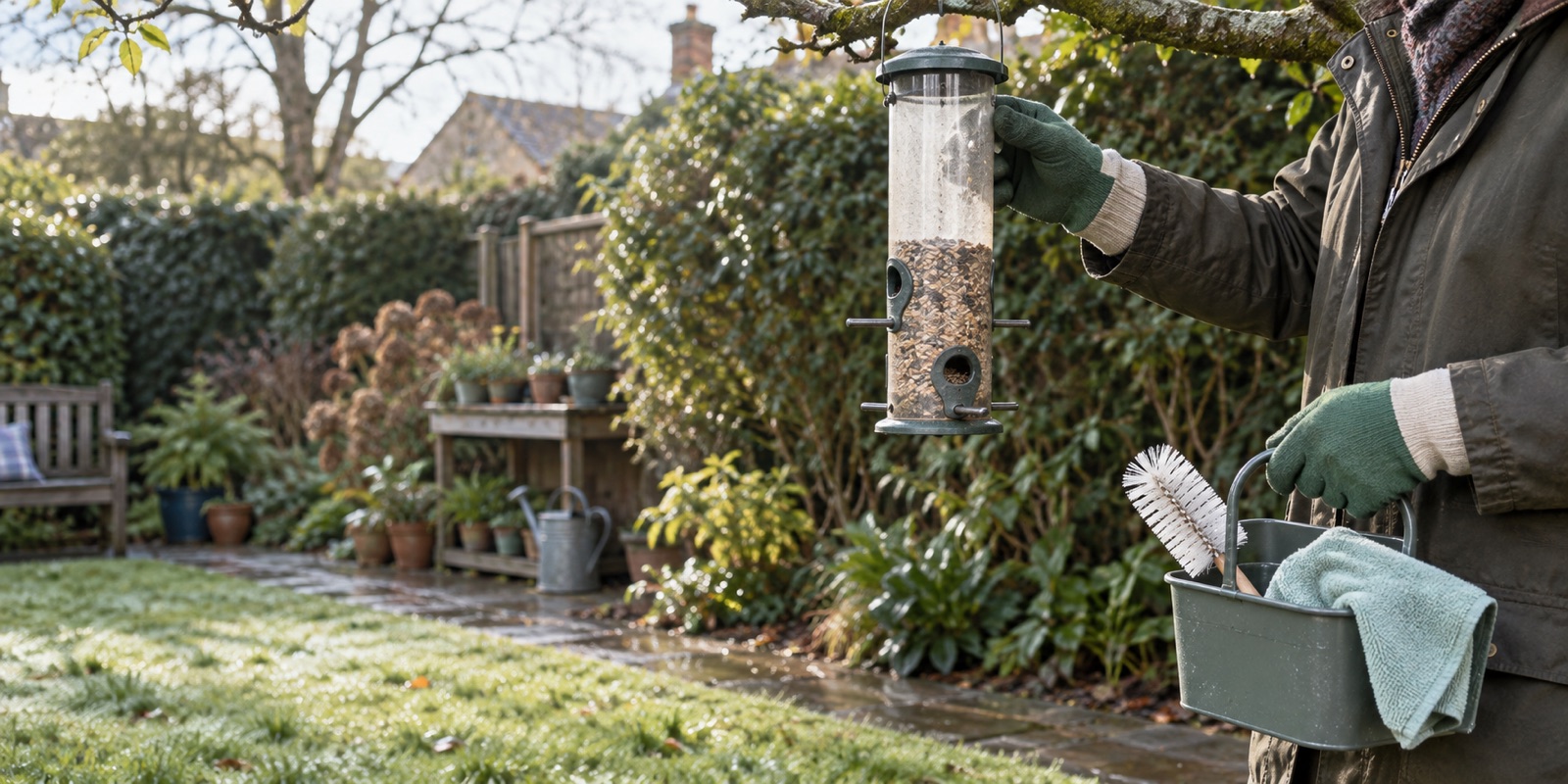
Keep one set of outdoor-only brushes and a washing bucket together with your gloves and disinfectant instructions. If cleaning every station in one session is unrealistic, stagger the work across the week without letting any feeder exceed the weekly interval.
Move feeding positions regularly where the garden allows. This helps prevent food and droppings building up in one area, but remember to reassess shelter, visibility and predator cover each time.
Cleaning versus everyday maintenance
Clearing one port, wiping a lid or brushing the ground is useful maintenance, but it does not reset the weekly date. A full clean means emptying and dismantling the feeder, washing, disinfecting, rinsing and drying it.
Likewise, a feeder looking clean from the outside is not proof that its base and port fittings are free from old material.
Seasonal feeding still matters
Current RSPB guidance recommends offering seeds and peanuts only between the beginning of November and the end of April. Cleaning more often does not override that advice. Outside that period, check the current guidance for suitable options and any disease updates.
Frequently asked questions
Is once a week always enough?
No. It is the normal minimum. Wet food, contamination, heavy use or a sticking mechanism means cleaning sooner.
Does rain automatically mean a full clean?
Inspect the feeder promptly. If the food or interior is damp, discard the fill and complete the full cleaning routine.
Can I just rinse it between weekly cleans?
Rinsing may remove loose fragments but does not replace the weekly dismantle, wash and appropriate disinfection.
Can a large feeder be cleaned less often?
No. Capacity does not make food safer for longer. Use small fills and keep the same weekly minimum.
Helpful products
Keep the weekly clean straightforward
A dedicated long brush and feeder cleaner are useful to keep together in the shed, so the complete clean is easy to start whenever a feeder needs attention.
Jacobi Jayne long bird feeder cleaning brush
Best for: Reaching along tube feeders and other narrow reservoirs
A long-handled natural-bristle brush made for reaching inside bottle-shaped and tubular bird feeders.
What stands out
- 57cm overall length
- Made specifically for bottles and bird feeders
- Loop for hanging with outdoor cleaning equipment
Keep in mind
- Keep it solely for outdoor bird equipment
- 57cm long
- Natural bristles
- Long handle
Inspired Bird Feeder Cleaner and Sanitiser
Best for: Routine washing of feeders, bowls and feeding-station parts
A ready-to-use 500ml trigger spray sold specifically for cleaning feeders, bowls and feeding-station equipment.
What stands out
- Sold specifically for bird-feeding equipment
- Ready-to-use trigger spray
- 500ml bottle
Keep in mind
- Follow the label exactly and rinse every part thoroughly
- 500ml
- Trigger spray
- For feeding equipment