Practical feeding advice
What to do if you find a sick or dead bird near a feeder
Immediate UK guidance for a sick or dead bird near a feeder: safe distance, welfare help, reporting, a disease feeding pause and cautious restart.
If you find a sick or dead bird near a feeder, keep children and pets away, avoid touching it and stop feeding where disease is suspected. Empty bird baths and seek appropriate wildlife or veterinary advice. Report the incident through the relevant route; do not put medicine into shared food or water or try to diagnose bird flu yourself.
One dead bird does not establish the cause. Disease, injury and other incidents need different responses, but reducing contact and getting the right advice are sensible first steps.
What to do immediately
- Keep a safe distance and move children and pets away.
- Note the location, date, number of birds and what you can see without handling them.
- If disease is suspected, stop feeding and empty bird baths.
- Contact a vet or appropriate wildlife welfare service about a living bird needing help.
- Use the official reporting route for dead birds and Garden Wildlife Health for garden disease incidents.
You do not need to purchase a cleaner, capture the bird or identify the disease before asking for advice. Do not carry a sick bird into a house, car or clinic without first speaking to the service that will advise or receive it.
Sick, injured or simply resting?
A bird sitting quietly is not automatically diseased. Equally, a bird that cannot move away, struggles to swallow or appears persistently distressed needs more than a change of food.
| Situation | First response | What not to do |
|---|---|---|
| Living bird apparently unwell | Keep people and pets away; phone a vet or wildlife service | Force water, give human medicines or pursue it |
| Bird injured or caught by a cat | Seek prompt professional advice | Assume a small or invisible wound is harmless |
| Dead bird near feeding equipment | Avoid contact; record and report as appropriate | Pick it up to identify the cause |
| Several sick or dead birds | Stop food access, empty baths and report promptly | Continue feeding while trying different products |
| Healthy-looking young bird with adults nearby | Check fledgling advice from a wildlife service | Automatically remove it from its parents |
These are routes for getting help, not diagnoses. A picture may help a professional, but take it without approaching or disturbing the bird.
The RSPCA’s sick and injured bird guidance is a useful starting point. In England and Wales, contact the RSPCA or a local vet; in Scotland, the Scottish SPCA or a local vet. In Northern Ireland, seek a local vet or suitable wildlife rescue service.
Where to report a dead bird
Use the route for your country and the current instructions for the species and number found.
| Location or incident | Reporting route | Important distinction |
|---|---|---|
| England, Scotland or Wales | GOV.UK dead wild bird reporting | Surveillance reporting does not guarantee collection |
| Northern Ireland | DAERA public guidance and reporting | Separate species and reporting criteria apply |
| Suspected disease in garden birds in Great Britain | Garden Wildlife Health | Wildlife-health reporting is not an emergency rescue service |
| Suspected deliberate harm or wildlife crime | Police through the appropriate reporting route | Do not investigate or handle possible evidence yourself |
DAERA’s guidance distinguishes reportable wild-bird groups from other single dead birds and ordinary garden-bird deaths. Follow its current criteria rather than treating the Great Britain form as a UK-wide service.
Keep a simple record, including whether other birds were affected and where feeders and water were positioned. Do not move a carcass for a better photograph or assume it will be collected once you submit a report.
How long should you stop feeding?
BTO recommends a pause of at least two weeks since the last unwell bird where disease is suspected. Restart only when you are no longer seeing signs of disease, and stop again if they return. BTO also advises leaving baths empty until no further sick or dead birds are seen.
The date of your first report is therefore not necessarily the restart date. Seeing another affected bird means reassessing the pause. Follow any additional advice given for the actual incident.
A feeding pause is intended to reduce birds gathering at the contaminated point. Do not move the same food to a tray on the other side of the garden, or put it over the fence for neighbours’ birds.
Clean safely when it is appropriate to do so
Keep carcass handling separate from routine feeder washing. Obtain the relevant advice before cleaning an area where a bird remains.
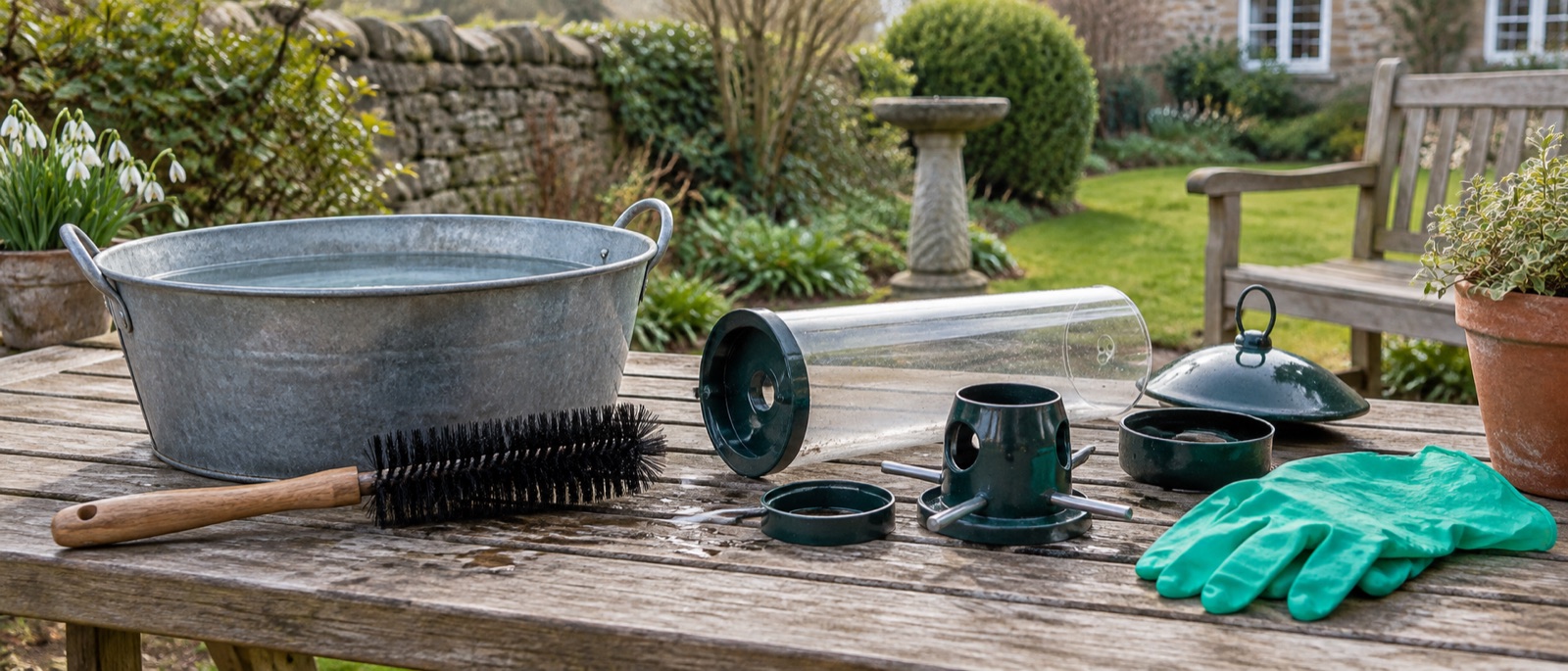
For equipment, remove food and debris, wash, use a suitable disinfectant according to its label, rinse thoroughly and allow it to dry. Keep tools outside and away from household food preparation. Wear appropriate gloves and wash hands and forearms afterwards.
Our complete feeder-cleaning guide covers the ordinary routine; cleaning below feeders covers waste on paving and soil. Do not dry-brush contaminated dust into the air or scatter discarded food elsewhere.
A long feeder brush is optional equipment for reaching the inside of a dismantled tube. It does not disinfect by itself or establish that a feeding station is safe to reopen. Do not mix cleaning chemicals or use a sanitiser as a bird treatment.
What about removing the dead bird?
Follow the advice for your country, property and incident. The England disposal guidance links to Scotland and Wales guidance and distinguishes small garden-bird incidents from other circumstances.
Do not assume that ordinary household disposal is appropriate for every bird, suspected disease outbreak or premises keeping captive birds. If you are unsure, ask the relevant authority or local council what to do. Keep pets from scavenging while awaiting advice.
Restart cautiously, not automatically
Before restarting, check the disease-pause advice, clean equipment and the current feeding season. The seasonal restart guide explains the November seed-and-peanut restart; that calendar date does not override an active disease concern.
Use small fresh portions in suitable equipment and watch for further signs of illness. If concerns return, stop again and seek advice.
Frequently asked questions
Does a dead bird mean bird flu?
No. Appearance and location cannot establish the cause. Avoid contact and follow the appropriate reporting instructions rather than trying to identify an infection yourself.
Should I put antibiotics in the food?
No. Shared food cannot ensure that only an affected bird receives the right treatment or dose. Speak to a professional.
Will the reported bird be collected?
Not necessarily. Reporting, testing, rescue and removal are different services; follow the instructions you receive.
Can I keep the bird bath filled during a disease pause?
Follow the BTO advice to leave baths empty until no further sick or dead birds are seen, alongside any incident-specific guidance.
Helpful products
Optional equipment for the cleaning stage
You do not need to buy anything before seeking help or reporting a bird. Use suitable equipment you already have; keep feeder brushes outside and separate from household washing tools.
Dedicated outdoor cleaning
Jacobi Jayne long bird feeder cleaning brush
A long-handled natural-bristle brush made for reaching inside bottle-shaped and tubular bird feeders.
Optional equipment for washing the inside of a dismantled feeder when it is safe to clean. It is not a disease treatment or disinfectant; professional advice and the feeding pause come first.