Practical advice
Contains affiliate links
How to repair a wooden bird feeder—and when not to
Assess loose roofs, split timber and rotten bases on wooden bird feeders without creating unsafe, hard-to-clean food-contact surfaces.
Stop feeding while assessing the damage.
Keep adhesives and preservatives away from food-contact areas.
Check the finished feeder is stable and fully cleanable.
You can repair a wooden bird feeder only when the underlying timber is sound and the finished feeder remains easy to clean. A loose exterior roof panel is different from a rotten floor that has absorbed old food and droppings. Take the feeder out of service, empty it and examine it dry before deciding.
Wooden feeders can look charming, but their seams and end grain may hold moisture. Current RSPB bird-feeding guidance advises against flat feeding surfaces because of disease risk. If your wooden feeder is effectively an open seed table, repairing its roof does not change the feeding format. Consider a suspended, cleanable alternative instead.
Repair or retire?
| What you find | Sensible decision | Why |
|---|---|---|
| Loose roof trim on otherwise sound timber | Consider refixing to the original design | External part can be secured without sealing in food |
| Sound replaceable exterior board | Use a matching maker-approved part if available | Preserves drainage and intended access |
| Soft, rotten or crumbling base | Retire the feeder | Porous food-contact surface cannot be reliably cleaned |
| Deep split through a food tray | Retire or replace the exact tray if supported | Crack can trap food and moisture |
| Wobbly support or exposed sharp fixing | Remove from service until a secure repair is confirmed | Collapse or injury risk |
Do not rely on paint to cover soft timber, squeeze glue into dirty joints or add a coating whose safety around bird food is unknown. If a maker specifies a treatment for its exact product, follow that guidance and allow the stated cure time before use; otherwise keep chemicals away from bird-contact and food-contact surfaces.
A conservative repair sequence for sound exterior timber
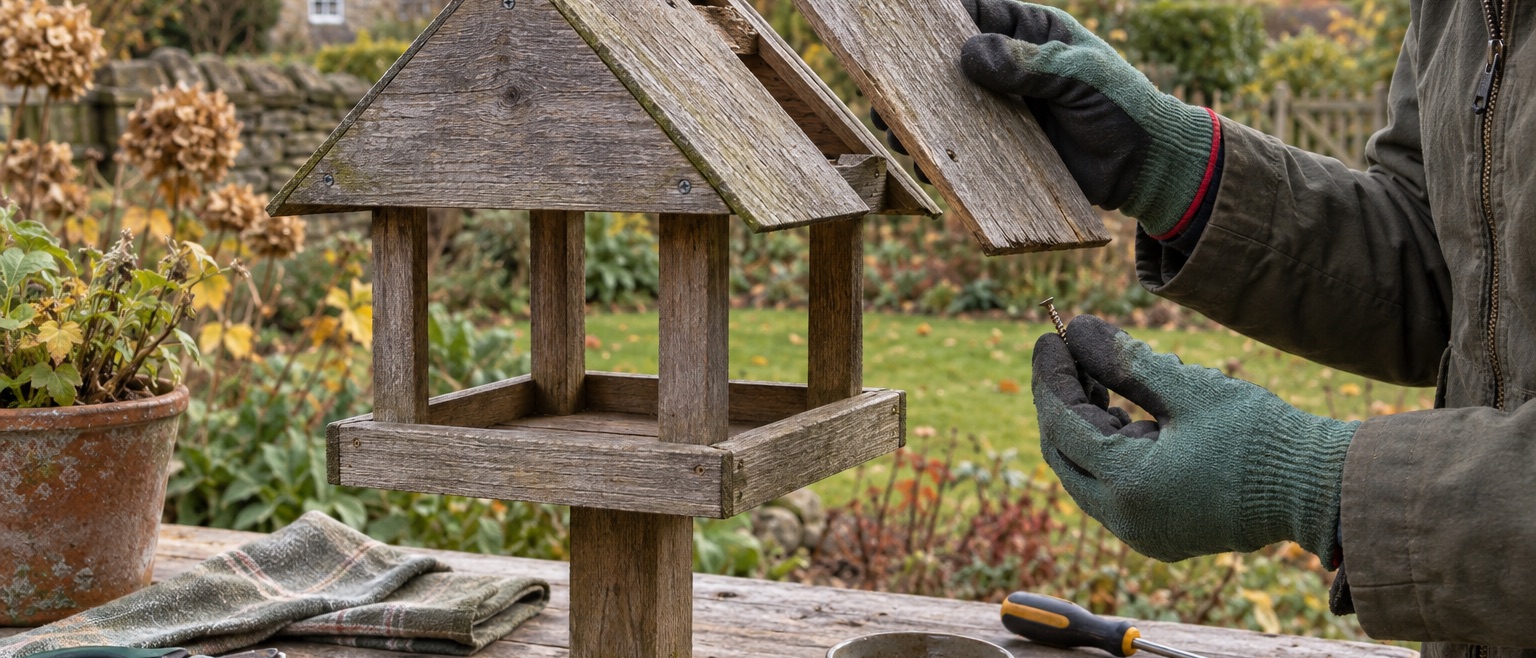
- Empty the feeder and stop using it. Wear gloves and wash it outdoors using the feeder-cleaning routine. Let the timber dry fully.
- Probe the damaged area gently. If wood crumbles, flexes or remains damp after drying, do not patch it.
- Photograph the original joint and check the manufacturer's instructions for a matching replacement part or fixing. Work only on an exterior structural section, not a food tray.
- Refit the board securely using the intended hardware. Make sure screws do not protrude into landing or feeding areas.
- Test stability without food. Confirm water can drain and the feeder can still be dismantled for cleaning.
This is a practical assessment, not a guarantee that any particular homemade repair is safe. If you cannot confirm the materials and fixing, ask the maker or replace the feeder. The spare-parts guide explains how to match a model.
When a replacement is a better long-term choice
A feeder with a removable base and reachable ports can make the required weekly clean realistic. Our choosing-a-feeder guide starts with fit and maintenance, while when to replace a feeder gives the wider checklist. Avoid buying another wooden design whose food-contact surfaces cannot be accessed.
Frequently asked questions
Can I paint a wooden bird feeder to make it last longer?
Do not assume any paint is suitable on food-contact or landing surfaces. Follow the exact maker's product advice and keep the feeder out of use until any approved treatment is fully cured.
Is a small crack harmless?
Not necessarily. A shallow cosmetic crack in exterior trim differs from a deep crack in the food tray. If it traps dirt or exposes a sharp edge, stop using the feeder.
Helpful products
When replacing is the safer decision
A removable-base feeder is easier to inspect and wash than a wooden food tray with permanent joints. The option below is a replacement route, not a product for repairing timber.
RSPB Classic easy-clean seed feeder (small)
A simple 500ml, two-port feeder with a polycarbonate tube and plastic fittings that come apart without tools.
Best straightforward alternative. Drawback: RSPB warns that squirrels and parakeets may damage the plastic parts.