Practical advice
How to stop squirrels eating bird food
A humane, practical approach to feeder position, baffles, spills and squirrel-resistant designs.
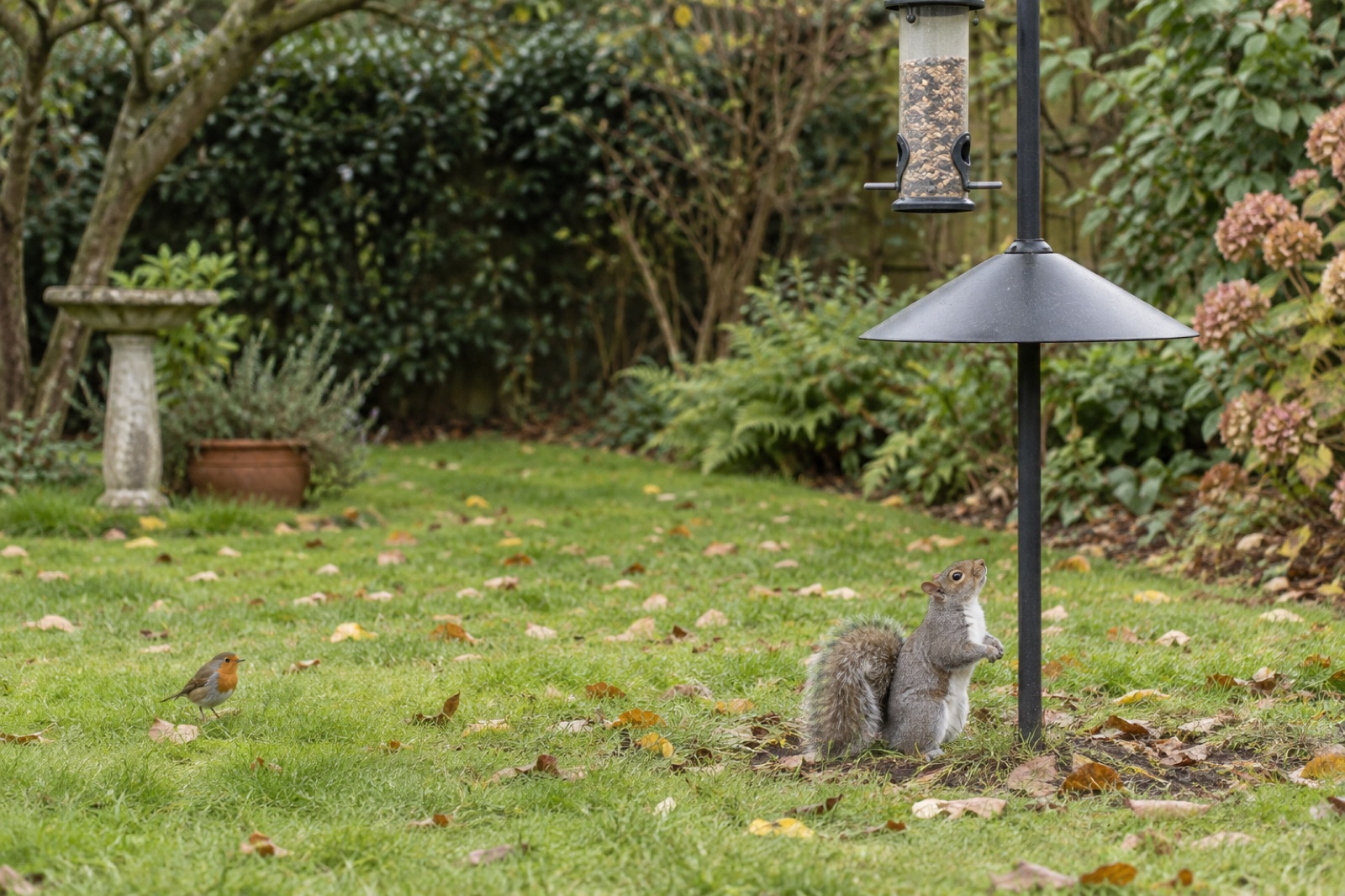
Identify whether access is from the ground, a pole, branch, fence or roof.
Reduce spills and keep the feeder away from possible launch points.
Use humane, purpose-made barriers or closing mechanisms when needed.
Squirrels are good climbers and persistent problem-solvers. A specialist feeder can help, but it will not work properly if a branch, fence or hanging line lets the animal bypass the mechanism.
Start by observing the whole route. The most useful question is not simply “How high is the feeder?” but “What does the squirrel touch on the way to the food?”
Follow these steps in order
1. Remove the easy reward
Clear spilled food from beneath the station and correct ports that leak. Put out only a small amount at a time rather than filling the feeder to capacity. This will not stop every attempt, but it removes the reliable meal waiting on the ground.
Avoid adding a large flat seed catcher. Current RSPB guidance recommends avoiding flat feeding surfaces because birds congregate on them and disease can spread more readily.
2. Identify the route
Watch from a distance at different times of day. Is the squirrel climbing the pole, travelling down the hanging wire, jumping from a branch or fence, reaching from a wall, or feeding mainly from the ground?
Take a photograph of the full station from more than one angle. It often reveals a flexible branch, nearby hook or roof edge that is easy to miss while standing underneath.
3. Reposition the feeder
Move it away from trunks, walls, roofs and fences while keeping the site safe and sheltered for birds. Remember that vegetation bends and grows. A gap that works in winter may disappear when a branch carries summer foliage.
The position must also remain easy for you to reach for cleaning. Do not trade squirrel access for an awkward or unsafe refill routine.
4. Block the remaining route
If the squirrel climbs a freestanding pole, a purpose-made baffle below the feeder may interrupt the route. If it descends from above, a suitable overhead guard may help. Fit the equipment according to its instructions and make sure there is no adjoining branch or support that provides a bridge around it.
A baffle in the wrong place is decoration rather than protection. Recheck the whole route after installation.
5. Choose a squirrel-resistant feeder if needed
The two main approaches are:
- Guardian cages, which put a physical barrier around the feeding ports
- Weight-operated designs, which close a shroud or individual ports when a heavier animal loads the feeder
A cage can also restrict some larger birds, while a moving mechanism adds parts that need regular cleaning. Weight-operated feeders require enough space for a squirrel to load the moving section rather than reaching in from another support.
Our squirrel-resistant feeder comparison looks at these trade-offs and the best uses for each design.
Which solution fits which route?
Squirrel climbing a pole
Use a smooth, freestanding support with a compatible pole baffle. Check that the animal cannot step around it from a wall, plant or neighbouring structure.
Squirrel jumping from the side
Increase clearance from launch points and account for branches moving under the animal’s weight. A specialist feeder may still be reached if it hangs against another object.
Squirrel descending from above
Remove the overhead route where practical or use a compatible guard above the feeder. A standard pole baffle underneath will not affect an approach from a branch or wire.
Squirrel defeating a closing feeder
Check that the shroud or ports move freely, that food is not jamming the mechanism and that the feeder has enough clearance to operate. Follow the manufacturer’s adjustment instructions where the trigger setting is configurable.
Squirrel eating from the ground
Reduce the fill, deal with leaking ports and clear waste promptly. The feeder mechanism cannot prevent access to food that falls outside it.
Keep the mechanism working
Seed fragments and dirt can stop a sliding shroud or closing port from moving properly. Include the mechanism in the weekly clean: dismantle only as instructed, wash away residue, disinfect appropriately, rinse and let it dry completely.
Check fixings, springs and moving parts before refilling. Remove damaged equipment rather than improvising a repair that could create a sharp edge or trapping point. Our feeder-cleaning guide covers the full routine.
What not to use
Do not use poison, grease, sticky substances, sharp wire, improvised traps or unapproved chemical deterrents. These can injure wildlife, contaminate food or make the station unsafe for you to handle.
The aim is to redirect access, not harm the animal. Keep cages and barriers in good condition and remove anything with a gap that could trap a foot or head.
Set realistic expectations
No arrangement is permanently squirrel-proof. Activity changes with weather and natural food, vegetation grows and fixings move. Inspect the route during the weekly hygiene visit and again whenever the feeder changes position.
A few quiet days do not prove a permanent solution, and one successful raid does not necessarily mean the feeder is defective. Identify what changed, correct that route and keep the setup simple enough to maintain.
Frequently asked questions
Will a squirrel-proof feeder work anywhere?
No. A squirrel may reach the ports without loading the closing mechanism if the feeder touches a branch, wall or another hanging item. Position remains essential.
Can I grease the pole?
No. Grease can affect wildlife and make the support hazardous to handle. Use a purpose-made physical barrier instead.
Should I stop feeding?
Supplementary feeding is optional. Check current seasonal and disease guidance first, and pause if you cannot keep the station clean or prevent persistent ground waste.
Is a cage better than a weight-operated feeder?
It depends on the route and which birds you want to accommodate. A cage is mechanically simple but adds cleaning surfaces; a weight-operated feeder can be effective when it hangs with enough clearance but costs more and needs moving parts kept clean.
Helpful products
Two squirrel-resistant feeders worth considering
Both use a weight-operated shroud to close access to the food. The Mini suits a smaller station, while the Plus adds an adjustable trigger and much larger reservoir.
Brome Squirrel Buster Mini
Best for: Smaller gardens with regular squirrel visits
A compact four-port feeder with a weight-operated shroud that closes access when a squirrel lands on it.
What stands out
- Weight-operated shroud
- Four feeding ports
- Compact reservoir
Keep in mind
- Trigger is not adjustable
- Still needs clearance from launch points
- Approx. 550ml
- Four ports
- Weight-operated
Brome Squirrel Buster Plus
Best for: Busy feeding stations with persistent squirrel pressure
Brome’s largest feeder uses an adjustable weight-operated shroud, chew-resistant fittings and a ventilated 2.8L seed tube that dismantles by hand.
What stands out
- Adjustable weight setting
- Chew-resistant fittings
- Tool-free dismantling
Keep in mind
- Bulky and expensive
- Needs careful positioning to work properly
- Approx. 2.8L
- Adjustable shroud
- Ventilated tube