Practical advice
Contains affiliate links
Which disinfectant should you use on bird feeders?
Choose a bird-feeder disinfectant, use it after washing, follow the label and rinse and dry the feeder before offering food again.
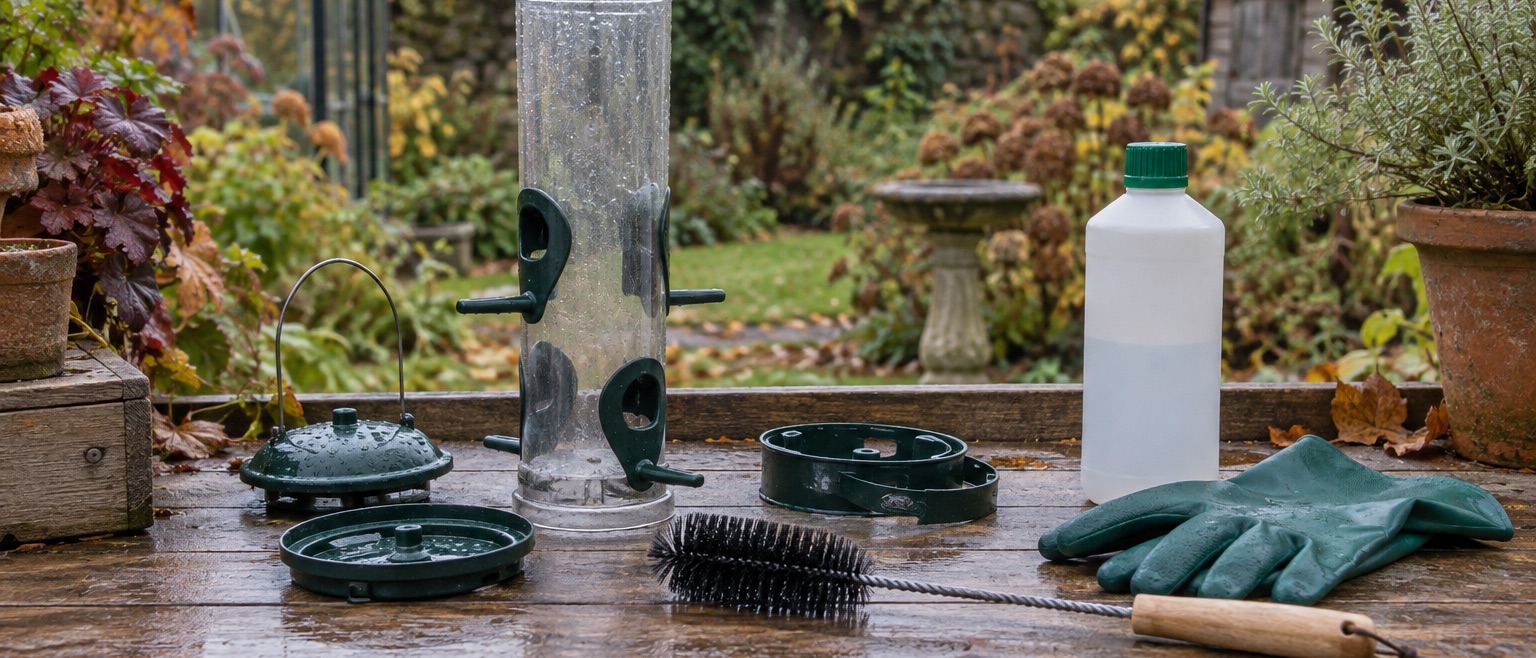
Wash the dismantled feeder before disinfecting.
Never mix products or guess a stronger dilution.
Rinse and dry completely before refilling.
For most garden bird feeders, use a disinfectant labelled for bird-feeding equipment, after washing the feeder. Read its current instructions for dilution, how long it must remain on the surface and whether it must be rinsed. Then rinse thoroughly and let every part dry before refilling. There is no benefit in using a stronger mix than directed.
The BTO's hygiene guidance explains why washing comes first: disinfectant works poorly when food, droppings and dirt remain. The RSPB's cleaning guidance likewise starts with dismantling and scrubbing, then disinfecting, rinsing and drying outdoors.
A specialist product or household bleach?
| Option | When it makes sense | What to check |
|---|---|---|
| Bird-feeder-labelled disinfectant | You want clear directions for equipment used by wild birds | Exact surfaces, dilution, contact time, rinsing and expiry |
| Domestic bleach | Only when following current official advice and the exact product label | Concentration varies between brands; do not improvise a recipe or mix it with anything |
| Washing-up liquid | For the washing stage, not a substitute for disinfection | Rinse all detergent away before the next stage |
| Vinegar or a fragrance cleaner | Not a reliable default disinfectant for this job | Avoid assuming a household cleaner is suitable for bird-contact surfaces |
The BTO mentions weak domestic bleach or a specialist product, but bottles differ. If you cannot confirm the right dilution and surface compatibility, choose a clearly labelled bird-equipment product rather than guessing. Never mix bleach with detergent, vinegar or another cleaner.
The order matters more than the bottle
- Take down the feeder when birds have left. Wear waterproof gloves and work outdoors, away from food-preparation areas.
- Empty and discard old food. Dampen dusty deposits before brushing so debris is not blown into the air.
- Dismantle removable parts and wash them with hot soapy water and a dedicated brush. Pay particular attention to feeding ports and the bottom of tubes.
- Apply disinfectant to the clean surfaces exactly as its label directs. Keep the surface wet for the specified contact time.
- Rinse as directed, including joints and undersides. Air-dry completely before rebuilding and adding a small fresh portion.
Our full feeder-cleaning guide covers this sequence in more detail. A tube feeder needs a long brush because its bottom can remain dirty even when the outside looks clean.
What about bird baths and the ground below?
An emptied bird bath can be washed and disinfected, but never add disinfectant to water birds can drink or bathe in. Rinse the bowl fully before refilling with plain fresh water. See how to clean a bird bath. Keep chemical runoff away from ponds and watercourses; read product hazard warnings.
Remove spilled food and droppings under the feeder as part of the same session. A clean feeder over a permanently dirty patch is only half a clean setup. Clear the area underneath and move the feeding position regularly where you can.
Frequently asked questions
Is disinfectant needed every time I top up?
The weekly full wash and disinfection is the baseline in current RSPB/BTO guidance. Do it sooner for wet food, droppings or visible contamination. Do not top up over old food.
Can I spray a full feeder to save time?
No. Empty and wash it first, including hidden ports and the base. Spraying over food and dirt is not a substitute for dismantling.
What if birds near the feeder look ill?
Stop feeding and follow the current RSPB bird-health advice. Cleaning alone is not a reason to restart immediately. Our sick-bird guide explains the first steps.
Helpful products
For the washable parts of a feeder
The cleaner is for emptied equipment, not an additive to food or water. A narrow brush helps remove dirt before disinfectant goes on. Check the product's current label and keep cleaner runoff away from ponds.
Inspired Bird Feeder Cleaner and Sanitiser
A ready-to-use 500ml trigger spray sold specifically for cleaning feeders, bowls and feeding-station equipment.
Best as the cleaning solution in a regular feeder-hygiene kit. Drawback: it must be used exactly as directed and rinsed thoroughly.
Jacobi Jayne long bird feeder cleaning brush
A long-handled natural-bristle brush made for reaching inside bottle-shaped and tubular bird feeders.
Best for cleaning the length of feeder tubes. Drawback: a smaller detail brush may still be useful around ports and threads.