Practical feeding advice
How to stop spilled bird seed growing
Reduce seed spills and sprouting with suitable no-grow mixes, careful refills and cleanup. Understand why no-mess is a different claim.
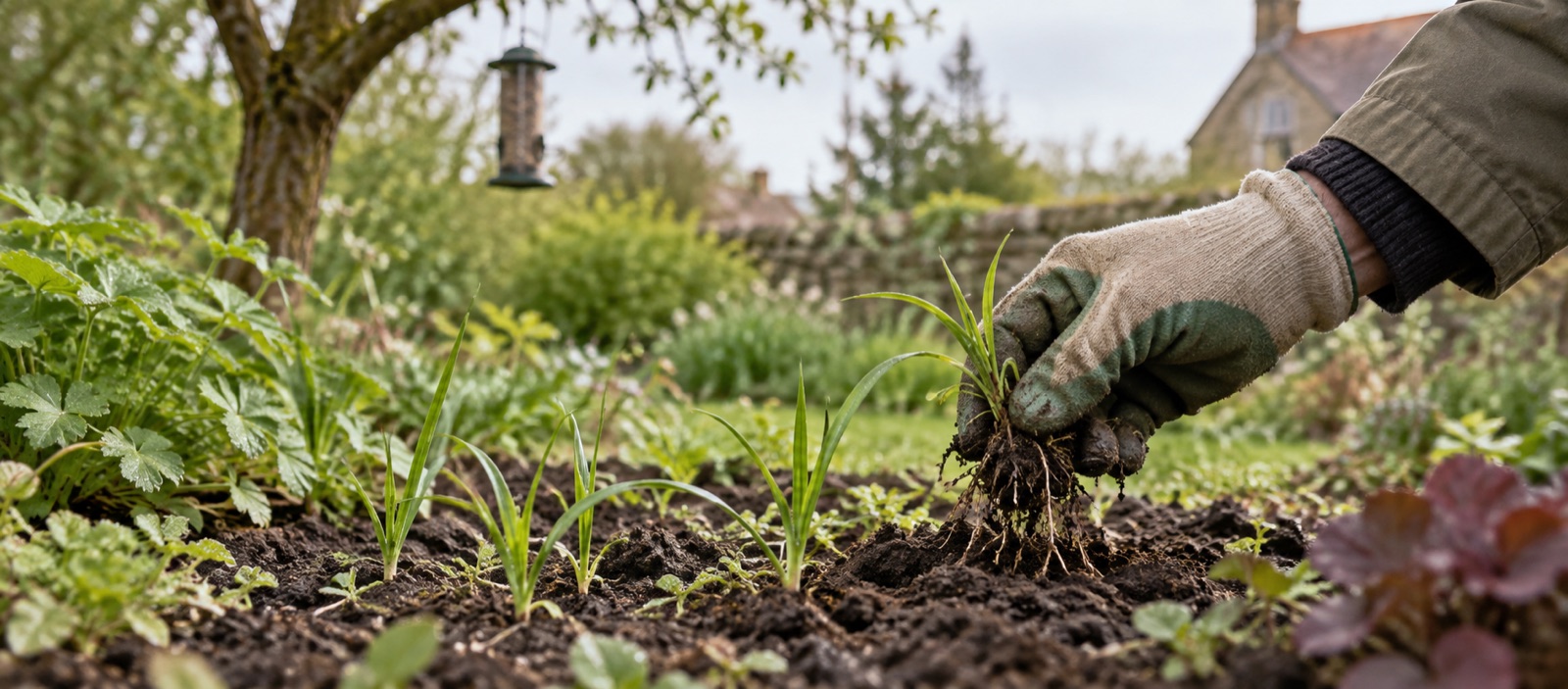
To stop spilled bird seed growing, reduce spills, remove leftovers before they settle into the soil and choose a mix explicitly processed to reduce germination. “No mess” is not the same as “no grow”: removing husks does not necessarily make seeds non-viable. No-grow food still needs cleanup and must follow the normal seasonal seed-feeding guidance.
Treat the seedlings and the falling food as two separate jobs. Pulling up growth deals with what is already there; changing the refill, mix or feeder helps prevent the next patch.
Check whether the growth is coming from bird food
A cluster beneath the hanging feeder makes spilled seed a plausible explanation, but it is not proof that every new plant came from the bag. Windblown seeds, existing soil seed and nearby plants can germinate in the same place.
Look for food accumulating just below the ports and for small shoots appearing in that spill area. You do not need to identify every cereal or grass to decide that uneaten food should be removed.
| What you find | Likely issue | Best first change |
|---|---|---|
| Whole seeds below the ports | Food is being dropped or sorted | Reduce the portion and check feeder compatibility |
| Empty husks without much edible food | Shell waste rather than a full spilled meal | Compare husk-free food, but still clean |
| Shoots concentrated under the station | Viable seed has reached soil | Remove young plants and reduce fresh spills |
| Growth despite a no-grow mix | Trace viable material or other garden seeds | Check the ingredients and avoid an absolute guarantee |
| Wet food and seedlings in a tray | Food is being retained on a flat surface | Remove the food tray and review the setup |
Use our no-mess feeding guide if your main concern is shells on paving rather than growing plants. The two problems overlap, but the label that solves one may not solve the other.
Understand no-grow versus no-mess
No-mess mixes usually aim to reduce inedible husks and food debris. Birds can still drop edible ingredients, and some dehulled or husk-free material may remain capable of growing.
No-grow mixes use processing such as flaking or kibbling to damage seeds and reduce germination. The Peckish explanation distinguishes those two approaches clearly.
Do not assume sunflower hearts, nyjer or any seed described as “clean” cannot sprout. Read the exact product's ingredients and processing claims, rather than turn a general category name into a guarantee.
Peckish also notes that traces of viable material can remain in its no-grow recipe. That is another reason to promise reduced germination, not a garden that can never produce a seedling.
Choose a pack that suits your winter turnover
Peckish No Grow 1.7kg is a modest pack when you want to try a processed mix without storing a large supply. Its listed flaked or kibbled ingredients are the relevant feature for this problem.
Extra Select No Grow is offered in a resealable 5-litre tub. That is a volume, not a verified 5kg weight. Check the current label and ingredients before deciding it fits your feeder and the birds using it.
Both options appear below with the exact Amazon product links. Their usefulness depends on preventing food accumulating as well as reducing germination; neither makes a messy station hygienic by itself.
Pause seed and peanuts from 1 May to 31 October under current RSPB advice. A no-grow mix is still seed food, even if a retail label describes it as suitable all year.
Stop edible food falling in the first place
Watch a busy feeding visit. If birds repeatedly flick out one ingredient, a different suitable mix may produce less waste than filling the same large reservoir.
Check that the food matches the port size. Very fine food in large openings can escape easily; unsuitable coarse pieces may obstruct flow or be rejected. Do not enlarge holes yourself to make a mix work.
Use a small fresh portion instead of filling every available centimetre. A large reservoir can disguise how slowly some ingredients are being eaten and makes it harder to spot old food at the base.
Check wind movement and loose fittings too. A feeder knocking against a branch can spill even a well-matched food. Correct the hanging arrangement safely rather than attach a broad tray beneath it.
Flat catch trays can become open feeding surfaces. We do not recommend adding one to solve this problem; the RSPB's expert feeding guidance advises against flat-surface feeders.
Clear the ground and remove young growth
Collect ordinary spilled food promptly, including what lodges in paving joints, gravel and the top of planted soil. Use dedicated outdoor equipment and the cleaning-under-feeders routine for the surface you have.
Lift unwanted small seedlings carefully while they are easy to remove, taking the root rather than pulling only the leaves. Keep this job separate from cleaning droppings or any suspected rodent-contaminated area.
Do not throw collected food into another corner of the garden or an open compost heap. That can simply relocate the feeding and germination problem.
If seedlings are appearing across the whole bed, review the nearby vegetation too. Changing bird food cannot prevent every plant seed from reaching your soil.
Avoid home seed treatments and garden chemicals
Do not microwave, oven-bake or chemically treat purchased bird food to make it sterile. Uneven processing can affect food quality, and there is no need to invent a home treatment when a suitable processed mix is available.
Do not apply weedkiller as a routine solution underneath feeding birds, or add salt, bleach or detergents to the soil. Remove the young growth and the spilled food instead.
If food is damp or mouldy, discard it rather than dry it and return it to the feeder. Visible germination inside a wet feeder is a food-storage and moisture problem, not evidence that the food should be salvaged.
A clean station matters more than a tidy lawn
Spilled edible food can attract rodents as well as produce shoots. Our rat-prevention guide explains why repeat activity calls for a pause and wider assessment.
After each change, inspect the spill area again. Less visible growth is encouraging, but food that no longer sprouts can still spoil, accumulate or provide a meal for animals underneath.
Use our seed-mix guide when choosing a new food so feeder fit, ingredients and freshness stay part of the decision.
Common questions
Does all bird seed grow?
No. Germination depends on the ingredient, processing and conditions. But ordinary whole seed can remain viable, and a husk-free description alone does not establish that it cannot grow.
Will no-grow food eliminate every weed?
No. Other garden seeds and occasional viable traces can still germinate. Use it to reduce growth associated with spilled food, not as a replacement for ordinary gardening and cleanup.
Can I just leave the seedlings for birds?
Natural plants can support wildlife, but a concentrated spill patch is not a reason to leave old food and droppings beneath the feeder. Encourage habitat in an appropriate area while keeping the feeding position clean.
Related guide
Before switching food, check why birds throw seed out of feeders. Empty husks, rejected ingredients and a damaged port need different fixes.
Helpful products
Two no-grow mixes for winter feeding
Choose an amount you can use while fresh. No-grow reduces a particular problem; it does not remove hygiene or seasonal requirements.
Modest 1.7kg pack
Peckish No Grow seed mix 1.7kg
A small 1.7kg mix whose ingredients are flaked or kibbled to reduce their ability to germinate beneath a feeder.
A modest winter pack of processed seed intended to reduce germination. Trace viable material and other garden seeds can still produce seedlings; spills still need removing.
Resealable 5-litre tub
Extra Select No Grow wild bird food 5L
A five-litre no-grow seed mix supplied in a resealable tub for cleaner storage and easier portioning.
A resealable no-grow mix sold by volume, not a verified 5kg bag. Check the current ingredients and your turnover; it does not remove hygiene or seasonal restrictions.