Practical feeding advice
How to prevent rats under bird feeders
Remove accessible bird food, improve indoor storage and recognise when repeated rat activity needs a feeding pause and professional help.
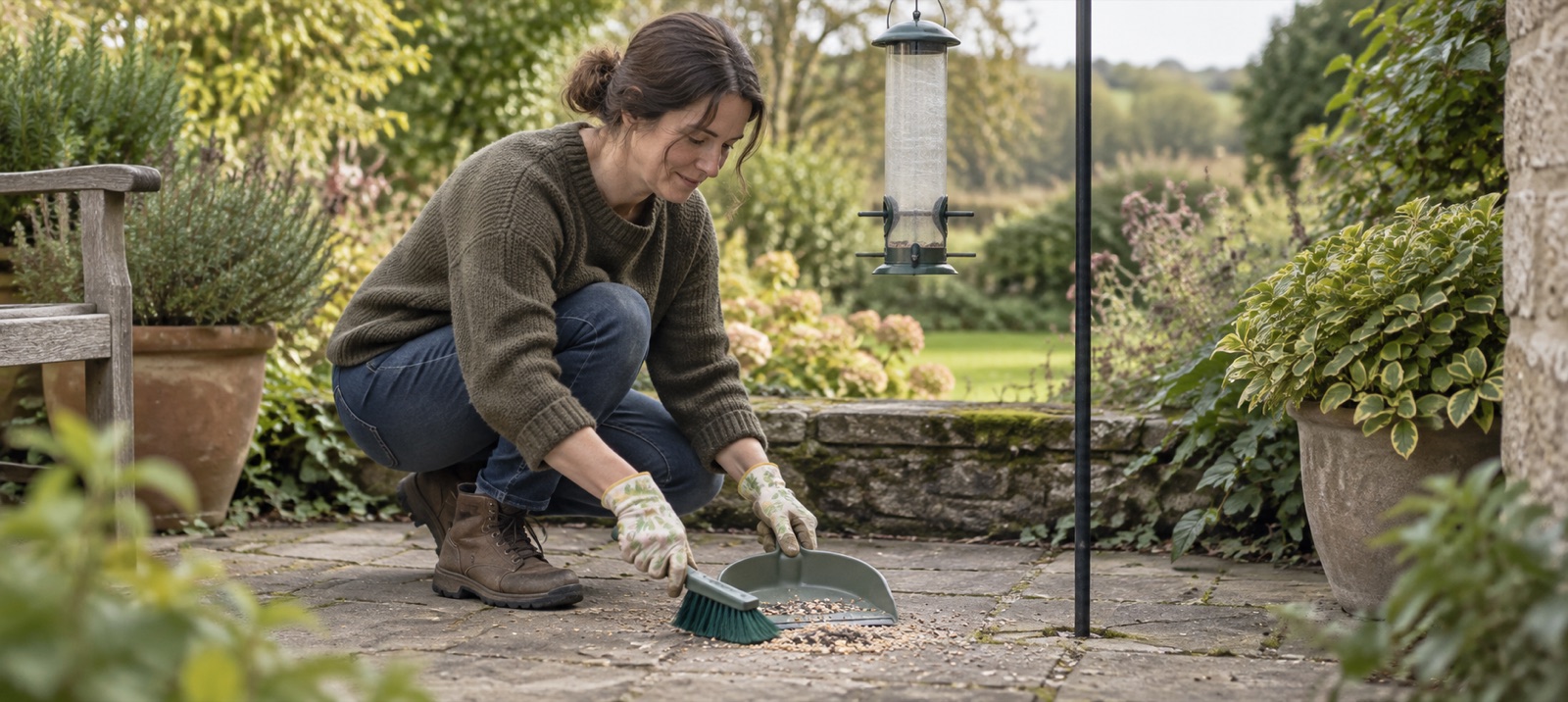
To prevent rats under bird feeders, remove accessible food: clear spills, use small contained portions and keep the main supply securely indoors. If rats repeatedly return, stop putting food out while you address the cause. A higher or “rat-resistant” feeder does not make an infestation safe to ignore; contact your council or a competent pest professional when activity persists.
This is mainly a food-access problem, not a search for a stronger poison or a feeder that promises to solve everything. Review the ground, the store and other food sources together.
Work out what you have actually seen
A brief glimpse of a small mammal does not establish an infestation or even confirm a rat. Note where it appeared, what it was doing and whether the same route is used repeatedly.
| Observation | What to check next | Appropriate response |
|---|---|---|
| One animal beneath fresh spills | Whether leftover food is attracting it | Remove food and monitor without adding more |
| Repeated visits or fresh burrow activity | Feeding, waste and building access | Pause feeding and seek professional assessment |
| Gnawed bags in the shed | Storage damage and possible entry points | Remove access to food; assess the building |
| Food vanishes overnight | Other signs and routes, not disappearance alone | Take down purchased food and investigate |
| Droppings or contamination in a store | Whether food and surrounding items are affected | Keep people and pets away; get safe-cleanup advice |
Do not identify a species solely from missing seed. Mice, birds and other animals can take food too. Our mice-around-bird-food guide covers smaller-rodent spill and storage problems, while this page focuses on recurrent rat activity and when to escalate.
Stop supplying the route while you investigate
Take down food when rats are repeatedly visiting. Do not merely move it from the lawn onto an open table: rats can climb, and flat feeding surfaces conflict with current bird-welfare guidance.
Clear accessible leftovers without spreading contamination. For ordinary feeder debris, follow the under-feeder cleaning guide. If rat droppings, urine contamination or a substantial infestation are present, get the professional's cleanup instructions rather than dry-sweep, vacuum or handle contaminated material casually.
A late refill can leave a meal available overnight. In a feeding setup without known recurring rats, remove accessible uneaten food by dusk and judge the next portion by real use. During a persistent problem, removal at night is not enough: pause daytime provision too.
The BPCA's rat guidance highlights excess bird food, unsecured waste and the value of professional help. Its older suggestion of a catch basket or table should not replace the newer RSPB advice against flat feeding surfaces.
Keep seed, suet and mealworms out of reach in storage
An open sack in a shed provides food even after you have stopped filling feeders. Check shelves, damaged packaging, lids and the floor beneath the store.
Keep purchased food dry in a closed container inside a secure building. Retain the pack's ingredients, date and storage instructions, and do not pour new food indefinitely over older remnants.
The ALL FOR PAWS container has a stainless-steel body, latches and a clear lid. It is an indoor-storage option, not a verified all-metal rat-proof safe. Its stated 11lb capacity is not a measured weight of your particular bird seed.
The DEAYOU 2.8-litre pour container can help keep refill portions modest, but its plastic construction should not be treated as protection against gnawing. Keep it indoors between uses, not hanging beside the station.
Our food-storage comparison covers those trade-offs. If a rat can enter the building or damage a lid, buying another ordinary container does not resolve the underlying access.
Check the rest of the garden's food supply
Look beyond the feeder. Accessible bin contents, pet food left outside, food waste and fallen leftovers may keep activity going after the purchased bird food is removed.
Secure damaged bins and keep food waste contained. Do not relocate a bag of discarded seed to an open compost heap where it becomes another meal.
Avoid stripping every wildlife habitat area in response to one sighting. Ask a professional to distinguish active rodent harbourage and building defects from beneficial planting before undertaking major clearance.
If a neighbouring property appears involved, approach the issue calmly and involve the appropriate council service where needed. Your own feeding pause remains worthwhile even if it cannot remove every food source in the area.
What feeder changes can—and cannot—do
A contained hanging feeder with appropriate ports can reduce casual waste. A weight mechanism or baffle may limit a particular access route, but it cannot prevent every rat from climbing, jumping or taking the food below.
Our rat-resistant feeder guide explains the limitations. Do not buy a product because “rat-proof” appears in a headline and then keep supplying an established infestation.
After the problem has been assessed and addressed, restart only if you can keep the area clean and respond promptly to renewed activity. Begin with a very small portion and inspect the ground after feeding visits. There is no universal safe restart interval that fits every infestation.
Know when to call for help
Repeated sightings, burrows, contamination, gnawing or signs of entry into a building warrant professional assessment. Your council may offer pest services; otherwise use a competent pest professional, such as a BPCA member.
Explain that the garden is used by wild birds, pets or children so the assessment considers non-target risks. Do not scatter poison beside feeders or install improvised traps, glue boards or entangling barriers.
Follow the professional's recommendations for access, monitoring and cleanup. Do not attempt to block a suspected occupied route or dismantle contaminated structures without advice.
The current RSPB routine is still relevant when feeding resumes: seeds and peanuts pause from May through October, and open flat food surfaces are not recommended.
Rat-feeding questions
Does no-mess seed stop rats?
No. Edible food remains attractive even when it has fewer husks. Removing shells is not a substitute for portion control, cleanup or a feeding pause.
Are rats only a night-time problem?
No. Seeing them in daylight does not let you estimate numbers reliably, but daytime visits still need attention. Do not assume food is safe simply because you put it out after sunrise.
Can I keep feeding while pest treatment is underway?
Follow the attending professional's instructions. Do not maintain an extra food supply that undermines the agreed plan or restart on the strength of a short quiet spell.
Related guide
Not sure when food disappears? Check what empties a feeder at night without leaving extra food as bait.
Helpful products
Indoor storage for a tighter routine
These help with dry indoor storage and controlled portions. Neither is a guaranteed rat-proof container or a solution to an infestation.
Steel-bodied indoor storage
All For Paws stainless-steel food container
An 11lb-capacity 304 stainless-steel dry-food container with a four-sided latching lid, silicone seal, clear top and scoop.
Steel-bodied indoor storage with a clear lid and latches. Keep it inside a secure building; neither the lid nor the listing establishes that it withstands rat gnawing.
Small refill container
DEAYOU 2.8L bird-seed pour container
A 2.8L clear plastic dry-food container with a three-sided locking lid, silicone seal, handle, measuring cup and pour spout.
A 2.8-litre indoor portion container for controlled refills. Plastic is not rat-proof; do not leave it at the feeder or use it in place of proper infestation control.