Garden bird guide
Nuthatches: food, feeders, identification and garden visits
Learn how to recognise a nuthatch moving headfirst down a tree, what it eats and when a rigid peanut or small seed feeder suits a UK garden.
What do nuthatches eat? They prise insects and spiders from bark, and also take seeds and nuts. They may visit a garden for peanuts or sunflower hearts, especially in winter when natural food is harder to find. The RSPB nuthatch account describes a resident woodland bird that also uses gardens; it is not a feeder-dependent species that needs food put out every day.
If one visits, you may see it leave quickly with a seed or nut and wedge food into bark for later. That behaviour makes a small feeder appear busy. Do not turn one visitor into a reason to leave a big quantity of food exposed through rain. The food-portion guide explains how to match a fill to actual turnover.
How do you identify a nuthatch?
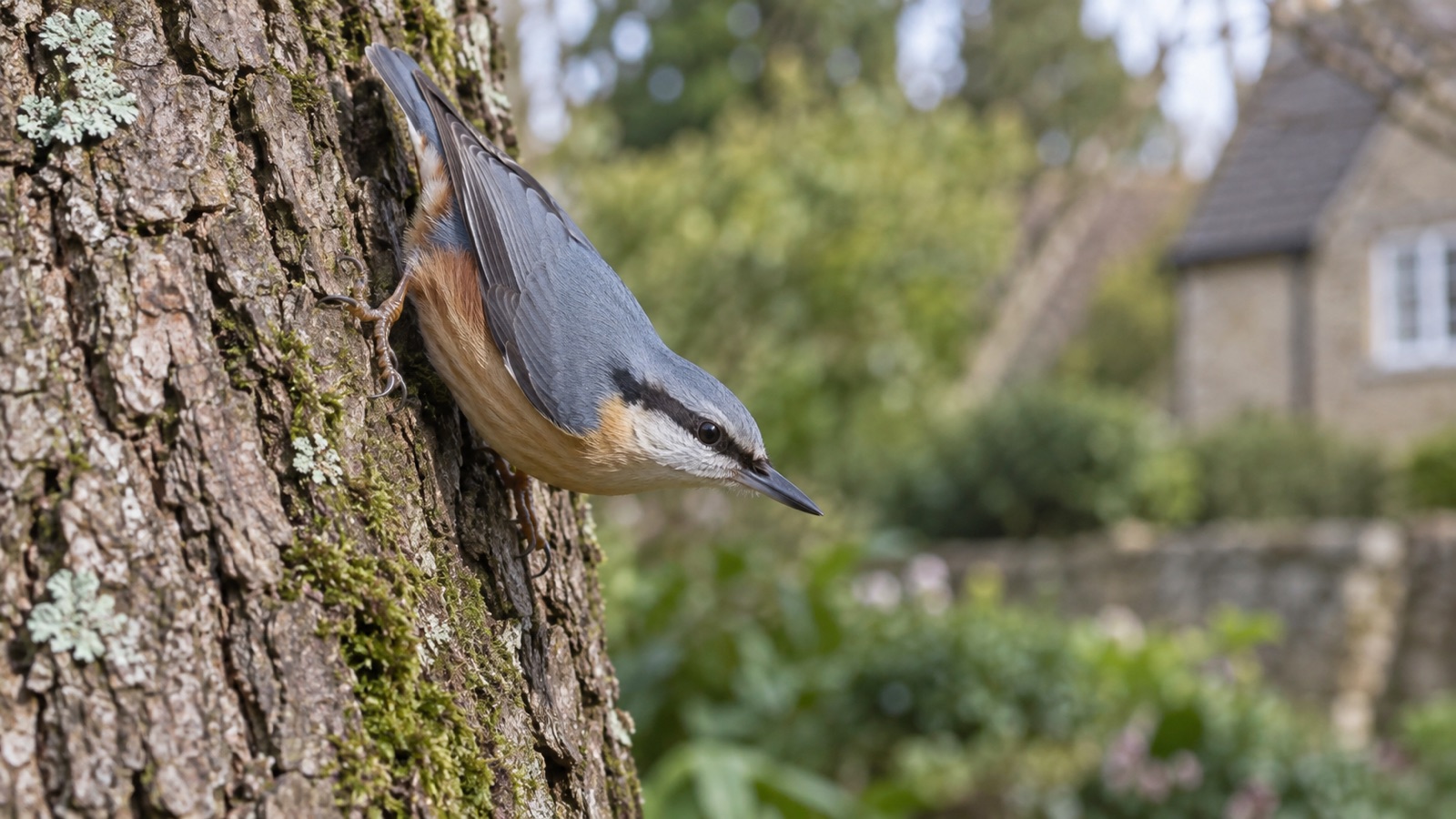
The combination of blue-grey upperparts, black eye stripe, pale face and warm chestnut sides is distinctive. It is about great-tit size but looks heavier at the front, with a long pointed bill and short tail. Most memorably, a nuthatch can move headfirst down a trunk. A treecreeper generally works upwards; a great tit may hop on branches but lacks this trunk-running style. Compare the RSPB photographs and the BTO profile when a bird is far away.
Nuthatches give loud whistles and can be heard before they appear. Watch the side of an old tree opposite where you stand: a bird may keep the trunk between itself and an observer. The hero above is illustrative, not a field record.
Will one use a peanut feeder?
Yes, some nuthatches use a rigid metal-mesh peanut feeder and cling to it while feeding. The RSPB feeder guide recommends suitable mesh for whole peanuts and notes nuthatches among visitors. Our peanut-feeder guide compares mesh, capacity and cleaning access; the peanut-food guide covers quality and storage. Never put loose whole peanuts on a table or in retail netting.
For sunflower hearts, a small seed tube may be more practical than a peanut setup if several birds already use it. The sunflower-hearts guide helps choose a manageable pack. Because a nuthatch can carry food away, judge a feeder by whether the food remains fresh, not by how long the bird stays perched.
Current BTO guidance limits supplementary seed and peanuts to November–April, then pauses both from May–October. Suitable mealworms or suet may continue in small amounts with hygiene, but are optional. Clean the equipment at least weekly, empty damp leftovers first and stop feeding if birds look ill. Follow the BTO hygiene instructions for the whole area, including spilled food.
Where are nuthatches most likely in gardens?
Mature deciduous trees and a connection to woodland are strong clues. The RSPB describes them across England and Wales and increasingly in parts of southern Scotland, with a much narrower chance in places lacking suitable woodland. Planting a small sapling is worthwhile for the long term, but it will not create a mature-tree bird habitat this winter. Preserve existing trees where safe, retain natural leaf and bark habitats, and keep clean water accessible.
If the bird has not visited for several days, do not keep moving a feeder around the garden. It may be foraging elsewhere in its territory. A quiet bird-feeder troubleshooting guide can help rule out wet food or an exposed position without promising a particular species.
Do nuthatches use nest boxes?
Nuthatches nest in tree holes and can use some boxes. The BTO profile notes that they may narrow an entrance with mud. That does not make a generic product labelled “nuthatch box” necessary or guarantee occupation. Choose a position away from disturbance, check the general nest-box guidance, and leave any occupied box alone. Do not enlarge or alter an entrance during use.
Is a nuthatch a woodpecker?
No. Both can move on tree trunks, but a nuthatch is smaller, has a blue-grey back and black eye stripe, and can descend headfirst. A great spotted woodpecker is much larger with bold black-and-white wings and red markings.
Can a nuthatch eat peanuts in summer?
The current UK garden-feeding advice pauses supplementary peanuts from May through October. Natural nuts and seeds in the bird's environment are a different matter from putting out a communal feeder.
Helpful products
Winter feeders a nuthatch can use
Start with a small, clean fill and watch whether the bird visits. A rigid mesh peanut feeder and a seed tube serve different foods; neither compensates for the loss of mature trees.
Jacobi Jayne Bird Lovers small peanut feeder
Best for: Whole peanuts in a secure mesh feeder during November–April
A compact 0.5L hanging mesh feeder for whole peanuts or suet pellets, with a twist-off quick-release base.
Keep in mind: A nuthatch may visit briefly and cache food; a large fill will only sit and spoil.
RSPB Classic easy-clean seed feeder (small)
Best for: A modest winter seed option near suitable mature trees
A simple 500ml, two-port feeder with a polycarbonate tube and plastic fittings that come apart without tools.
Keep in mind: Pause seed May–October and clean the feeder at least weekly.