Garden bird guide
Great spotted woodpeckers: food, feeders and identification
Identify a great spotted woodpecker by its markings and drumming, and choose suitable winter peanuts or net-free suet without neglecting mature trees.
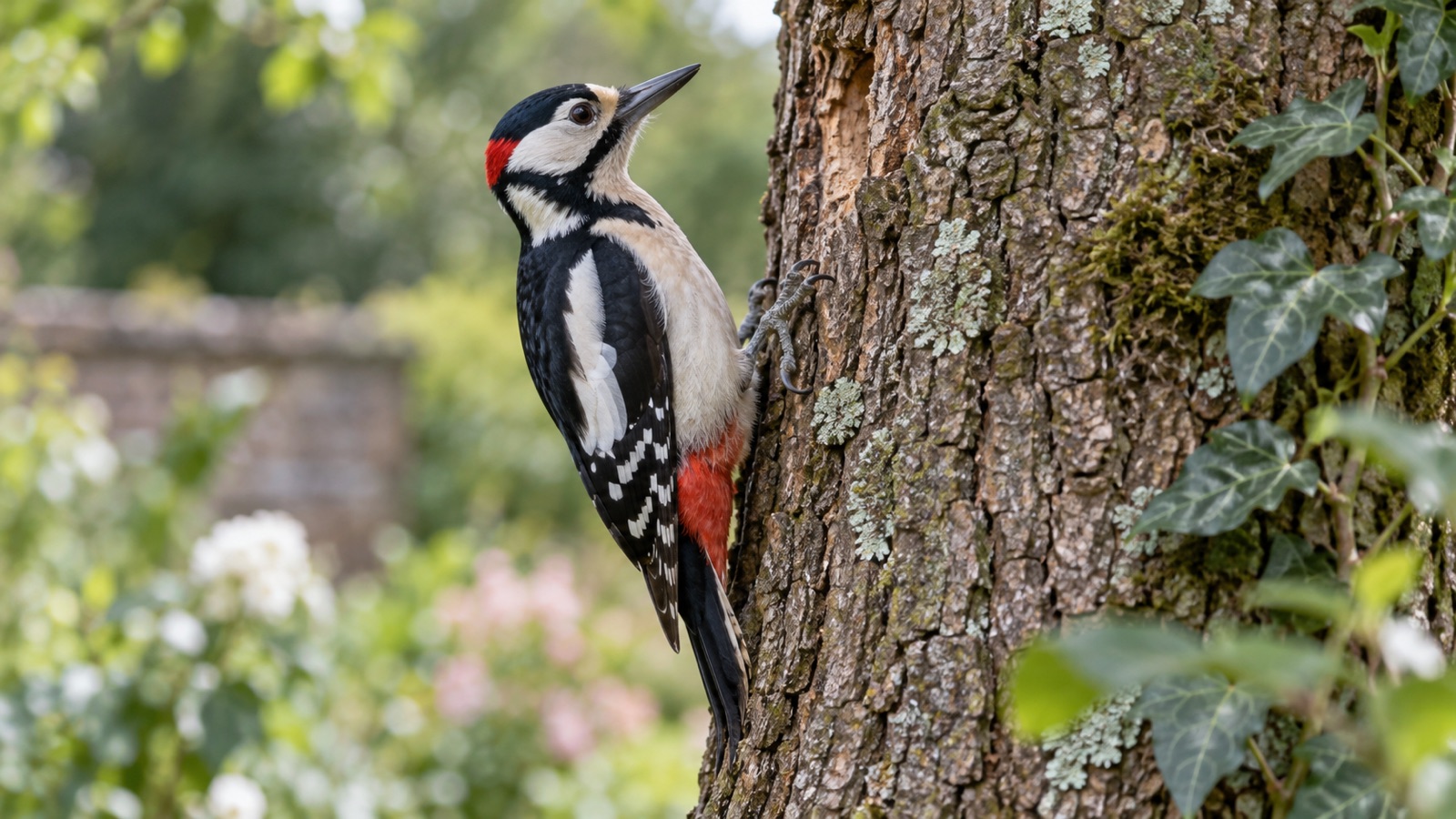
What do great spotted woodpeckers eat? They find insects and larvae in and around trees, and also use natural seeds and nuts. In gardens, some take peanuts or suet from suitable feeders, particularly in winter. The RSPB great spotted woodpecker account describes visits to peanut and suet feeders, but a garden near mature trees is a much stronger prospect than a treeless patio with a large new food station.
Listen for the sharp call and look along trunks and heavier branches. They may cling on the far side of a tree, moving out of view as you approach. A brief sighting high up can be easier to confirm by the wing pattern and flight than by its red markings alone.
How do you identify a great spotted woodpecker?
It is roughly blackbird-sized, with bold black-and-white wings, a red area below the tail and an undulating flight. Adult males have a red patch at the back of the head; young birds have a red crown. Females lack the adult male's red nape. The RSPB identification page shows these differences and provides the distinctive call.
Do not confuse it with a nuthatch, which is smaller, blue-grey and able to descend a trunk headfirst. The woodpecker's spring drumming is a rapid burst rather than the sound of feeding. Our illustrative image shows one posture; use real species photographs when you need a certain identification.
Which peanut feeder is suitable?
If you offer whole peanuts, use a rigid metal-mesh feeder so a bird must take small pieces through the mesh. Never leave loose whole nuts or hanging retail netting. A woodpecker is heavier and more forceful than a small tit, so check the branch, hook and feeder are securely mounted. The peanut-feeder guide compares mesh and build; the peanut-food guide covers quality and storage.
Under current BTO feeding guidance, garden peanuts and seed belong in the November–April supplementary window. Pause them May–October, even if a familiar woodpecker still visits. Offer small fills that turn over quickly, and clean the mesh and surrounding area at least weekly. A food source that stays damp is not a benefit.
Can you offer suet instead?
A net-free rigid suet-cake holder provides a surface a woodpecker can grip. Use a holder sized for the food, mount it firmly and avoid hot-weather products that soften or spoil. Our suet-block feeder guide addresses holder shapes, while the suet-block food guide helps choose a sensible quantity. The RSPB's current feeding guidance permits small amounts of suitable suet through the year with careful hygiene and turnover.
There is no need to put out both peanuts and suet simply to improve your chances. Start with what you can inspect, replace and wash. If several species crowd the same holder, spread any permitted feeding points rather than building one busy cluster. Clear debris below and follow the BTO hygiene routine.
Will a garden woodpecker use a nest box?
Great spotted woodpeckers normally excavate cavities in suitable trees. A standard small tit box is not a woodpecker nesting solution. Retaining mature trees and standing dead wood where it is safe and appropriate is more relevant than buying a generic box. Do not investigate, block or alter a cavity that may be in use. Our nest-box guide is for species suited to those boxes, not a promise for woodpeckers.
Why has one stopped visiting?
Its feeding route and natural food availability can change. A woodpecker may be present without visiting your feeder at all. Check food freshness and mounting security, but do not repeatedly add more or hang a feeder in an unsafe location. If you notice an ill bird at a communal feeding point, stop supplementary feeding and follow BTO disease advice.
Is the red head a male bird?
An adult male has a red patch at the back of the head. A juvenile can have a red crown, so the position of red matters more than its mere presence.
What is the best food to attract one?
There is no guarantee. In a garden with suitable mature trees, a secure rigid-mesh peanut feeder in winter or a clean net-free suet holder is plausible; maintaining the trees remains the stronger long-term choice.
Helpful products
Two ways to offer food to a clinging bird
A rigid peanut feeder and a suet-cake holder suit different foods. Both need a secure fixing, sensible portions and cleaning; neither promises a woodpecker visit.
RSPB Premium peanut feeder (15 inch)
Best for: A rigid-mesh winter peanut feeder for a clinging bird
A 15-inch feeder with stainless-steel mesh, powder-coated metal fittings and room for about 630g of whole peanuts or suet nibbles.
Keep in mind: Check the mounting strength and stop peanuts during May–October.
Jacobi Jayne Silhouette suet cake feeder
Best for: A rigid net-free holder suited to a vertical clinging approach
A dishwasher-safe hanging leaf-shaped holder for one suet cake, with two open feeding faces and no conventional perch.
Keep in mind: The suet cake is separate; replace softened or stale food and clean the holder.