
Buying guide
Best nest boxes for starlings in UK gardens
Choose a genuinely starling-sized bird box, understand the 45mm entrance and find a safe, sheltered wall position.
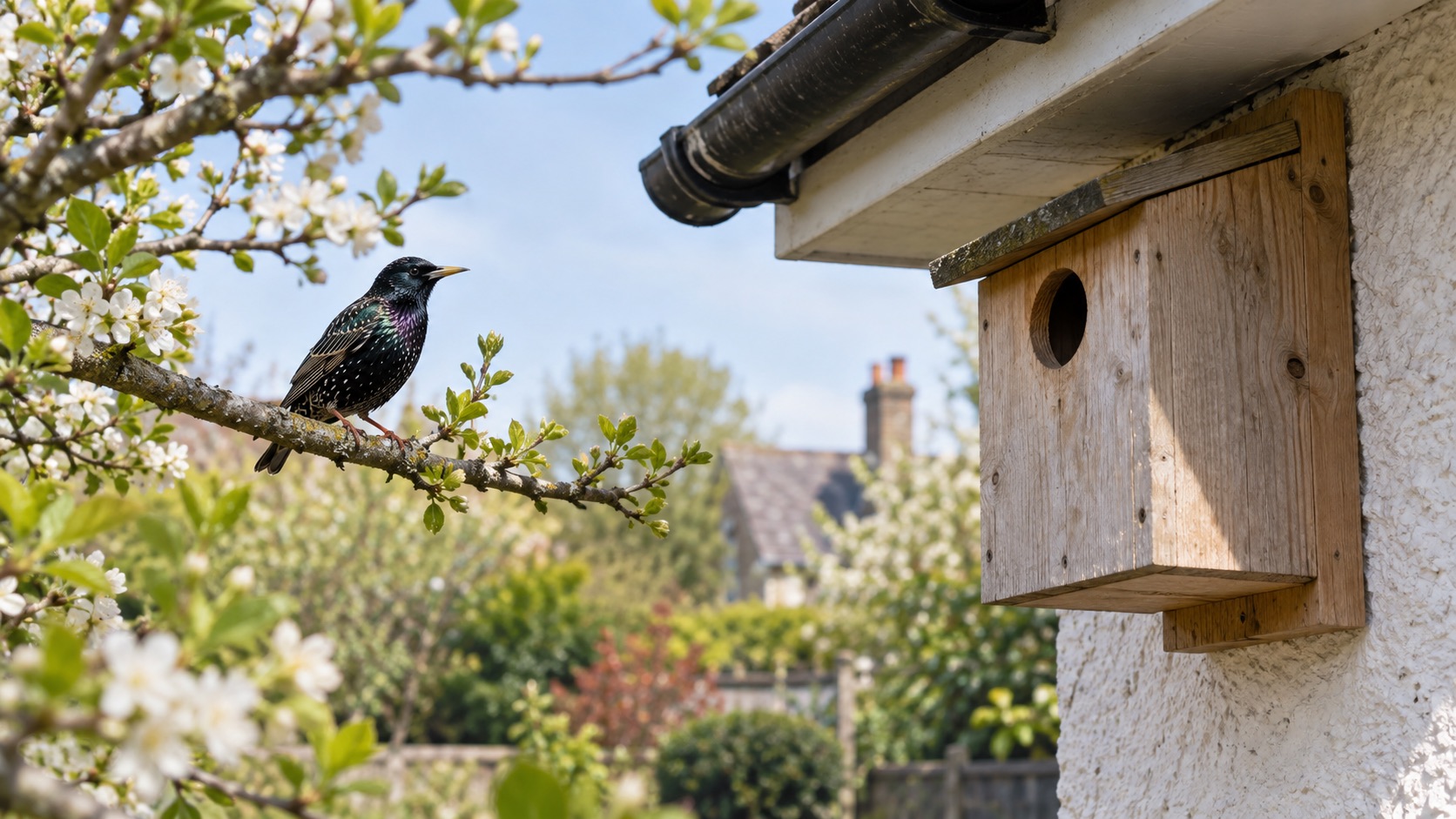
Our recommendations
Three purpose-made starling boxes
Each box is intended for starlings. The timber, composite and specialist-retailer choices have different weights and mounting demands; none is a substituted 28–32mm tit box.
dobar Green Label 45mm starling box
Best for: A 45mm starling box on a sound wall or tree-safe support
A timber starling box with a 45mm round entrance and a tall, purpose-made chamber.
A lighter timber option for a sound wall or tree-safe fixing. Drawback: check roof, joints and mounting regularly outside the nesting season.
CJ Wildlife WoodStone starling box
Best for: A long-term position with fixings strong enough for a heavy composite box
A heavier wood-and-mineral composite starling box with a 45mm round entrance and a larger nesting chamber.
A durable alternative where the wall and fixings can carry the extra weight. Drawback: the higher cost and heavy body make installation more demanding.
Specialist retailer
RSPB Apex starling nest box
Best for: A secure wall site with room for the larger chamber and opening
A purpose-made starling box with a larger entrance and chamber than a standard tit box.
Best specialist starling choice. Drawback: the larger box needs substantial wall fixings and a site with enough clearance.
What size nest box do starlings need?
A starling box has a substantially larger chamber and entrance than a small-tit box. BTO starling-box instructions describe a 45mm square opening for a medium hole-entrance box; RSPB guidance also commonly refers to a 45mm starling entrance. Check the shape as well as the quoted measurement when comparing products: a 45mm round hole and a 45mm square opening are not identical specifications.
Do not enlarge an existing small box just to let starlings in. Its internal floor, depth, wall strength and access may still be unsuitable, and work on an occupied box is unacceptable. A purpose-made unit gives you a better starting point.
How do the starling boxes differ?
The dobar box is a purpose-made timber model with a 45mm round entrance. Its comparatively light construction is useful if you have a sound wall or appropriate tree-safe support, but inspect wooden joints and roof condition outside the nesting season. The CJ Wildlife WoodStone box also has a 45mm round entrance; its more durable composite body needs stronger fixings. The RSPB Apex remains a specialist-retailer option with a purpose-made starling chamber.
These round-hole models are not identical to the BTO's 45mm-square construction plan, so compare the complete design rather than treating one number as a guarantee. Before purchase, check the current listing for dimensions, weight, opening mechanism and included fixings. A larger box should not be hung from a light fence slat.
We have not included a 32mm general box. It may suit great tits or sparrows, but it is not an honest substitute for a starling box. If your garden lacks a safe wall position, improve the site before buying.
Where should a starling box go?
RSPB nest-box guidance places starling boxes higher than many small garden boxes, often around two to four metres. The exact location should have a clear approach, protection from strong sun and driving rain, and a wall or substantial support capable of taking the box's weight.
Do not fix a box over a frequently used doorway or immediately beside a feeder. Starlings are social and noisy, but a nesting pair still benefits from a calmer approach. Consider droppings and maintenance access too; a box that nobody can safely reach once empty is difficult to inspect and clean.
Our general positioning guide covers direction and mounting. For size comparisons, the entrance-hole guide distinguishes starlings from tits and sparrows.
Does a starling box need special maintenance?
Choose a design that can be opened after the breeding season. The lid or front should close securely against wind and rain, while the base needs sensible drainage. A roof overhang helps reduce water entry; an external perch is unnecessary.
Check fixings before the breeding season and only when the site is not active. Larger boxes can be heavy, especially when wet. If safe access requires a ladder at height or work over a path, use a competent installer. Never open or move a box because a camera or viewing angle would be convenient.
What if another bird uses it?
An entrance suitable for starlings can admit other birds too. You cannot guarantee the species by writing a name on the box. Do not remove an active nest because the occupant is not the bird you hoped for. If a box is repeatedly occupied by another species, review the wider mix of boxes on the property after all nesting activity has ended.
For the bird itself—food, winter plumage and garden behaviour—see our starling profile. That page covers feeding; this one stays focused on buying and siting a nest box.
Frequently asked questions
Can I use a 32mm bird box for starlings?
No. A standard 32mm small-bird opening is too restrictive for a typical starling. Choose a box expressly built for starlings and verify its current dimensions.
Should I put two starling boxes together?
Only where the building offers enough well-spaced, safe sites. A group of boxes is not a guarantee of occupancy, and each needs its own secure fixing and unobstructed entrance.
When should it be installed?
Autumn or winter is convenient because the box can settle into its location before breeding activity. If starlings or other birds have begun investigating or nesting, stop alterations. Our timing guide explains when to put up a bird box and when to leave it alone.
The buying decision in one sentence
Buy a starling-sized box only when you have a suitable strong location; otherwise improve the site first. The BTO's construction advice remains a useful check on insulation, drainage and access whatever retailer you use.