Buying guide
Best artificial nests for house martins
Choose an enclosed house martin nest cup for suitable exterior eaves and understand siting, safe installation and existing-nest protection.
Our recommendations
Two enclosed house martin cups
Both are made for exterior eaves. The composite and terracotta choices differ in material and mounting details; ordinary bird boxes and open swallow bowls do not reproduce a house martin's enclosed nest.
CJ Wildlife WoodStone house martin nest
Best for: Sheltered exterior eaves with a clear approach and strong fixings
A purpose-made enclosed house martin cup with a small upper entrance, composite shell and supplied fixings for exterior eaves.
A sturdy single-nest alternative for suitable sheltered eaves. Drawback: it needs a sound mounting point and safe high-level access.
Terracotta cup
RSPB house martin nest cup
Best for: A single enclosed nest beneath suitable exterior eaves
An enclosed artificial cup designed to fit beneath suitable exterior eaves with a small entrance.
Best single-cup choice for suitable eaves. Drawback: building access, fixings and a clear flight approach matter more than the cup alone.
What kind of artificial nest do house martins use?
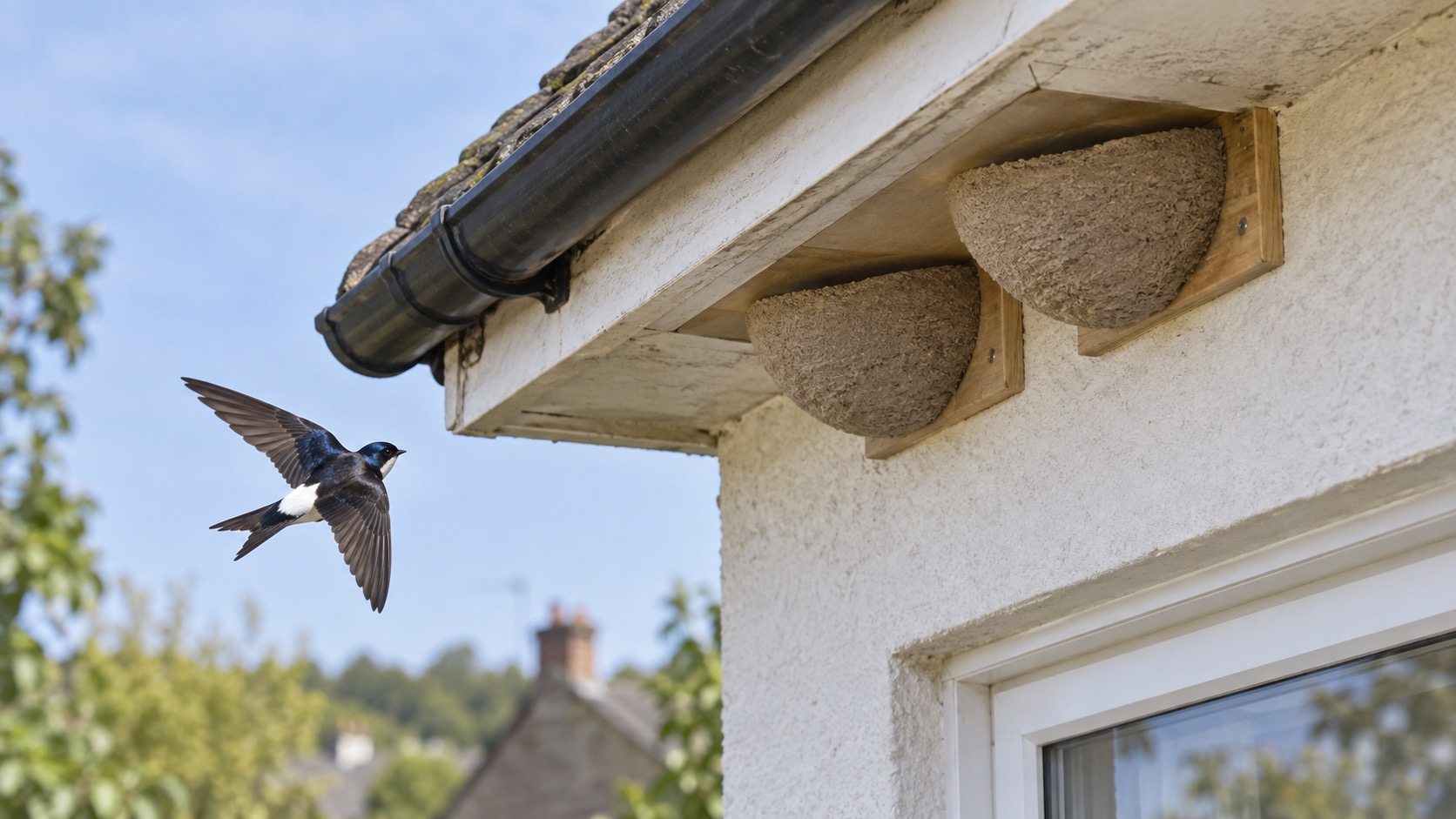
House martins naturally build enclosed mud nests under the outside eaves of buildings, leaving a small opening near the top. An artificial house martin nest cup follows that enclosed shape. It is not interchangeable with the open bowl used by swallows, which usually nest inside accessible buildings.
CJ Wildlife's WoodStone cup and the RSPB terracotta cup are both purpose-made for this setting. The CJ model is sold on Amazon with fixings; the RSPB model is a direct specialist-retailer option. Confirm the current mounting method, dimensions and whether any backing board is required before purchase; eaves and wall construction differ greatly between houses.
Is an artificial cup worth adding?
It can offer a nesting opportunity where house martins visit and the building has suitable sheltered eaves. The BTO's house martin account notes that some birds use artificial nests, but a cup is not a promise of occupation. Birds also need nearby aerial insects, a safe approach and a location free from repeated disturbance.
Do not remove old natural nests to make the wall look tidier. Existing nests may be reused or repaired, and nests that are active are legally protected. If renovation, painting or roof work is planned, establish nest status before contractors start and seek appropriate conservation advice where necessary.
Where should the cup go?
Choose an exterior position directly beneath a sound overhang, with enough clearance for birds to fly to the opening. Eaves provide rain shelter and a firm visual cue for returning birds. Avoid a spot where a downpipe, tree branch, cable or roof projection blocks the approach.
Think about the people below. A nest above a busy entrance or dining area can create practical problems. A discreet droppings board may be considered beneath an existing nesting site only if it can be installed without disturbing birds; do not retrofit anything close to an active nest. Never use netting to block birds from an active site.
How many cups should you install?
House martins often nest in loose groups, so adjacent cups can be plausible where there is room and a proven approach. But buying a row of cups for a building that has never attracted the birds is not automatically better than a single well-placed cup. Begin with the structure and local activity, then add only where safe attachment and maintenance are realistic.
Before ordering several cups, measure the usable eaves, allow room around windows and downpipes, and confirm each fixing point is sound. Do not drill into fragile soffit or insulation without understanding the construction.
How is this different from a swallow nest?
House martin cups are enclosed and externally mounted. Swallow cups are open and commonly placed inside barns, garages or other buildings with a reliable flight opening. Installing the wrong format in the wrong place is unlikely to help either bird.
Our swallow-cup guide makes the building-access distinction clear. Swift boxes are different again: they have a narrow slot and a cavity under high eaves or on a wall. See the swift-box guide rather than substituting a martin cup.
When is installation safe?
Put up new cups before birds begin nest building, ideally outside the breeding season. If you see active nests, regular entry or birds carrying mud, postpone nearby work. The UK government guidance explains legal protection in England; requirements vary elsewhere in the UK, so check the relevant jurisdiction before building work.
High exterior work brings a separate safety risk. Use appropriate access equipment and competent installation rather than leaning from a window. The cup must remain securely fixed through weather and repeated use.
Frequently asked questions
Can a house martin use a wooden bird box?
A normal tit box is not the right shape or position. House martins use an enclosed mud-cup form beneath eaves, or an artificial cup designed to mimic it.
Do I need to play calls?
Some projects use attraction methods, but a speaker is not a substitute for a suitable building or local birds. Start with the cup, safe position and unobstructed access; avoid noise that could disturb neighbours.
Can I clean out a house martin cup?
Do not interfere with an active or potentially reused nest. Specialist advice may be needed for maintenance of fixed cups and building work. Our general nest-box care guide applies to conventional opening boxes, not automatically to attached martin nests.