Practical food advice
Foods you should never feed wild birds
Foods to avoid for wild garden birds, from mouldy seed and salty snacks to cooking fat, plus dog-safety warnings and safer feeding choices.
Do not feed wild birds mouldy food, salty snacks, greasy cooking residues or food whose ingredients you cannot identify. Milk is not a substitute for drinking water. Avoid dry hard bread for nestlings, and keep grapes and dried vine fruits away from any garden that dogs can access.
Food safety also depends on timing and presentation: clean seed can still be the wrong choice during the May–October seed pause, and fresh food can still spread disease on a shared flat tray.
Foods to avoid, and why
| Food or problem | What to do instead |
|---|---|
| Mouldy seed, nuts, suet or fruit | Discard the contaminated food; investigate damp storage or slow turnover |
| Salted nuts, crisps and strongly seasoned leftovers | Use clearly labelled wild-bird food, with no added seasoning |
| Roast drippings and greasy cooking juices | Choose an appropriate purpose-made suet product |
| Milk and creamy desserts | Provide clean water when needed, in a separate maintained bath |
| Dried coconut and cooked porridge oats | Leave them out; choose recognised wild-bird food instead |
| Dry hard bread, especially around nesting birds | Choose suitable insect food and support natural foraging |
| Grapes, raisins, sultanas and currants where dogs have access | Choose sound apple or pear instead |
| Unknown mixed leftovers | Leave them out of the feeding routine |
The RSPCA's food-safety advice specifically excludes dried coconut, cooked porridge oats, milk, cooking fat, and mouldy or salted food. Some other foods are poor supplementary choices rather than universal poisons. Freshness and how food is offered matter as well as the ingredient.
Mould is a reason to discard food
A little fresh seed added to a clumped base does not make the old food safe. Empty the feeder, remove the contaminated contents and clean it before putting out a new portion.
Check stored food as well as the feeder. Damp bags, condensation in a container and chewed packaging all deserve attention. If a bulk bag has become contaminated, do not sieve out visible lumps and carry on feeding the remainder.
BTO hygiene advice stresses fresh food and cool, dry storage. Peanuts need particularly careful sourcing because poor-quality nuts can carry aflatoxin. Use our peanut guide for supplier and mesh-feeder checks.
Salted human snacks are not bird food
Salted sunflower seeds, roasted snack peanuts, crisps and heavily seasoned food should not be offered. “Birds eat sunflower seeds” does not mean the flavoured human version is a suitable purchase.
For leftovers, read the actual recipe rather than looking only at the main ingredient. Rice with sauce is not plain rice; potatoes covered with gravy are not plain boiled potato. If you cannot separate out what was added, it is simpler to leave the dish out.
The kitchen-scraps guide gives a narrow shortlist rather than encouraging a general leftovers buffet.
Cooking fat is not the same as bird suet
Roast drippings contain a mixture of cooking residues and can be greasy and perishable. Do not mix them with seed to make homemade food blocks or pour them onto a feeding surface.
A suitable commercial suet cake has a defined recipe and intended holder. That makes selection easier, but does not grant indefinite outdoor life. Remove it if it becomes spoiled, dirty or unsuitable in heat. Our suet-block guide explains food pack sizes and holder fit.
Vegetable cooking oil and softened greasy spreads should not be treated as an inexpensive feeder refill either.
Bread, milk and young birds
Bread is not a useful staple for garden birds. Dry hard pieces are a particular concern during spring and summer, when adults may take food to chicks. Do not soak old bread in milk and regard it as a better feeding mixture.
Milk should not be provided as a drink. A bird bath is for clean water, with its own daily replacement and cleaning routine; adding food or milk makes it harder to keep hygienic. See winter water advice for freezing conditions.
Do not hand-feed a fledgling with kitchen food or put food into an occupied nest box. A young bird on the ground does not automatically need feeding by a person; seek appropriate wildlife advice if injury or genuine danger is suspected.
A separate warning for dogs
Grapes and dried vine fruits can be toxic to dogs. This is a pet-safety warning, not a claim that blackbirds cannot eat raisins. A raised dish does not solve it because fruit can fall or be carried away.
Avoid these foods in dog-accessible gardens and choose fresh apple or pear if fruit provision is appropriate. PDSA advises contacting a vet immediately if a dog may have eaten grapes, raisins, sultanas or currants. Do not wait for symptoms or attempt a home remedy.
Our safe-fruit guide explains the simpler alternatives.
Good food can still be offered badly
Follow current RSPB guidance: no flat-surface feeders; seasonal seed and peanut provision; small fresh portions rather than long-lasting shared food patches.
Removing visible dirt daily does not guarantee that birds cannot share contaminated food. Avoid broad catchers and permanent piles, clear beneath feeders and move positions. If birds seem unwell, stop provision and follow authoritative disease advice rather than simply changing the brand.
Useful equipment for avoiding contaminated food
A long feeder brush helps reach a narrow tube and its base. Use it only for bird-feeding equipment, outside the kitchen; it is not a substitute for dismantling, washing, rinsing and drying.
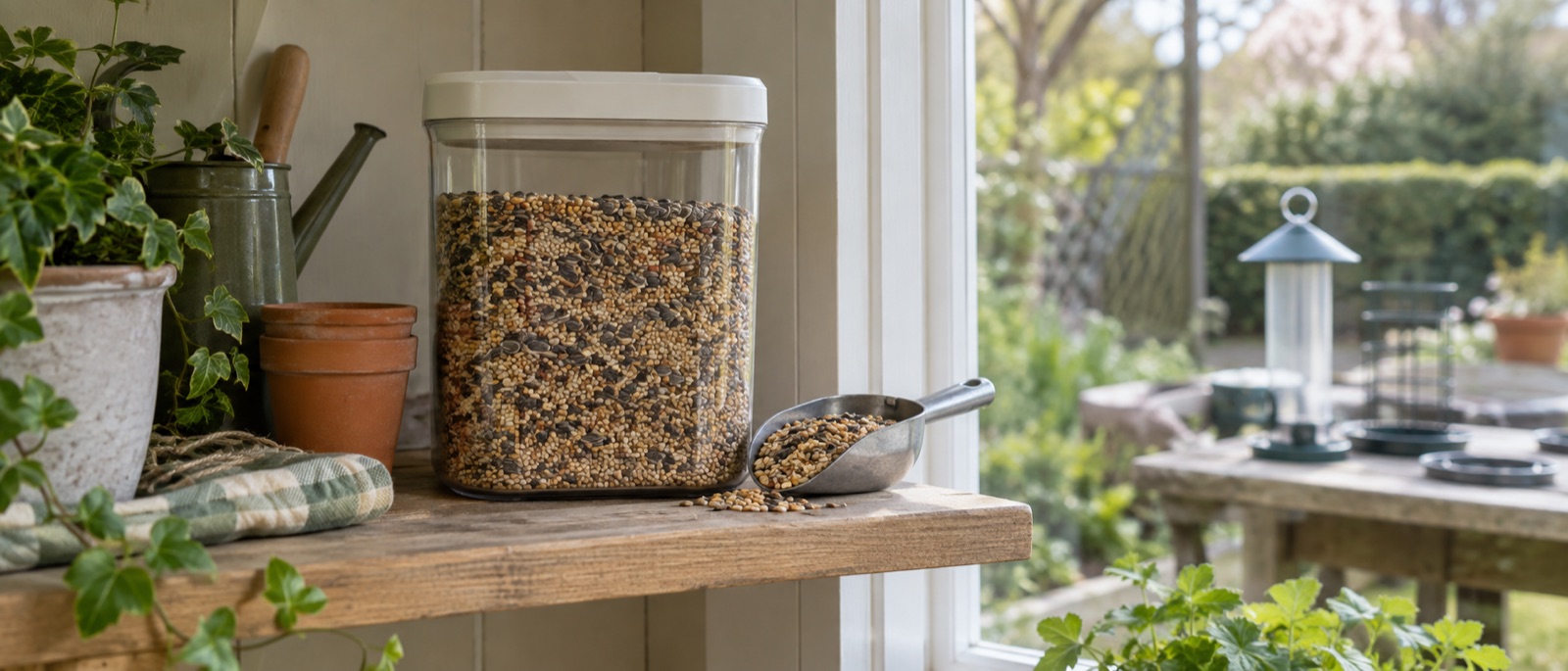
A small indoor pour container can help you measure modest dry portions. The DEAYOU container is a storage aid, not a rodent-proof outdoor bin and not a place for soaked mealworms. Wash it before changing batches and do not decant new food on top of stale crumbs.
Frequently asked questions
Is bread poisonous to birds?
Not universally. It is a poor regular choice, and dry hard bread can be unsuitable for chicks. Appropriate bird food is a better option.
Can I cut mould off fruit for birds?
Do not offer a visibly spoiled fruit. Choose sound fruit instead of using birds to dispose of it.
Does a “safe for birds” label remove all risk?
No. Freshness, seasonal use, feeder design and cleaning remain important. Follow the current welfare advice as well as the product label.
Helpful products
Equipment for fresher food and cleaner feeders
Use a dedicated outdoor brush for feeding equipment and a dry indoor container for measured portions; neither removes the need for fresh food and regular checks.
Jacobi Jayne long bird feeder cleaning brush
A long-handled natural-bristle brush made for reaching inside bottle-shaped and tubular bird feeders.
Best for cleaning the length of feeder tubes. Drawback: a smaller detail brush may still be useful around ports and threads.
DEAYOU 2.8L bird-seed pour container
A 2.8L clear plastic dry-food container with a three-sided locking lid, silicone seal, handle, measuring cup and pour spout.
Best small container for controlled daily portions. Drawback: its plastic body is for tidy indoor storage, not a claim of rodent-proof protection.