Practical feeding advice
How to protect bird feeders from ring-necked parakeets
Check reach, guard layout and damaged fittings before choosing robust feeder equipment for gardens visited by ring-necked parakeets.
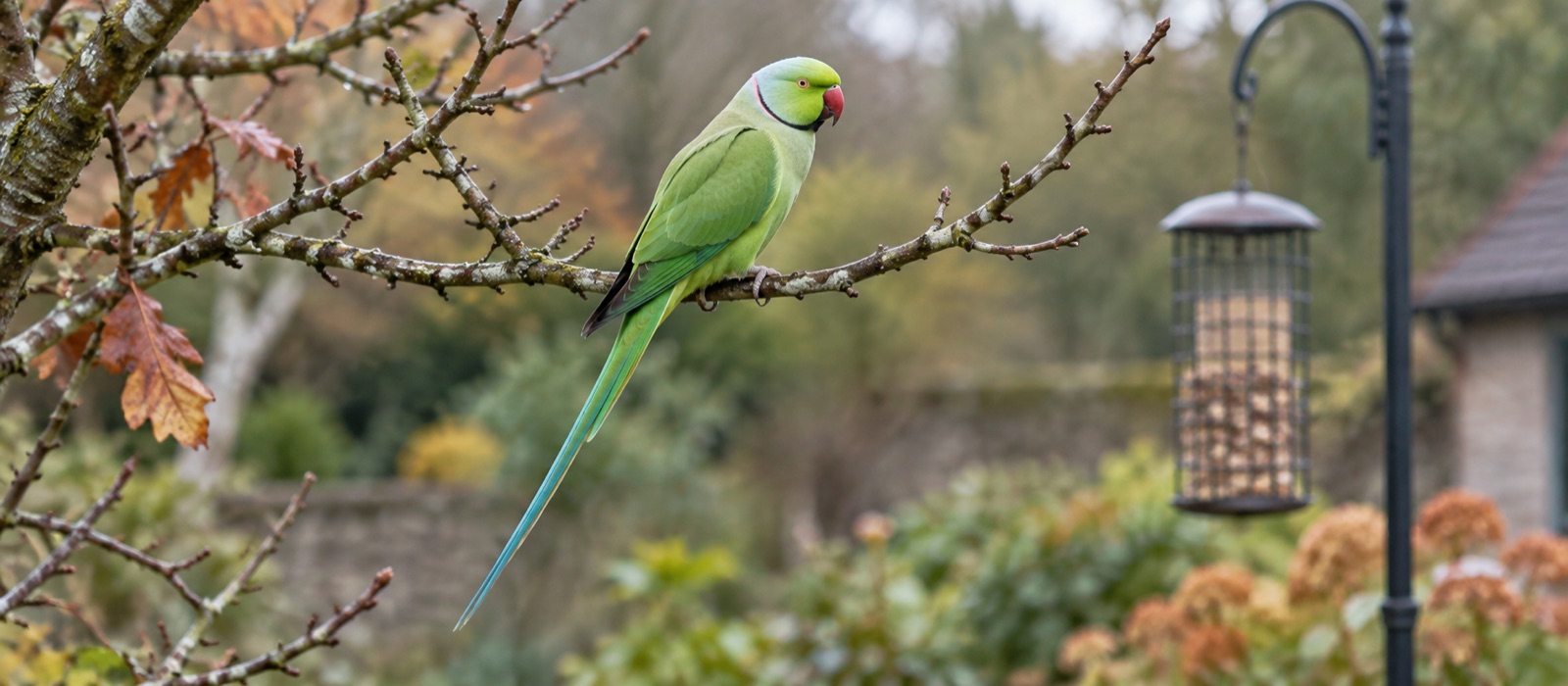
To protect bird feeders from ring-necked parakeets, use a securely hung, robust guarded design and remove easy access to exposed food. Check whether a parakeet can reach through the guard, perch on a neighbouring support or damage fittings with its bill. No ordinary cage should be assumed parakeet-proof; replace damaged parts and keep portions small.
Their bright plumage makes them easy to spot, but watching exactly how they reach the food tells you much more than buying a feeder with “proof” in its name. The best change depends on whether you are dealing with competition, spilled food or damaged equipment.
Identify the route before replacing the feeder
Watch a few visits from indoors. A parakeet may use the outer guard itself, balance on a nearby hook or work at a lid. Those are different problems.
| What happens | What to check | Practical response |
|---|---|---|
| Food is taken from exposed ports | Perch and port arrangement | Compare an integrated outer guardian |
| A bird reaches through the cage | Distance between outer mesh and food | Try another complete design; do not modify the gaps |
| Lid or fittings are worked loose | Catch engagement and material condition | Remove the feeder if damaged; use proper replacement parts |
| Bird hangs from an adjacent support | Nearby hooks, branches or feeders | Reposition securely without sacrificing sightlines |
| Food falls and is eaten below | Port fit, swinging and food sorting | Reduce the portion and clear leftovers |
Photograph the damaged fitting while the feeder is down, if you need help from the supplier. Do not assume that a scratch proves parakeet damage: squirrels, weather and loose assembly can also affect equipment.
Choose robust fittings, not an unsupported guarantee
Metal outer guards are a reasonable place to start when exposed food is too accessible. Check the inner tube, lid, base and catches as well; a metal cage does not turn every other part into chew-resistant material.
The RSPB's Classic feeder listing explicitly warns that parakeets can damage parts of that model. This is a useful reminder to inspect construction, not evidence that every feeder will fail or that another range is guaranteed safe from damage.
Choose a design you can dismantle fully for cleaning. If the outer guard prevents you from reaching debris around the ports, the feeder may be more demanding to maintain than its appearance suggests.
Our caged-feeder guide explains the difference between preventing entry and preventing reach. Both matter when the visitor has a long neck and an agile bill.
Two guarded formats worth considering
The Supa caged fat-ball feeder has a powder-coated steel outer frame and flip-top filling. It offers a contained position for net-free fat balls rather than an exposed holder. Inspect whether food is reachable through the guard and whether catches remain secure.
The RSPB guarded seed feeder is an option for winter seed feeding when a plain tube gives easy access. Check the complete assembly before ordering replacements; the outer guardian alone is not the whole feeding system.
Neither option should be described as parakeet-proof. A product's general larger-bird or squirrel marketing does not establish the result with ring-necked parakeets in your garden.
See the large-bird feeder comparison if you need to compare other intended visitors. A cage that changes parakeet access may also change whether robins, blackbirds or other birds can feed.
Position the feeder so the guard can do its job
Do not hang it against a branch or another feeder that offers a convenient support beside the food. Make sure the hook is closed or secured as its instructions require and that the assembly does not rub repeatedly against nearby objects.
A hanging feeder should still be easy for you to take down. Adding height that requires unsafe ladder work for every refill is not a good trade-off. Nor is hiding it inside dense growth where a cat can wait and you cannot see what is happening.
A squirrel baffle mainly addresses a climbing or jumping route; it does not stop a flying parakeet landing on a feeder. Our guards-and-baffles guide helps separate those jobs before you buy an accessory.
Control spills and check equipment frequently
Keep the quantity in line with actual use, especially after changing the guard. If smaller birds are taking time to adapt, filling the entire tube leaves food sitting unnecessarily.
Collect fallen food rather than introduce an open catch tray or scatter more below. Use the under-feeder cleaning guide and pay attention to food lodged around the base of the cage.
Remove equipment with sharp edges, broken mesh, a loose lid or a cracked food tube. Use manufacturer-compatible replacement parts, not wire ties across feeding openings or improvised string loops. A bird should not have to squeeze past a repair to enter or leave.
Keep an eye on all your feeding positions. Solving access at one guarded feeder achieves little if an exposed food holder remains beside it.
Use humane changes and seasonal food
Wild ring-necked parakeets should not be trapped, poisoned or injured because they visit a feeder. Government guidance for England explains wild-bird protection and licensing; nuisance at a garden feeder is not automatic permission for harmful control.
Do not use loose netting, fishing line, glue or sharp improvised barriers. Do not interfere with occupied nests. If the setup cannot be kept safe and manageable, taking purchased food down is an available option.
Current RSPB guidance pauses seed and peanuts from 1 May to 31 October. See the winter-feeding guide for a modest November restart rather than increase food to keep pace with a visiting flock.
Common parakeet-feeder questions
Will a weight-sensitive feeder exclude parakeets?
It responds to weight on its moving part, not species. A bird reaching food from another support may bypass the intended action. Treat it as an arrangement to evaluate, not a promised parakeet detector.
Can I make the cage openings smaller?
Do not bend or cut mesh or add loose netting. Improvised alterations can leave sharp edges, snagging points and trapped-bird risks. Choose a complete design intended for the access arrangement you need.
Do parakeets mean I should stop feeding altogether?
Not automatically. Start with safe equipment, manageable portions and the current seasonal routine. Pause if damage, crowding, disease signs or repeated waste mean you cannot maintain that setup.
Helpful products
Guarded formats to inspect for fit
These offer guarded feeding positions, not guaranteed parakeet exclusion or resistance to bill damage.
Metal outer cage
Supa caged fat-ball feeder
A powder-coated steel guardian surrounding a holder for four standard fat balls, filled through a flip-top lid.
A steel outer guard around net-free fat balls, worth considering where exposed food is easy to reach. Not parakeet-proof; check catches, mesh and beak access.
Guarded seed feeder
RSPB caged seed feeder
An easy-clean seed feeder enclosed by a metal guardian that limits physical access to the feeding ports.
A guarded winter seed position rather than an exposed tube. Do not assume the cage or feeder fittings are chew-proof, and remove damaged equipment promptly.