
Feeder buying guide
Best bird feeders to keep larger birds out
Compare cages, small ports and weight-activated feeders for limiting pigeon and other large-bird access without impossible exclusion promises.
Our recommendations
Three ways to limit access
Choose the barrier for the route larger birds actually use: landing at the port, reaching through a cage or feeding from spill.
Supa caged seed feeder
A powder-coated steel cage around a seed tube, with a flip-top lid and stated overall dimensions of about 26 by 17 by 17cm.
Best simple guarded seed option. Drawback: the cage cannot guarantee exclusion and creates more joints to inspect and clean.
RSPB Ultimate seed feeder and guardian (small)
An easy-clean seed feeder enclosed by a metal guardian that limits physical access to the feeding ports.
Best guarded-cage approach. Drawback: the cage adds more joints to clean and cannot exclude every larger visitor.
Brome Squirrel Buster Mini
A compact four-port feeder with a weight-operated shroud that closes access when a squirrel lands on it.
Best compact weight-operated option. Drawback: the trigger is not adjustable and nearby launch points can defeat the mechanism.
“Keep large birds out” is a useful shopping question, but it needs a more precise answer. A woodpigeon landing on a broad rim, a starling clinging to wire and a squirrel reaching from a fence are different problems. Watch the approach before buying a guarded feeder; otherwise you can spend more and still find the food vanishing beneath it.
The three designs compared
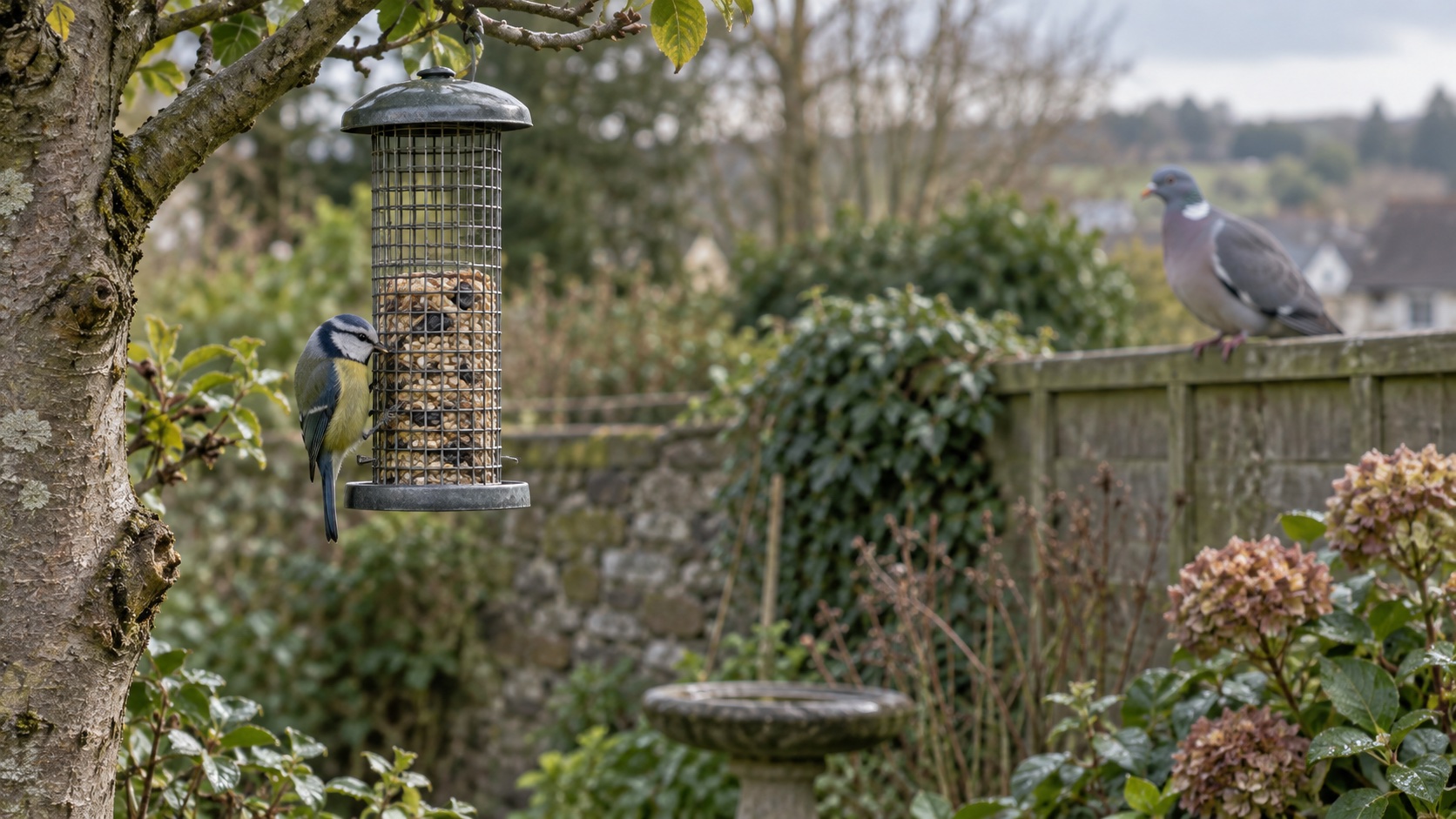
The Supa caged seed feeder places a tube inside a metal cage. It is a lower-cost way to make direct port access harder for pigeons and doves. Check the distance between bars and ports, not just the outside width: a bird may reach through even when it cannot enter. The cage adds more corners to the weekly clean and can make a timid small bird hesitant at first.
The RSPB Ultimate seed feeder and guardian offers a more purpose-made inner feeder and outer guard. Its removable sections are a practical advantage if you will actually dismantle the whole assembly. It costs more and is bulkier than the Supa. Neither cage should be described as starling-proof: slim or persistent birds may still get through or reach a port.
The Brome Squirrel Buster Mini uses a different principle. A weight-operated shroud closes seed ports when enough weight is placed on it. This may reduce access by a heavier bird as well as squirrels, but the Mini's trigger is not adjustable. Several smaller birds can add weight, while a bird perched on an adjacent support may reach sideways. It is a compact mechanism, not a species-selective gate.
Which design fits which problem?
If pigeons land directly at the feeding ports, start with a cage that leaves sufficient inner clearance. If starlings dominate, read our more targeted starling-resistant feeder comparison; body shape and beak reach may matter more than gross weight. If larger birds eat from food below, no cage fixes the spill. Reduce portions, choose a food and port that shed less, and clear the ground daily. A broad catch tray creates another flat feeding surface and is contrary to current BTO guidance.
The existing pigeon-resistant guide looks more closely at pigeon behaviour. This page is the broader decision between cage and mechanism. Neither approach should be used to harm or trap unwanted visitors.
Food choice, season and cleaning
All three shortlists are primarily seed feeders. Under RSPB's 2026 advice, seed and peanuts should be offered only from November through April. Fill for a day or two of expected demand, not to the top by default. During May–October, small amounts of mealworms or suitable suet can be offered in appropriate non-flat holders instead.
Clean at least weekly. Remove the inner tube from any cage and scrub both sets of surfaces. On a weight mechanism, check the sliding shroud for food dust and wear, then confirm that it moves freely after drying. Relocate the feeder regularly to prevent a persistent debris patch. See how to clean bird feeders.
Set the feeder up fairly
Allow room for small birds to approach without squeezing through foliage or across a cat's waiting place. Leave enough clearance from walls, branches and roofs that a squirrel cannot simply lean across. A guard hung too close to a fence will work much worse than its product photograph suggests. Separate multiple feeders to reduce crowding rather than packing every bird onto one pole.
Common questions
Are caged feeders pigeon-proof?
They can make direct access much harder, but a pigeon may still eat spill or exploit a badly positioned feeder. Measure what is happening before buying.
Can starlings get through a small-bird cage?
Some can, depending on bar spacing, inner clearance and individual size. A cage is not a guarantee of species exclusion.
Are weight-activated feeders better than cages?
They solve a different problem. A shroud reacts to loading; a cage blocks physical entry. The right choice depends on which birds arrive, their approach and your willingness to clean moving parts.