Practical feeding advice
How to stop starlings dominating a bird feeder
Give smaller birds a fair feeding position with appropriate guards, realistic portions and honest limits on weight-sensitive feeders.
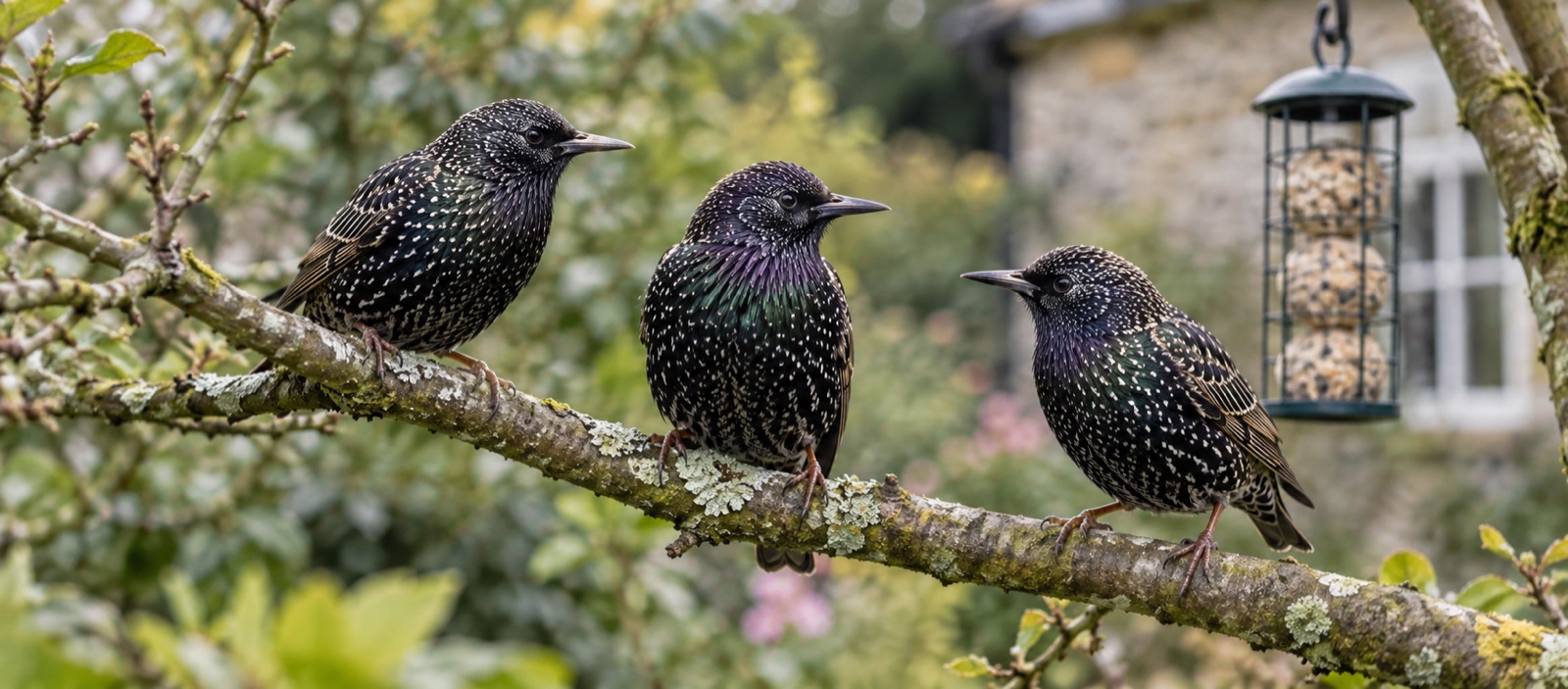
To stop starlings dominating a bird feeder, give smaller birds a separate guarded feeding position and reduce the amount of exposed food. Watch whether starlings enter the cage, reach through it or take spills instead. Weight-sensitive feeders may help in some setups, but they react to load—not species—and can also close when several small birds gather.
Starlings are not unwanted wildlife. They are native, social birds on the RSPB's Red List. The practical goal is to share access without turning your garden into a large, crowded feeding point.
Decide whether the problem is access or quantity
A busy flock can empty a suet holder quickly. That does not necessarily mean smaller birds are being excluded throughout the day. Watch before the flock arrives, while it feeds and afterwards.
| Pattern at your feeder | What it suggests | Useful first response |
|---|---|---|
| Small birds cannot approach exposed food | Competition at one easy feeding point | Add a suitable guarded position, not a bigger open dish |
| Starlings reach food through the cage | The outer guard does not separate them from food enough | Compare a different complete design |
| All food disappears in one short visit | The portion suits a flock more than your intended routine | Offer less and review how frequently you refill |
| Small birds activate a weight mechanism together | Combined load exceeds the setting | Follow the adjustment instructions; do not assume a species fault |
| Starlings feed mainly underneath | Food is falling or being scattered | Fix spills and stop ground leftovers accumulating |
Our starling species page explains their food and flock behaviour. A sudden winter increase can reflect visiting birds as well as your own resident group; you do not need to keep raising the food allowance to match it.
Give smaller birds a genuinely different option
A second exposed feeder with the same food and wide perches may simply give the flock another easy stop. A guarded position offers a different access arrangement.
The Supa caged fat-ball feeder surrounds the inner holder with a powder-coated steel frame and has a flip-top lid. Use net-free fat balls and a portion you can inspect and replace readily. It holds four standard balls, but holding capacity is not an instruction to fill every space.
Some starlings may still reach inside from outside the guard. Observe the actual access and check that tits and other intended visitors can enter and leave without snagging. Do not cut the cage or add wires to make its gaps smaller.
See the starling-resistant feeder comparison for the fuller shortlist. Resistance is a useful distinction here: “starling-proof” is too strong without evidence about the exact arrangement.
Understand what a weight setting can do
The Squirrel Buster Plus is an adjustable weight-sensitive seed feeder. It can be worth considering for winter seed when heavier visitors are loading the moving part, rather than reaching food from another support.
It does not identify starlings. A light individual may not trigger closure; several smaller birds may create enough combined load to do so. Its large reservoir also makes overfilling easy, so use a small fresh portion instead of treating capacity as an advantage on its own.
Follow the manufacturer's adjustment and clearance instructions. A branch, hook or neighbouring feeder that supports a bird without loading the mechanism may undermine the setup.
Our weight-activated feeder guide explains those limitations. Start with the access problem you have observed before buying a more expensive mechanism.
Reduce the food that keeps a crowd in one place
Do not compensate for rapid emptying with a large tray of suet pellets or seed. Open food can increase crowding and leaves a harder cleaning job.
Keep to small contained portions and avoid repeatedly topping new food onto remnants. Clear spills, particularly beneath a busy fat-ball holder, and remove spoiled food promptly. The RSPB's feeding questions stress moderation and avoiding flat feeding surfaces.
A clean, manageable feeder that occasionally empties is preferable to a large supply that you cannot inspect. It is also reasonable to reduce purchased feeding and support birds with natural habitat instead.
Do not solve one access problem by creating another
Moving food deep inside dense growth may make it harder for you to clean and easier for a cat to wait unnoticed. Keep visibility around the feeding position, while retaining nearby escape cover.
Check every hook on the station. A guarded feeder cannot protect the food in an exposed holder immediately alongside it. On the other hand, not every feeder needs to exclude every larger species: decide which position is intended for smaller birds and keep its purpose clear.
If repeated aggression or excessive waste continues, pause and simplify the setup. More hardware is not always the answer. Our feeder-choice guide helps work through access, food and maintenance together.
Keep the current hygiene and seasonal rules
Pause seeds and peanuts from 1 May to 31 October under current RSPB advice. A seed-feeder mechanism does not change that recommendation. Suitable small suet portions can be offered in an appropriate holder, with careful inspection in warm conditions.
Clean the cage, catches and inner feeder rather than wipe only the outside. Use the feeder-cleaning routine and stop feeding if birds appear sick.
Do not use poison, traps, sticky substances or entangling netting to keep starlings away. Do not disturb active nests. Restricting access to purchased food should remain a humane equipment decision.
Questions about starlings and feeders
What food can I offer that starlings will not eat?
There is no dependable universal food switch that feeds all your preferred small birds while excluding every starling. Food choice also needs to fit the season and the feeder. Change access and portions instead of relying on a magic ingredient.
Are starlings bullying the other birds?
They can displace other visitors at a concentrated food source, but a flock feeding actively is not evidence that the species is harmful. Look for whether smaller birds still get access during quieter periods.
Will feeding starlings elsewhere solve it?
It may simply increase the amount of food and the size of the gathering. Start with a small guarded position and spill control before creating another feeding point.
Should I chase the flock every time it arrives?
No. Repeated disturbance affects other birds too and is unlikely to provide a sustainable routine. Make the food arrangement manageable, then let birds respond to it.
Helpful products
Two ways to change feeder access
The guard changes physical access; the mechanism changes access by weight. Neither identifies or excludes every starling.
Guarded fat-ball holder
Supa caged fat-ball feeder
A powder-coated steel guardian surrounding a holder for four standard fat balls, filled through a flip-top lid.
A guarded position for a small quantity of net-free fat balls. Some starlings can still reach in; inspect access rather than assume the species is excluded.
Adjustable weight mechanism
Brome Squirrel Buster Plus
Brome’s largest feeder uses an adjustable weight-operated shroud, chew-resistant fittings and a ventilated 2.8L seed tube that dismantles by hand.
An adjustable winter seed-feeder option if weight is the access problem. It does not identify starlings; several smaller birds can also activate the mechanism.