Feeder design guide
Weight-activated bird feeders: how they work and which to choose
Understand sliding shrouds, fixed and adjustable triggers, placement clearance and the limits of weight-operated bird feeders before buying.
Our recommendations
Three mechanisms to compare
Compare trigger adjustability, reservoir size and how easily each shroud comes apart—not just the number of ports.
Brome Squirrel Buster Mini
A compact four-port feeder with a weight-operated shroud that closes access when a squirrel lands on it.
Best compact weight-operated option. Drawback: the trigger is not adjustable and nearby launch points can defeat the mechanism.
Brome Squirrel Buster Plus
Brome’s largest feeder uses an adjustable weight-operated shroud, chew-resistant fittings and a ventilated 2.8L seed tube that dismantles by hand.
Best large-capacity squirrel-resistant option. Drawback: it is bulky, expensive and should still be filled only for short food turnover.
PROVIDE weight-activated small-bird feeder
A metal seed feeder with spring-loaded feeding ports intended to close when a heavier animal lands on the perch.
Best direct weight-triggered option marketed for rat deterrence. Drawback: the seller's absolute pest-proof wording is not treated as a guarantee and placement still matters.
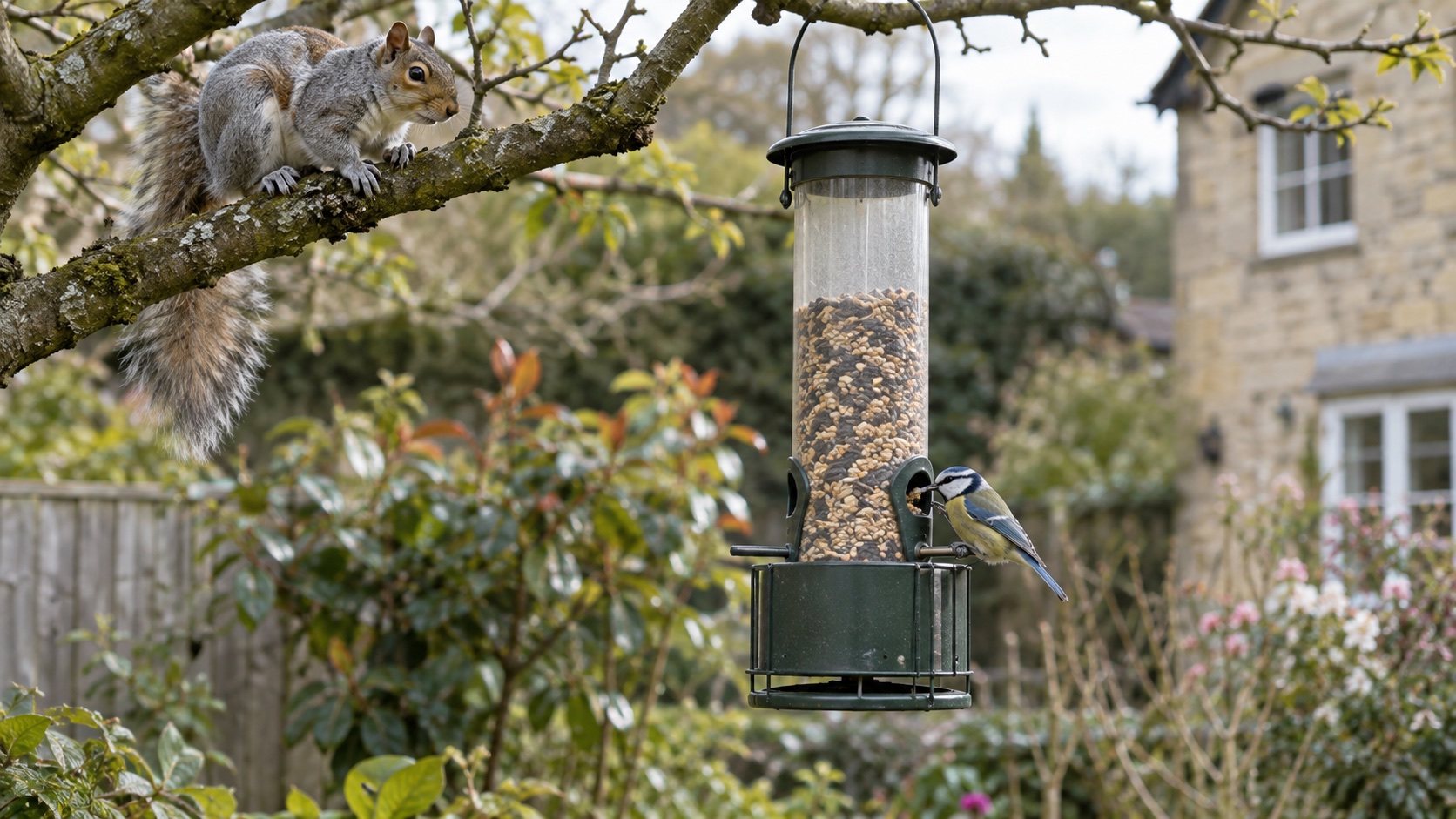
Weight-activated feeders work by turning a landing animal's weight into movement. A shroud drops, a port closes or access becomes awkward. They are useful when a squirrel is landing directly on an ordinary seed feeder; they are much less useful when the squirrel reaches across from a fence without loading the mechanism.
Three practical choices
The Brome Squirrel Buster Mini is the compact option. Its four seed ports sit behind a weight-operated shroud, and the body is smaller than Brome's Plus. It suits a modest garden where food should turn over quickly. The trigger is not adjustable, so it cannot be tuned for a particular bird mix. Several small birds together may load it; a squirrel supported elsewhere may avoid loading it at all.
The Brome Squirrel Buster Plus adds a larger ventilated reservoir and adjustable weight setting. Adjustment is useful if the default threshold closes for wanted visitors or admits a heavier one. The drawback is its size: a large reservoir should still be partly filled to keep seed fresh, and the heavy full feeder needs a strong support. The shroud and multiple parts take longer to wash than a simple tube.
The PROVIDE model is an alternative spring-loaded seed feeder sold on Amazon UK. Its listing uses absolute “squirrel, pigeon, rat proof” language; treat that as marketing rather than a guarantee. Check the current listing's dimensions, spring action and dismantling method against your support and the birds you want to feed. We would not choose it ahead of a well-documented mechanism solely because its headline promises more.
The placement test before buying
Stand where the feeder would hang. Can a squirrel sit on a branch, fence, gutter or wall and reach the ports without touching the shroud? If yes, move the proposed position or use a suitable baffle; do not expect the spring to compensate. Leave the manufacturer's stated clearance around the feeder and above the lid. A baffle on the wrong side of a launch point solves little.
Look below. A weight shroud cannot stop pigeons or rodents eating spilled seed on the ground. Use a compatible seed, small portions and regular clearing. Do not attach a broad catch tray: BTO now advises avoiding flat feeding surfaces. Our squirrel positioning guide takes you through the site before the product.
Fixed versus adjustable triggers
A fixed trigger is simpler and can suit a small feeder when its behaviour matches your visitors. Adjustable settings give more control but require observation: make one change, watch which birds can use the ports, then readjust if the feeder closes unnecessarily. Neither type recognises species. A heavy cluster of wanted birds can close a port, while a light unwanted bird may still feed.
Test the shroud by hand only when the feeder is empty and you can safely reach it. It should move freely and return without grinding. Clean food dust, seed hulls and dried residue from the slide surfaces according to the maker's instructions. Never oil a food-contact mechanism without explicit manufacturer guidance.
Food season and hygiene
These are seed feeders. Current RSPB advice says to offer seeds and peanuts from November through April and pause them May–October. Fill only for one or two days of expected demand, even if the reservoir is large. Dismantle and clean at least weekly; dry the mechanism fully before adding seed. Move the station regularly and clear waste beneath. See our feeder-cleaning guide.
Common questions
Do weight-activated feeders stop pigeons?
They may make port access harder for a heavy pigeon, but a pigeon can still reach from nearby supports or eat spill. For a direct physical barrier, compare caged feeders.
Will they stop rats?
No reliable absolute claim is justified. A rat may reach from a structure or take dropped seed. If rats are present, address food spill and the wider issue; see rat-resistant feeder advice.
Is bigger better?
Not if seed sits for days. Choose capacity according to actual consumption, cleaning access and the strength of the hanging point.