Practical feeding advice
How to stop pigeons dominating bird feeders
Limit pigeon access with guarded hanging feeders, smaller portions and spill control—without harmful deterrents or an open catch tray.
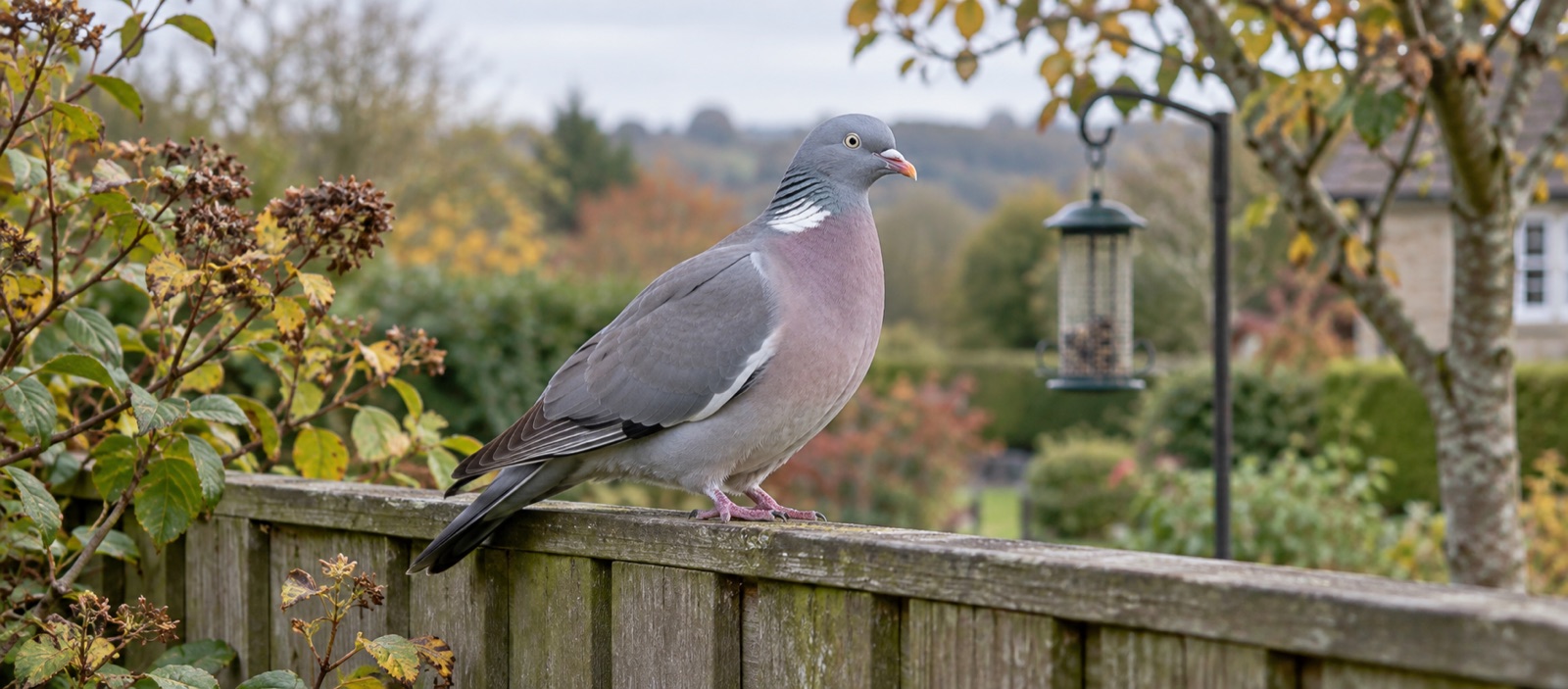
To stop pigeons dominating bird feeders, remove the easy meals first: open trays, exposed seed ports and food spilled underneath. Offer a small winter seed portion inside a suitable guarded feeder, then watch whether pigeons can still reach it. A cage can limit access, but no design guarantees that every pigeon will stay out.
The aim is to give smaller birds a fair opportunity, not to drive every larger bird out of the garden. If your main problem is a table rather than a hanging feeder, use the separate bird-table pigeon guide.
Find out where the pigeons are getting food
Watch from indoors before changing the setup. A pigeon sitting nearby is not necessarily taking food from the feeder: it may be eating the seed dropped by finches, or using a broad ring beneath the ports.
| What you see | Likely access route | Change to try |
|---|---|---|
| Pigeons standing on a dish | An open feeding surface | Remove the food dish and use a contained hanging format |
| A bird balancing beside the ports | An accessible perch or support | Compare a proper outer guardian rather than alter the original perch |
| Pigeons feeding below the station | Dropped seed and stale leftovers | Reduce the portion and clear spills |
| A bird reaching through a cage | Food too close to the outer mesh | Check the feeder's actual layout; do not shrink mesh yourself |
| Pigeons feeding from another hook | A second unguarded food source | Review every feeder on the station, not just the new one |
Notice whether the visitors are woodpigeons, feral pigeons or collared doves. Size and reach vary, so success with one visitor does not establish a reliable exclusion rule for the others.
Remove the buffet beneath the feeder
Replacing the hanging feeder achieves little if a fresh pile of seed appears below it each morning. Start with less food, check what is falling, and remove leftovers before topping up.
A feeder may spill because the mix is unsuitable for its ports, because birds sort through ingredients, or because wind shakes it. Fix the cause instead of adding a flat catch tray: the RSPB's September 2026 feeding advice advises against tables and other flat feeding surfaces.
Our cleaning-under-feeders guide covers paving and planted ground. Do not sweep dry droppings into the air or leave wet waste in a corner where other wildlife can reach it.
For a useful check, inspect beneath the feeder immediately after a busy visit. If pigeons arrive only once the small birds have finished, the spilled food—not the cage—is probably the first thing to address.
Choose a guard around the actual feeding ports
The useful feature is separation between the outer cage and the food, not the word “proof” in a listing. A pigeon that cannot enter may still stretch its neck towards a port.
The RSPB guarded seed feeder is an option when an exposed tube is too accessible. The Supa caged seed feeder provides another enclosed format with a flip-top lid. Compare those exact products in the cards below; both still need inspection and cleaning.
Do not use the Supa's overall 26cm height or 17cm width as a measurement of its cage openings. They describe the whole feeder, not the space a bird must pass through. If the supplier does not state the opening dimensions, do not invent a species-fit promise.
For a broader shortlist, see our pigeon-resistant feeder comparison. If a bird is getting food from the outside, choose a different complete design rather than bend wires, add loose netting or attach improvised hanging strings.
Set up a fair small-bird feeding position
Hang the guarded feeder securely, away from adjacent supports that offer convenient access to its ports. Keep a clear view around it and somewhere birds can retreat without placing the feeder directly in a concealed cat waiting spot.
Give smaller visitors time to investigate. Removing familiar open food and adding an unfamiliar cage may make the station quieter at first; that is not a reason to spread extra seed on the ground.
Check the result over several ordinary feeding visits. Are smaller birds entering comfortably? Does the guard swing excessively? Are pigeons simply reaching another feeder? Adjust one issue at a time so you can tell what helped.
A cage can also exclude birds you hoped to feed. Use our large-bird access guide to weigh that trade-off rather than assume smaller always means better.
Keep portions and the season in proportion
Seed feeders are a winter choice under current RSPB guidance: pause seeds and peanuts from 1 May to 31 October. See the winter-feeding routine before restarting in November.
Fill only for the birds that actually use the guarded position. A large reservoir left partly full is not a success if food ages at the bottom. Check moisture, empty rather than endlessly top up, and dismantle the guard as well as the inner tube when cleaning.
There is no need to create a separate pigeon feeding station to compensate. That can make the original problem bigger and leave more uneaten food around the garden.
Avoid harmful or entangling deterrents
Do not use poison, glue, sticky gels, exposed sharp points or loose netting around feeding birds. Do not disturb an occupied nest because a pigeon visits your garden.
Wild-bird protection guidance for England explains the restrictions on harming birds and active nests. A bird eating your purchased seed is not, by itself, permission to take harmful action.
Common questions
Will a squirrel-proof feeder stop pigeons?
Sometimes a guard or weight-sensitive mechanism also limits pigeon access, but squirrel resistance is not a guarantee about every bird. Check where the pigeon stands and whether it can reach the food without activating the mechanism.
Should I remove the perches?
Do not alter a feeder against its instructions. Removing or cutting fittings can leave sharp edges or make it harder for intended birds to feed. Choose a suitable complete guarded feeder instead.
Why are pigeons still visiting after I changed feeders?
They may be taking spilled food, using another unguarded feeder, or simply resting nearby. Judge success by access to the food and the condition of the feeding area, not by whether every pigeon disappears.
Helpful products
Guarded options for winter seed
Choose by cage layout and cleaning access, not an absolute pigeon-proof promise. Use a small seed portion only in the appropriate season.
Guarded seed ports
RSPB caged seed feeder
An easy-clean seed feeder enclosed by a metal guardian that limits physical access to the feeding ports.
Useful when pigeons can sit beside exposed seed ports. The guardian limits access; birds may still reach from outside, and all cage joints need cleaning.
Simple steel cage
Supa caged seed feeder
A powder-coated steel cage around a seed tube, with a flip-top lid and stated overall dimensions of about 26 by 17 by 17cm.
A straightforward steel-cage alternative for a small hanging seed position. Overall dimensions do not establish the mesh openings or guarantee pigeon exclusion.