Practical feeding advice
What is emptying my bird feeder at night?
Check overnight feeder loss without guessing the animal: timing, damaged fittings, rodents, removing food access and optional camera footage.
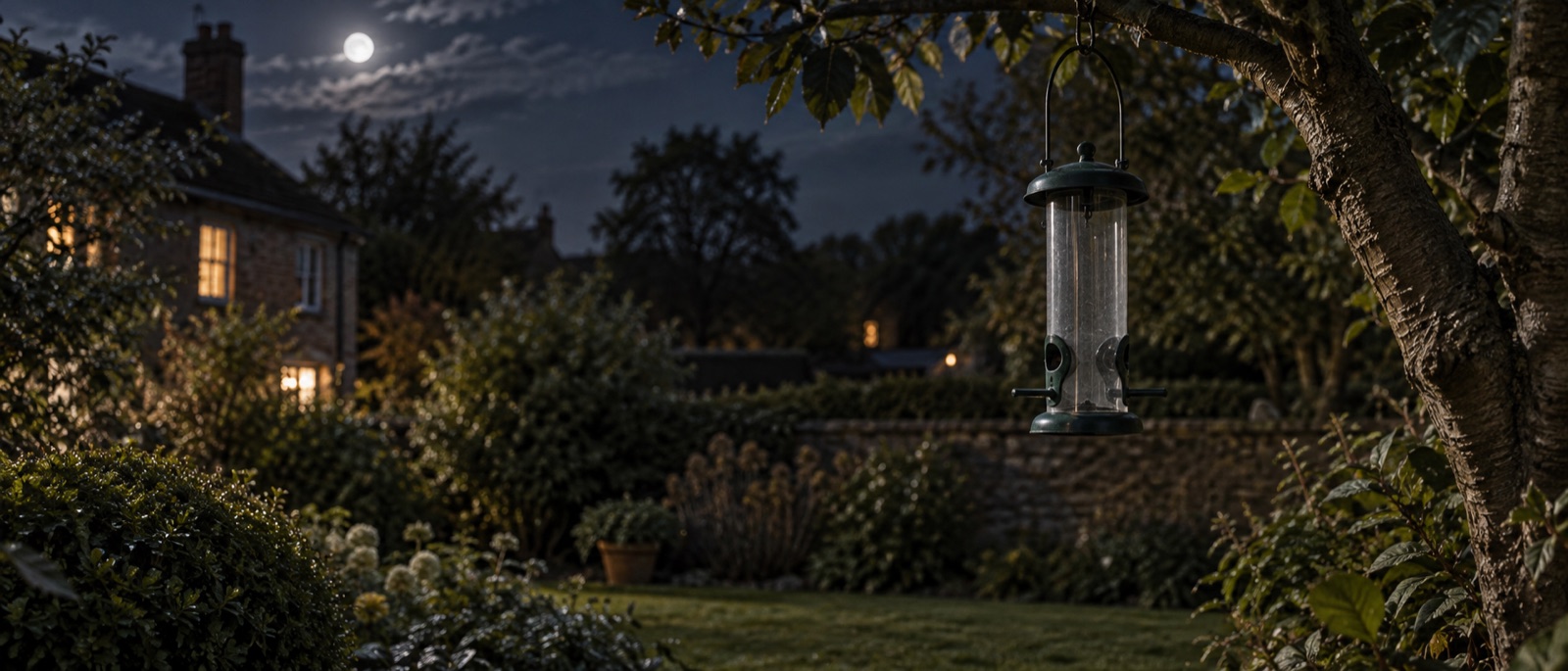
A feeder empty at night may have been visited by mice or rats, emptied at dusk or dawn, or lost food through damage and wind. The empty tube alone cannot identify the cause. Check it before dusk and again before sunrise, remove overnight food access, and use a camera only if the route remains unclear.
Do not assume squirrels are responsible simply because you see them in the garden by day. Establish when the loss happens before choosing a deterrent.
Is it really happening in darkness?
A feeder filled in late afternoon and found empty after breakfast has not necessarily been emptied at night. Birds may have fed before roosting or returned before you looked outside.
Note the food level just before dusk and check early enough to distinguish overnight loss from morning visits. A quick photograph from a safe distance can help you compare levels without standing beside the feeder.
Check the ground and equipment too. A loose base, open lid or damaged port can let food fall out. Wind can shake a feeder or expose a fault, leaving a pile of seed that animals eat later. Fix the fault rather than buying a predator deterrent.
Clues worth checking
| What you find | Possible explanation—not proof | Next check |
|---|---|---|
| Food falls while the feeder sways | Loose fittings, damage or unsuitable ports | Empty and inspect the feeder |
| Gnawed fittings and overnight loss | A climbing animal reaching food | Watch or record the actual route |
| Disturbance and food loss near ground level | Rodents or another ground visitor | Remove access and inspect safely |
| An empty feeder only after sunrise | Early bird visits | Compare the level before birds begin feeding |
| A moved or fallen feeder | Unstable support or an animal pulling it | Check fastening, pole stability and footage |
| No damage and no obvious signs | A visitor you have not seen, or missed timing | Avoid identifying a species by guesswork |
Do not handle droppings bare-handed or use their shape as your only identification method. Keep children and pets away from suspicious contaminated areas.
Remove overnight food access first
Bring accessible feeders in before dusk if nocturnal theft is recurring. Put them in a dedicated washable area separate from kitchen surfaces and fresh stored food. Check condition before hanging them again; old or wet seed should not be saved simply because the feeder spent the night indoors.
Clear edible spills outside as well. Removing the tube but leaving a heap underneath still leaves a meal. Secure the main food supply in a dry indoor location, with lids closed and damaged packaging removed.
For the next refill, use a modest amount suited to daytime turnover. The RSPB’s current advice limits seeds and peanuts to November–April and avoids flat feeding surfaces. Do not add a ground dish to distract an overnight visitor.
Could it be mice or rats?
Both need considering where food remains accessible. Small animals can reach places that appear difficult from human height, so an elevated feeder is not proof against access.
If you see repeated rat activity, stop putting food out and deal with the broader source of attraction. Review waste bins, stored bird food, pet food and spills; seek competent pest advice for a persistent problem rather than relying on a new feeder.
Use our rat-prevention guide for that response and the mouse guide for storage and access checks. Avoid poisons or traps placed around feeding birds, and do not leave extra food outside to “test” whether the animals return.
When a trail camera is useful
A camera can show the animal, timing and route rather than just the result. Aim at both the feeder and its approach, keeping neighbouring windows, gardens and public paths out of the view.
Test framing in daylight with the feeder empty. Check that the clock is correct and that a moving branch will not trigger recordings continuously. A camera that misses the relevant height or leaves its batteries flat is not evidence that nothing visited.
The MAXDONE camera listed here is a battery-powered motion camera with infrared night recording. Its listing specifies 850nm low-glow infrared, not invisible no-glow illumination. It requires batteries and access to stored recordings; do not assume it will provide live phone alerts or capture every small animal.
Compare formats in wildlife cameras for garden birds. An existing suitable camera may be enough. You do not need to buy one before removing a food source or addressing a visible rat problem.
What a baffle can—and cannot—solve
A pole baffle may help where the recorded route is climbing from below. It will not stop an animal arriving from a neighbouring fence or branch, and “squirrel-proof” does not automatically mean mouse-proof or rat-proof.
Confirm collar fit, clearance and the manufacturer’s instructions. Keep mechanisms clean and remove damaged equipment. Do not wrap supports with sticky materials or sharp wire.
Treat any hardware change as a response to a route you have seen, not a substitute for reducing edible waste. The guard and baffle guide explains the different jobs these products do.
Keep morning refills separate from used equipment
The DEAYOU pour container holds a small indoor supply and can make controlled refills easier. Its plastic body is not rat-proof. Keep it inside a secure building and do not tip used seed from an outdoor feeder back into it.
Wash equipment separately from household utensils. Clear contaminated debris carefully and use the feeder-cleaning routine before restarting with suitable fresh food.
Frequently asked questions
Do garden birds normally empty feeders in the middle of the night?
Most familiar garden feeder visitors feed by day. Dusk and dawn can confuse the timing, so check the actual period of loss rather than assuming a nocturnal bird is responsible.
Will a squirrel-proof feeder stop mice?
Not necessarily. Weight mechanisms and access openings differ; a small animal may not activate a mechanism intended for a heavier visitor.
Should I leave food out so a camera catches the culprit?
Do not create an extra food source, especially where rodents are suspected. Record existing approach routes while keeping food access removed.
What if the camera shows nothing?
Check framing, batteries, storage, clock and trigger behaviour. Missing footage does not establish that no animal visited.
Helpful products
Tools for watching the route and managing refills
You do not need a camera to remove overnight food access. If the cause remains unclear, recorded footage is more useful than guessing from an empty feeder.
Record the approach
MAXDONE 4K 60MP wildlife camera
A motion-activated trail camera with a screen, supplied 32GB card and infrared night recording.
An optional battery-powered motion camera for seeing the feeder and approach route. The listing specifies 850nm low-glow infrared—not invisible no-glow—and footage is not guaranteed to capture every visitor.
Keep refills indoors
DEAYOU 2.8L bird-seed pour container
A 2.8L clear plastic dry-food container with a three-sided locking lid, silicone seal, handle, measuring cup and pour spout.
Small indoor refill storage for the morning, not a rat-proof container. Keep removed equipment in a separate washable place, never pour used seed into this container.