Bird food guide
Live vs dried mealworms for birds
Compare live and dried mealworms for garden birds: moisture, storage, soaking, portion sizes and appropriate ways to offer insect food.
Our recommendations
Two manageable dried-mealworm options
Both products below are dried food. Their pack sizes offer different storage and comparison advantages.
Supa dried mealworms (1L tub)
Dried mealworms in a reusable one-litre bucket, sized for smaller portions and straightforward storage.
Best small reusable tub. Drawback: the listing states volume rather than net weight, so price-per-weight comparisons are limited.
RSPB dried mealworms (500g)
A 500g pack of dried mealworms in a resealable pouch, offering a clear weight for comparison and portion planning.
Best clearly weighed mid-size pack. Drawback: the pouch is less rigid than a tub and still needs protection from moisture and pests.
For a first purchase, a modest dried pack is usually the simpler option. Live food makes sense when you can follow the supplier's care instructions and use it promptly.
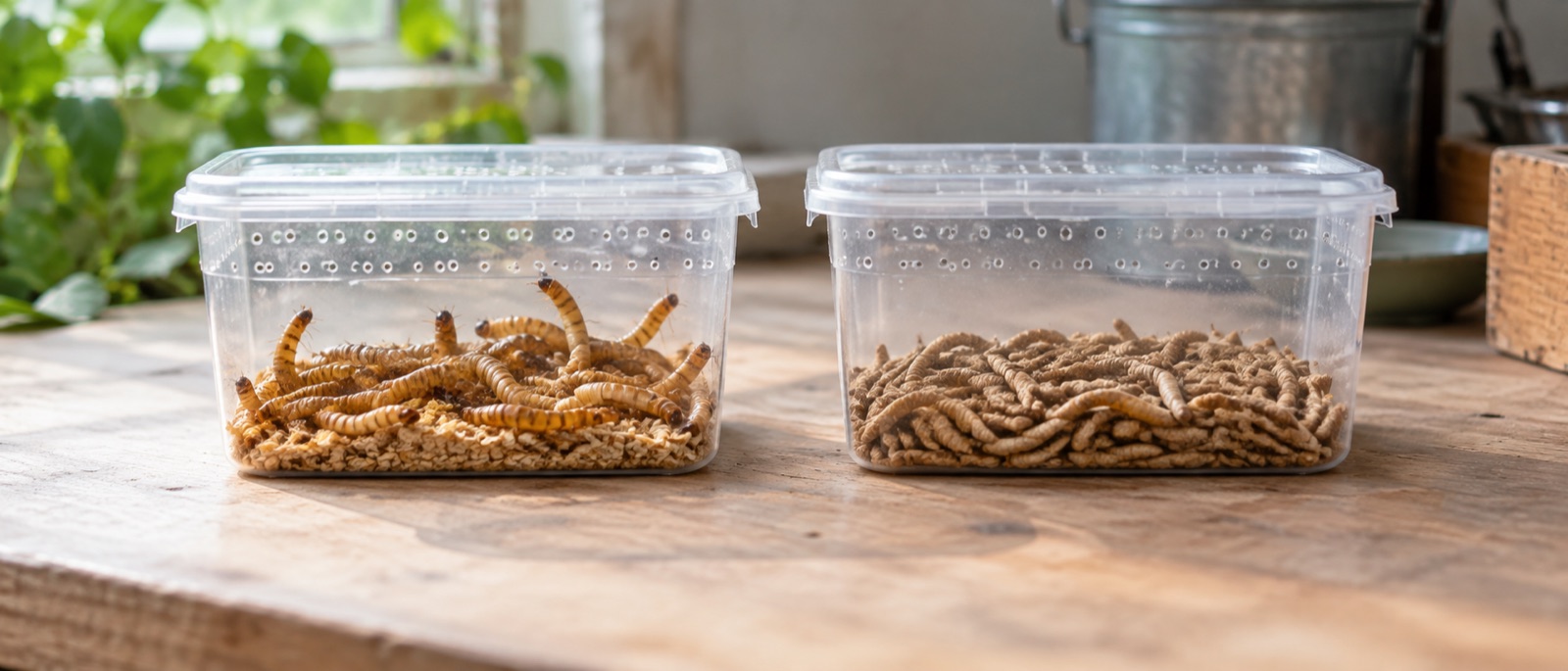
Live and dried mealworms compared
| Practical point | Live mealworms | Dried mealworms |
|---|---|---|
| Moisture | Naturally moist | Dry until soaked |
| Appeal | Movement can attract attention | Birds may need time to recognise them |
| Storage | Living insects need supplier-directed care and ventilation | Keep dry, sealed and away from pests |
| Portioning | Buy an amount you can look after and use | Take out a small dry portion as needed |
| Once offered | Remove uneaten food by dusk | Remove uneaten food by dusk, especially after soaking |
The RSPB's mealworm comparison supports both options. Its practical distinction is convenience, moisture and appeal, not a claim that dried food becomes nutritionally worthless.
Which birds are you feeding?
Robins, blackbirds, starlings and tits are among the visitors that may take mealworms. A packed feeder of sunflower seed and an insect-eating robin on the lawn are two different situations; buying a new seed mix does not solve both.
Consider access before quantity. A blackbird that never clings to a mesh tube cannot benefit from its contents just because the packet names blackbirds. A robin may learn a feeding route, but you should not create a permanent shared dish to achieve that. See the robin and blackbird pages for species-specific context.
Mealworms complement natural foraging. Leaf litter, insect-rich planting and undisturbed soil remain important, particularly for birds that do not readily use hanging equipment.
Buying live mealworms
Choose a reputable live-food supplier with clear instructions about delivery, storage and how long to keep the insects. Check whether the offer is measured by weight or count; neither converts reliably into the other without the supplier's own information.
Buy the smallest useful quantity first. You are looking after living beetle larvae, not storing dried food. Do not seal them in an airtight seed jar or assume a general household fridge setting is suitable: follow the supplier's temperature and ventilation instructions.
Keep containers secure, away from food preparation, children and pets. Inspect the delivery promptly and ask the supplier about damaged packaging or dead insects rather than offering a deteriorating batch.
Choosing a dried pack
The Supa one-litre tub is convenient for modest portions and a lid you can close easily. Its limitation is that litres describe volume, not a verified net weight. Do not rank it against a 500g pouch by an invented grams-per-litre conversion.
The RSPB 500g pouch gives a clear weight and resealable packaging. It is useful for someone who wants to track roughly how much is used over several weeks. Keep the pouch dry and protect it from pests; a resealable seal is not rodent-proof armour.
Both shortlisted products are dried mealworms. Neither is a live-food substitute in its packaging or handling. The fuller dried-mealworm buying guide compares an additional bulk option.
Should you soak dried mealworms?
Yes during spring and summer: current RSPB advice recommends soaking before offering them so they are softer and more moisture-rich. Prepare only the immediate portion in a clean container using fresh water.
Drain before offering. Once rehydrated, treat them as perishable food, not as something you can put back in the dry pouch for tomorrow. Discard any surplus or uneaten portion. There is no reason to soak an entire bag to save a minute at the next refill.
Do not make a slurry of stale worms, seed and cooking fat. Different foods have different storage and feeder needs, and mixing them makes leftovers harder to inspect.
Offer small portions without a shared tray
RSPB advice permits small scattered mealworm amounts, but its newer disease guidance rejects flat-surface feeders. Those points are not an invitation to leave a concentrated feeding carpet or a dish that is repeatedly topped up. Keep any dispersed provision brief, avoid cat ambush points, change location and remove leftovers by dusk.
If using a feeder, check that it is genuinely compatible with the food and does not have a broad trough or inner dish. Many products sold as “mealworm feeders” do. Our mealworm-feeder guide explains the design checks rather than assuming every species-marketed product is appropriate.
Seasonal choices and hygiene
Small mealworm portions can continue during the May–October seed pause, but mixing them into seed does not make that seed suitable for the paused season. Use seasonal food advice when planning the whole setup.
Wash your hands after handling food and equipment. Use separate outdoor cleaning tools, dry feeders before use and stop feeding if illness appears. BTO hygiene guidance explains how to respond to sick birds.
Frequently asked questions
Are mealworms actually worms?
No. They are beetle larvae. Wild-bird food commonly uses yellow mealworm larvae, not earthworms collected from the garden.
Can I switch from live to dried mealworms?
You can try, but birds may not recognise the dried food immediately. Offer a small fresh portion and judge actual use rather than increasing the amount.
Are mealworms enough for nesting birds?
No single supplementary food replaces a varied natural diet. Provide insect-rich habitat and avoid interfering with nests or feeding chicks yourself.