Practical feeding advice
What to do when a sparrowhawk visits your feeder
Understand a sparrowhawk visit, improve feeder sightlines and crowding, and know when to pause without harming a natural predator.
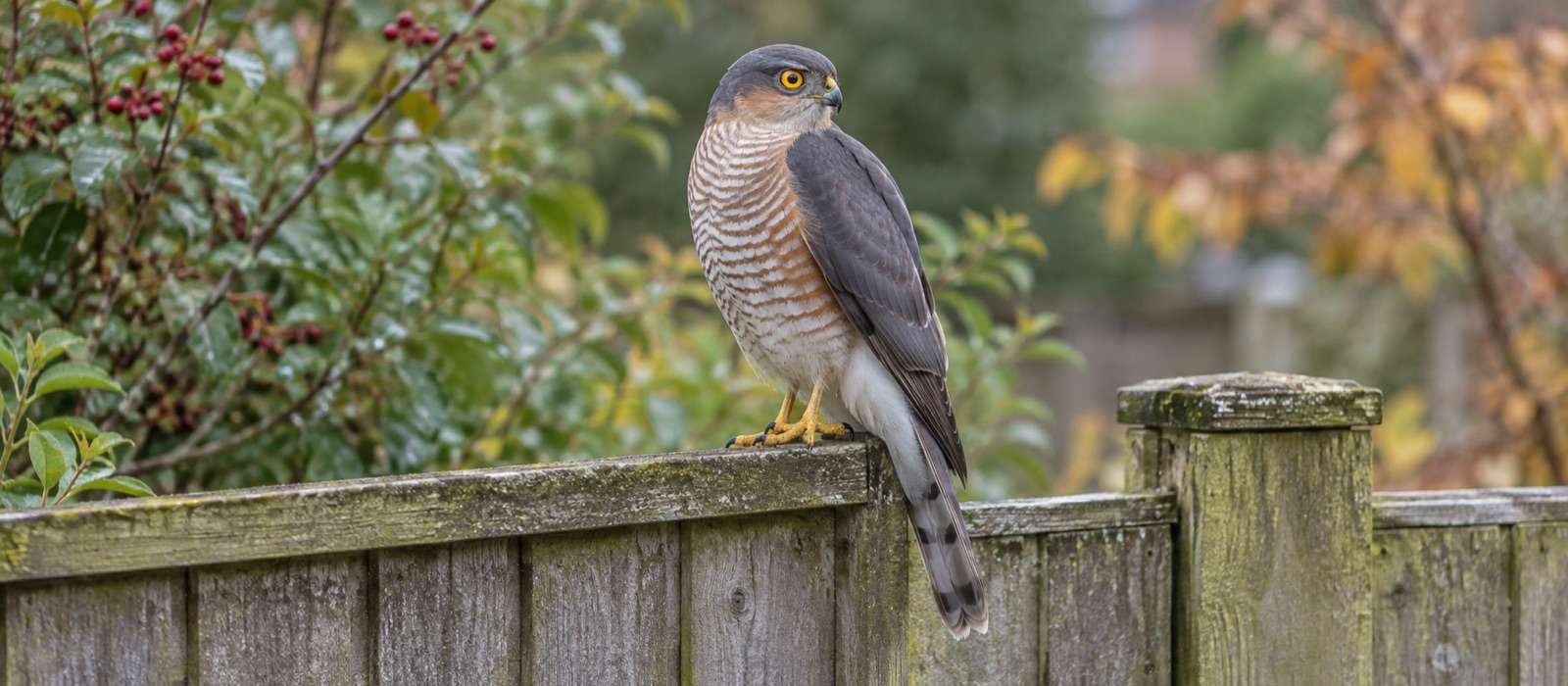
If a sparrowhawk visits your bird feeder, watch quietly and let it leave naturally. Sparrowhawks are native predators, not a feeder fault to eliminate. Review whether your setup creates a crowded, exposed feeding point, with poor escape routes or hidden approaches. You can improve the position or pause feeding, but no accessory guarantees protection from a flying predator.
Seeing a hunt can be upsetting, especially when you recognise the birds that visit every morning. The useful response is to make your purchased feeding manageable without trying to remove a wild predator from the garden.
First, check that it really is a sparrowhawk
A long tail, relatively short rounded wings and a fast dash through cover are useful clues. Adult males have blue-grey upperparts and orange-brown barring underneath; females and young birds are browner, and females are larger.
The RSPB's sparrowhawk identification guide explains its appearance and garden-hunting behaviour. A bird of prey circling overhead is not necessarily a sparrowhawk, and a brief glimpse does not establish which visitor caused birds to scatter.
Do not approach for a closer look. Observe from indoors, and use a photograph taken without disturbance if you want help identifying it. A bird resting on a fence may move on without any change to your setup.
What to do during a visit
| Situation | Sensible response | What not to do |
|---|---|---|
| Hawk resting or watching the garden | Keep your distance and let it leave | Chase it, throw objects or try to catch it |
| Small birds scatter with alarm calls | Allow them to retreat naturally | Flush them from cover to inspect what happened |
| A hunt is underway | Avoid intervening or adding disturbance | Release pets or use noise to pursue the hawk |
| Visits repeatedly use the same concealed approach | Review feeder position and crowding | Stretch strings or netting across the flight route |
| Bird of prey appears injured or trapped | Contact an appropriate rescue professional | Handle its bill or talons yourself |
Keep children and pets back. You do not need to stand guard each time birds visit, and repeated attempts to scare one animal can disturb the smaller birds you are trying to help.
Check the feeding point, not just the hawk's perch
Look at how birds approach, feed and leave. A crowded line of feeders can concentrate activity in a small area, while a fixed hook beside a building or thick growth may give a predator a concealed approach.
Good sightlines and usable escape cover are more helpful than hanging food in either a completely bare area or an impenetrable shrub. Do not try to turn the garden into a predator-free enclosure.
RSPB placement guidance recommends visibility around feeding birds while retaining cover they can reach. Our station-placement guide looks at that balance alongside cats, wind and maintenance.
Check glass and fencing too. A startled bird should not have to fly towards an obvious reflective window to get away. Move the feeding position if the current route repeatedly funnels birds into an obstacle.
Moving the feeder may be enough hardware change
If a fixed branch or wall hook makes a poor feeding position, a freestanding pole offers flexibility. Honeyfield's two-hook metal station can support a simpler arrangement away from the old attachment point.
It is optional positioning hardware, not an anti-sparrowhawk product. It will not stop a flying hawk reaching the garden, and moving it without improving the surroundings may change very little.
Install any pole securely and keep the load manageable. A position you can reach for cleaning is more useful than an awkward tall setup that gets neglected.
If the existing feeder can be rehung safely in a better position, try that before buying a pole. Do not add a cage solely because it is advertised as predator-resistant: approaching birds remain outside it, and poorly improvised barriers can create new risks.
Reduce crowding rather than keep adding food
Use a small quantity matched to observed demand. If the reservoir empties, that does not require immediate repeated refills throughout the day. Our quantity guide explains how to judge portions without leaving old food underneath.
Follow current seasonal advice: pause seed and peanuts from 1 May to 31 October, and restart modestly rather than create a winter buffet. The September RSPB update also stresses cleaning and avoiding flat feeding surfaces.
A quieter station may still receive a sparrowhawk visit. That is not evidence that the change failed: the goal is a sensible feeding arrangement, not a promise that natural predation disappears.
Supporting natural food and shelter elsewhere in the garden can reduce your emphasis on a single purchased feeding point. Keep occupied nests and wildlife habitat undisturbed while making changes.
When pausing feeding makes sense
You can pause if repeated visits make you uncomfortable or if you cannot find a position you can maintain safely. Remove the purchased food, clear leftovers and reconsider the arrangement before restarting.
There is no dependable number of days that guarantees a sparrowhawk will leave permanently. It ranges beyond one feeder, and a quiet interval is not proof that it has gone.
Keep this separate from a disease pause. Sick birds, spoiled food or a rat problem need their own response, not an assumption that the hawk will resolve them.
Cats are also a different situation: a domestic cat regularly waiting beside food calls for practical pet management and siting changes. See protecting feeding birds from cats rather than apply the same response to every predator.
Do not trap, poison or entangle a bird of prey
Do not use traps, poisons, sticky substances, fishing line or loose netting to block flight routes. Do not disturb an active nest or attempt to relocate a healthy wild sparrowhawk.
Wild-bird protection guidance for England explains the legal restrictions; visiting your feeder is not a licence to harm a bird.
For an injured bird of prey, contact a wildlife rehabilitator or the relevant animal-welfare service. The RSPCA's wildlife advice treats birds of prey as animals needing specialist handling, not something to pick up casually.
Questions people ask after a visit
Has my feeder caused sparrowhawks to move into the area?
One visit cannot establish that. Gardens are part of their hunting habitat, and a concentrated food source may be one place they investigate. Look at the setup you control rather than infer a population change.
Will a plastic owl or reflective tape keep one away?
Do not expect a lasting guarantee from a scare device. It can also disturb visiting birds. Thoughtful positioning and a manageable feeding routine are the better starting point.
Should I put food out for the sparrowhawk?
No. Do not offer raw meat, live prey or a separate feeding lure. Let a healthy wild bird forage naturally.
Helpful products
Optional hardware if the position needs changing
A pole can free you from a poorly placed branch or wall hook. It is not a hawk deterrent, and moving an existing feeder may be enough.
Move the feeding position
Honeyfield's heavy-duty feeding station
A powder-coated metal feeding station with a 20mm tube, two hanging hooks and a stability plate for the ground spike.
An optional way to relocate feeders when a fixed branch gives poor sightlines. This is positioning hardware, not a sparrowhawk deterrent or a guarantee against predation.