Practical feeding advice
How to protect feeding birds from cats
Choose a safer feeding position, remove ground spills and manage cat access without relying on a supposedly cat-proof feeder.
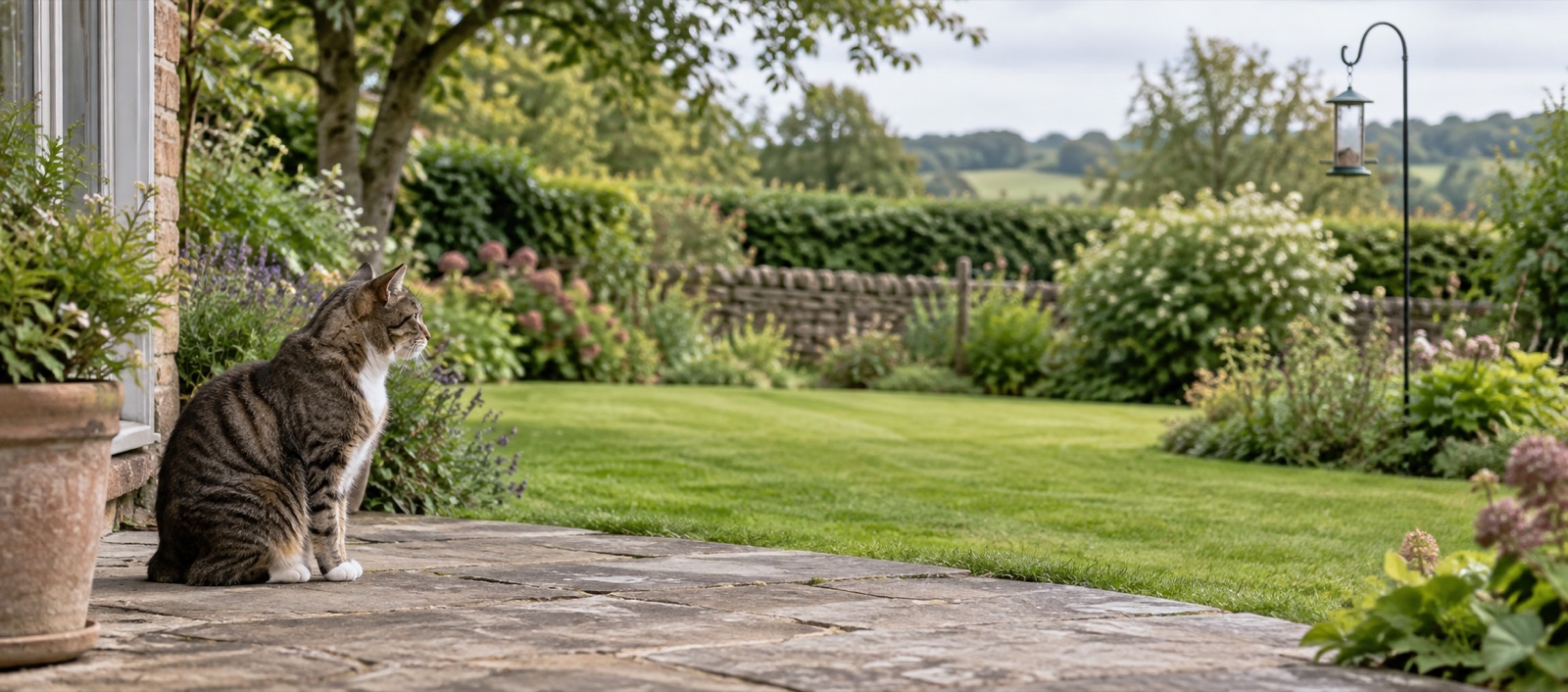
To protect feeding birds from cats, place contained hanging feeders away from climbable fences, walls and branches, with clear sightlines and nearby escape cover. Remove spilled food that draws birds to the ground. If a cat repeatedly waits beneath the feeder or reaches it, pause feeding while you change the position; no feeder is reliably cat-proof.
A high feeder is only part of the answer. What matters is the route a cat can use and where birds land before, during and after a visit.
Look at the feeding position from ground level
Walk around the station without birds present. Look for concealed waiting places and raised surfaces beside it, including bins, garden furniture and low roofs.
| Risk at the position | Why it matters | Better approach |
|---|---|---|
| Hook beside a fence or wall | A cat may approach from a raised surface | Move to a position without that launch point |
| Low feeder over scattered food | Birds spend time within ground-level reach | Use contained hanging food and remove spills |
| Dense growth immediately underneath | A waiting cat is hard to see | Choose a more open feeding position |
| No escape cover anywhere nearby | Birds have little refuge after alarm calls | Retain useful cover without placing food inside an ambush spot |
| Repeated stalking despite changes | The site remains unsuitable | Pause feeding and reassess, rather than keep topping up |
Do not take a single quiet afternoon as proof that a location is safe. Check at the times cats and birds normally use the garden. If you cannot see the area from indoors, it is harder to notice a recurring problem.
Separate escape cover from a cat's hiding place
Birds benefit from somewhere to retreat, but a feeder pressed into a thick shrub can hide a predator just below it. Aim for an open approach and view around the food, with useful cover nearby rather than directly enclosing the feeder.
There is no universal height or clearance that guarantees protection in every garden. A feeder high above a lawn may still be reachable from the shed roof next to it. Measure the whole arrangement, not just the distance to the ground.
Current RSPB feeder-placement advice balances visibility and escape cover. Our feeding-station placement guide helps apply those principles to hooks, poles and access for cleaning.
Do not remove every shrub to create an empty garden. Move the feeding point instead, and retain habitat away from the immediate waiting route. Check for active nests before any pruning.
When a freestanding pole is useful
A metal feeding pole can let you move food away from a tree trunk, fence or fixed wall hook. Honeyfield's two-hook station is a straightforward option with a 20mm tube and supplied stability plate.
Its value here is positioning flexibility, not a cat-proof claim. Install it in suitable firm ground, keep loads balanced and inspect it after wind. A pole that leans or tips can bring the food within easier reach and make cleaning awkward.
Our pole stability guide covers that separate job. Follow the product's own installation instructions rather than assume a stability plate makes all soil suitable.
Do not add grease, oil, sticky gels or sharp barriers to the pole. A squirrel baffle is not automatically a validated cat barrier, and a guarded feeder does not make the birds approaching it safe from attack.
Stop spilled food creating a second feeding point
Even a well-positioned hanging feeder can draw birds down if food falls underneath. Watch where visitors collect after leaving the ports and clear the food they are following.
Reducing the refill quantity, checking food-to-port fit and moving away from an unstable hook may help. Our pigeon feeder guide also explains why ground spills can defeat changes to the feeder above.
Do not scatter seed as an alternative, or fit a flat food tray to solve the mess. The RSPB's September 2026 guidance advises against flat feeding surfaces and pauses seeds and peanuts from May through October.
Water deserves the same siting check. A bird bath that is regularly watched by a cat may need moving or taking out of use while you find a better position.
If the cat belongs to you—or a neighbour
For your own cat, consider keeping it indoors around busy bird-feeding periods, alongside appropriate play and enrichment. Discuss any change in routine or diet with your vet if needed; do not assume a well-fed cat never hunts.
Cats Protection's indoor-and-outdoor guide discusses feeder placement away from launch surfaces and reducing hunting opportunities. An enclosed outdoor space, where suitable, can separate your cat's garden access from the birds.
If a neighbour's cat is visiting, explain the observed route calmly and ask whether a practical timing change is possible. You cannot control every visit, so keep your own feeding arrangement safe independently of that conversation.
Cats Protection's humane deterrent advice is a better starting point than home-made chemical mixtures. Do not harm, frighten aggressively or trap a visiting cat. A deterrent's sales claim is not a guarantee that birds are protected.
What to do if a cat catches a bird
Keep pets away and contact a vet or wildlife rehabilitator promptly for instructions. A bird caught by a cat needs treatment even if it has no obvious wound: the RSPCA's injured-bird advice highlights the infection risk.
Do not simply release it because it can flutter or appears to recover. Follow current handling precautions, including the RSPCA's bird-flu warning, rather than picking up a sick bird unprotected.
Do not force food or water into its beak or attempt home medication. If you cannot transport it safely, ask the professional how to proceed. A healthy fledgling on the ground is a different situation: keep cats away and seek advice before assuming it needs rescuing.
Common questions
Will a caged feeder protect birds from cats?
A cage mainly changes access to food. It does not protect a bird landing nearby or collecting spills underneath. Position, ground-food removal and cat management remain the important measures.
Should I stop feeding if cats regularly hunt there?
Yes, pause while you remove the risky feeding arrangement and reassess the location. Continuing to attract birds to a known waiting spot is not a sensible solution.
Are ultrasonic deterrents enough?
Do not rely on a device as your only protection. Its effect depends on the product and situation, and a visiting cat can still approach from outside its coverage. Fix the feeder position and routine first.
Helpful products
Optional hardware for a better position
Use a pole only if it improves the position. It does not replace safe siting, spill control or managing repeated cat visits.
Freestanding position
Honeyfield's heavy-duty feeding station
A powder-coated metal feeding station with a 20mm tube, two hanging hooks and a stability plate for the ground spike.
Useful for moving hanging feeders away from a climbable tree or fence. A pole is not cat-proof: site it carefully, install it securely and check actual reach.