
Practical advice
Wooden vs woodcrete nest boxes: which should you choose?
Compare timber and woodcrete bird boxes for insulation, durability, weight, cost and practical mounting in a UK garden.
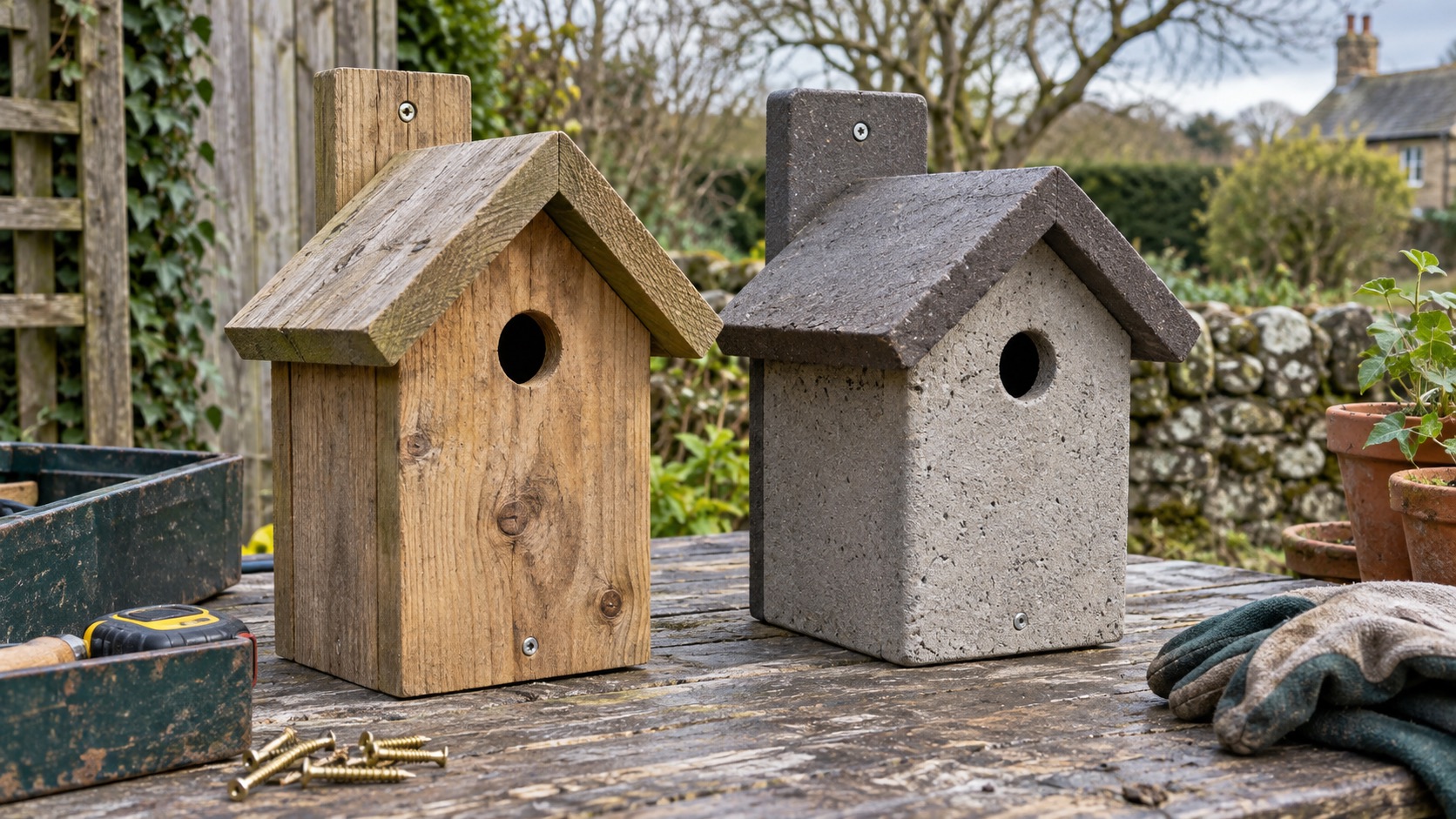
Wooden and woodcrete nest boxes can both provide useful insulated cavities for UK garden birds. The better choice is the one with the right entrance and chamber for your target species, a safe position and a fixing you can maintain. A thick timber box may outperform a poorly positioned woodcrete one; material alone is not a quality score.
What is woodcrete?
Woodcrete is a mixture of wood and mineral material formed into a nest-box body. It is intended to combine insulation with durability. The BTO accepts woodcrete as an insulating option alongside wood, while cautioning against dense metal or ceramic walls that can become too hot or cold.
Not every “concrete” garden ornament is a proper woodcrete nest box. Read the manufacturer's description and check the roof, entrance, drainage and access. A specialist brand such as Schwegler offers several models, and their openings are not interchangeable.
Where does timber make sense?
Timber boxes are often lighter, easier to mount and available in more entrance styles. A flat-backed wooden box can be fixed to suitable masonry or a tree-safe support without the weight of a heavy cast body. If it is built well, timber offers useful insulation.
The BTO recommends wooden walls at least 15mm thick. Thin plywood novelty houses, split boards or a roof that lets in water are poor choices. Wood also weathers: inspect the roof, hinge, joints and fixings outside the nesting season. The CJ birch-log box is a substantial timber example, though its irregular shape needs careful mounting.
Where does woodcrete make sense?
Woodcrete is worth considering where longevity and resistance to weathering are priorities. The Schwegler 1B 32mm model is available through Amazon; RSPB also offers a 32mm Schwegler box directly. A durable fixture still needs the right entrance and chamber for the intended bird. Its heavier body is the main practical drawback.
Check the actual weight and mount it to a support rated for the load, including wind and a wet box. A flimsy fence, weak branch or improvised wire loop is not enough. Some models require their own brackets or hangers. If access is at height, use competent installation rather than balancing a heavy box on a ladder.
Which material stays warmer?
Both thick wood and purpose-made woodcrete are chosen for insulating properties, but the conditions inside depend on wall thickness, roof, shade, ventilation and exposure. Avoid a blanket claim that every woodcrete box is cooler in summer or warmer in winter than every wooden one; product construction varies.
Direct afternoon sun on a south-facing wall can overheat either type. A shaded north- or east-facing site often helps in a UK garden, but observe the location through the day. Our placement guide shows how aspect and weather exposure interact.
What should you check before buying?
Start with entrance type and size. A 25mm blue-tit box, a 28–32mm tit box, a 45mm starling box and an open robin box answer different needs. Confirm an accessible roof or front for off-season maintenance, drainage, ventilation and secure closure. Avoid a perch or sharp hardware at the entrance.
Then compare total fitted cost, not just box price. A heavier box may need special fixings or professional help. A cheaper timber box may require replacement sooner if it is poorly made or badly exposed. See nest-box hole sizes and open front versus hole entrance before comparing materials.
How should either box be maintained?
Inspect only when the box is not in use. Check for leaks, rot or cracks, a loose hinge and an insecure bracket. Do not apply paint or preservative inside. If an exterior treatment is permitted by the maker, it should be non-toxic and water-based, with enough time to dry before birds return.
Active nests, eggs and wild birds are protected; do not open a box to assess the material while nesting is underway. Follow our nest-box cleaning guidance for the appropriate timing.
Frequently asked questions
Is woodcrete always better than wood?
No. A well-built, properly sited timber box is an excellent option. Woodcrete's durability can be valuable, but its weight and fixing requirements may make it the poorer choice for some gardens.
Can I paint a wooden nest box?
Follow the manufacturer's instructions. Do not paint the interior or seal ventilation and drainage; any permitted exterior treatment should be bird-safe and fully dry before use.
Can I switch materials during the nesting season?
No. Do not replace, move or alter an active nest box. Plan any change only after you have established that no nest is in use.
Helpful products
Timber and woodcrete examples
The timber example and two woodcrete options illustrate the material trade-off. Check the current entrance variant and manufacturer's fixing instructions before choosing.
CJ Wildlife birch-log 32mm nest box
Best for: A lighter, naturally insulated box with careful maintenance
A rustic FSC birch-log box with a 32mm entrance, rain-shedding roof and solid insulating walls.
Best natural 32mm design. Drawback: the broader entrance allows more competing species and the irregular exterior needs careful mounting.
Schwegler 1B 32mm woodcrete nest box
Best for: A durable 32mm box on a strong, safe support
A cast woodcrete nest box with a 32mm entrance, supplied for small cavity-nesting birds.
An Amazon woodcrete comparison for a sturdy support. Drawback: the heavy body and exact 32mm variant must suit both your target species and fixing point.
Woodcrete example
RSPB Schwegler 32mm woodcrete nest box
Best for: A durable box where the heavier weight is safely supported
A durable insulating woodcrete box with a 32mm entrance and supplied mounting hardware for small hole-nesting birds.
Best durable general-purpose 32mm option. Drawback: it is heavier, so check the support and fixing method before installation.