Practical advice
Contains affiliate links
How to make a garden safer for birds when you have a cat
Reduce ambush opportunities with cat routines, careful water and feeder placement, and realistic expectations about deterrents.
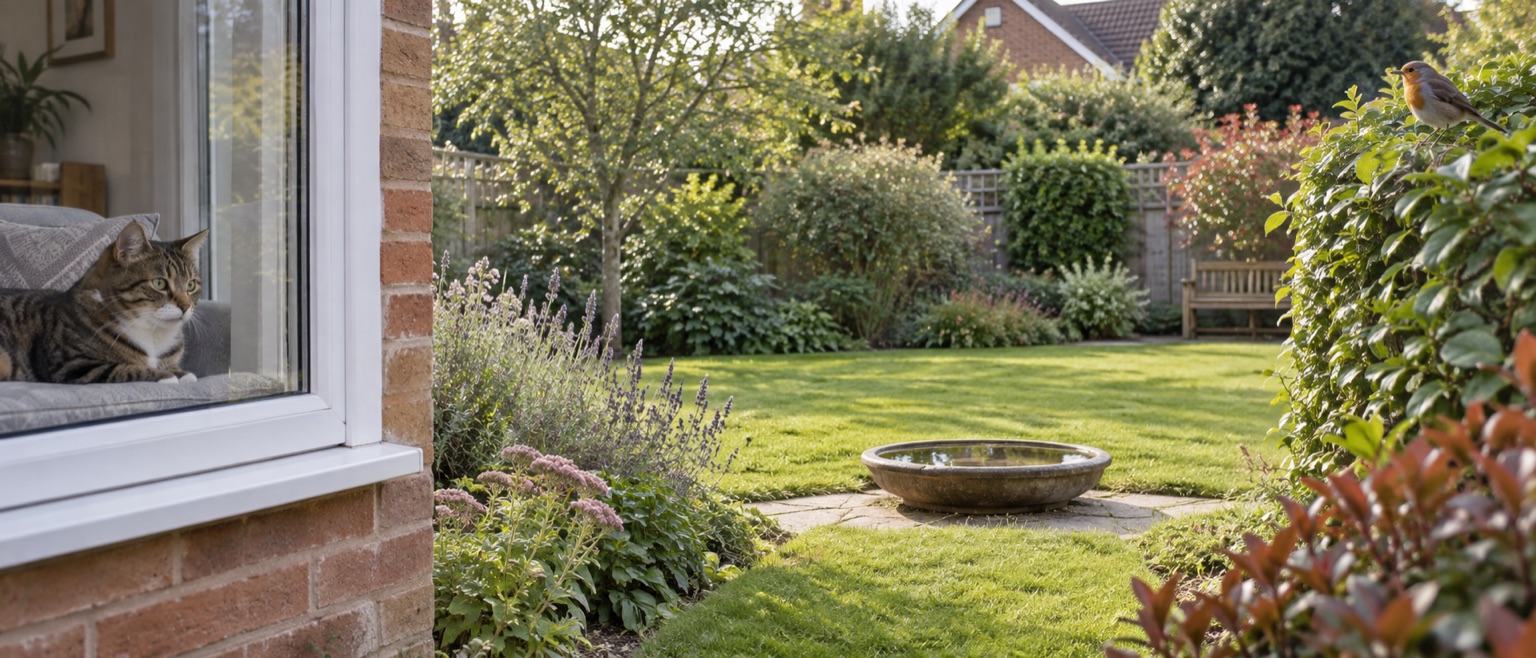
Manage your cat's outdoor time first.
Remove ambush cover immediately beside bird stops.
Keep escape routes open and review after incidents.
You cannot make an open garden completely risk-free for birds if a cat has access, but you can make it safer. The most important change is to manage the cat's access—particularly around dawn and dusk—and avoid setting up a bird bath or feeder beside dense cover a cat can use as an ambush. Buying a taller feeder while leaving the same launch point beside it is unlikely to solve the underlying problem.
Cats Protection advises keeping cats indoors at dawn and dusk as one way to protect wildlife, alongside plenty of indoor play. Its night-time cat advice also covers the cat's own safety. Every household's routine differs, but this is more directly controllable than trying to deter every cat with a device.
Start with the cat's routine
If the cat is yours, identify when it is most active outdoors and when birds use the garden. Keep it inside during those periods where practicable. Make indoor time rewarding with play, resting places and enrichment rather than treating the garden as the only source of stimulation. If a catio or secure enclosure is possible, check dimensions, access and planning or tenancy permission; do not assume a partially enclosed space is escape-proof.
For neighbours' cats, avoid confrontations or harmful deterrents. First remove food spills and obvious ambush opportunities. If a visiting cat repeatedly waits in one area, a humane deterrent may be worth discussing, but it still requires sensible positioning and realistic expectations.
Map where birds stop and where a cat could wait
| Spot | Risk to look for | Safer adjustment |
|---|---|---|
| Bird bath | Dense shrub or wall immediately at the rim | Clear view around the dish, with reachable escape cover further away |
| Hanging feeder | Fence, shed or low branch within jumping distance | Relocate to a position that cannot be launched at easily |
| Ground-feeding patch | Cover from which a cat can pounce | Avoid concentrated food on the ground; keep the area open and clean |
| Nesting hedge | Cat access from a fence or nearby structure | Reduce easy approaches without disturbing occupied nests |
Our feeder-focused cat guide goes deeper into pole and feeder siting. If you are reducing supplementary feeding altogether, natural food without feeders offers a different approach—though plants do not remove predation risk.
What about bells and collars?
Some owners use a bell, but it is not a guarantee. Cats Protection says a collar must be quick-release and any bell must not trap claws or create another hazard. Do not put a non-release collar on a cat for the sake of birds, and do not attach oversized accessories without considering cat welfare. Indoor timing and garden layout remain the primary measures.
The RSPB sells a CATwatch device for deterring visiting cats and cites a trial of its effect. We treat it as an optional additional tool, not a promise that birds are protected. Check its current directions, power requirements and position before purchase. Do not aim any deterrent at a pet's rest area or use a device contrary to the manufacturer's instructions.
Keep water and nest areas sensible
A bird bath should be easy to clean and offer birds room to see danger coming. Do not tuck a ground-level dish under an overhanging shrub because it looks sheltered. Equally, do not strip every hedge bare: birds need cover and routes through gardens. The goal is to separate safe refuge from a concealed launch point at the place birds land.
Before pruning around a nest, inspect carefully and leave any active nest untouched. The RHS notes legal protection for active nests. Observe quietly from a distance rather than repeatedly checking a nesting shrub.
Frequently asked questions
Can a deterrent make the garden safe on its own?
No. Cats may approach from a different route, and effectiveness varies. Pair any device with managed cat access and a safer layout.
Should I stop providing water if cats visit?
Not necessarily. First assess whether you can offer a dish with open sightlines and nearby—but not adjacent—escape cover. If there is no safe position, prioritise planting and revisiting the layout instead of creating a predictable ambush point.
Helpful products
Optional help with visiting cats
The RSPB's CATwatch is a supplementary measure for recurring visits by neighbouring cats. It is not a substitute for keeping your own cat indoors at higher-risk times, and its effect will vary with position and behaviour.
RSPB CATwatch cat deterrent
An optional ultrasonic device sold by the RSPB for reducing visits by neighbouring cats. It does not remove the need for good siting or safe cat management.
Only if recurring visiting cats remain a problem and the device can be placed and maintained as directed. Not a way to supervise your own cat.
Pestbye motion-activated cat repeller
A motion-activated ultrasonic unit with a ground stake for discouraging visiting cats from a particular part of the garden.
Only an optional extra where neighbouring cats visit. Requires four AA batteries, which are not included; do not rely on it instead of supervision and safer bird-bath or feeder placement.