
Bird bath guide
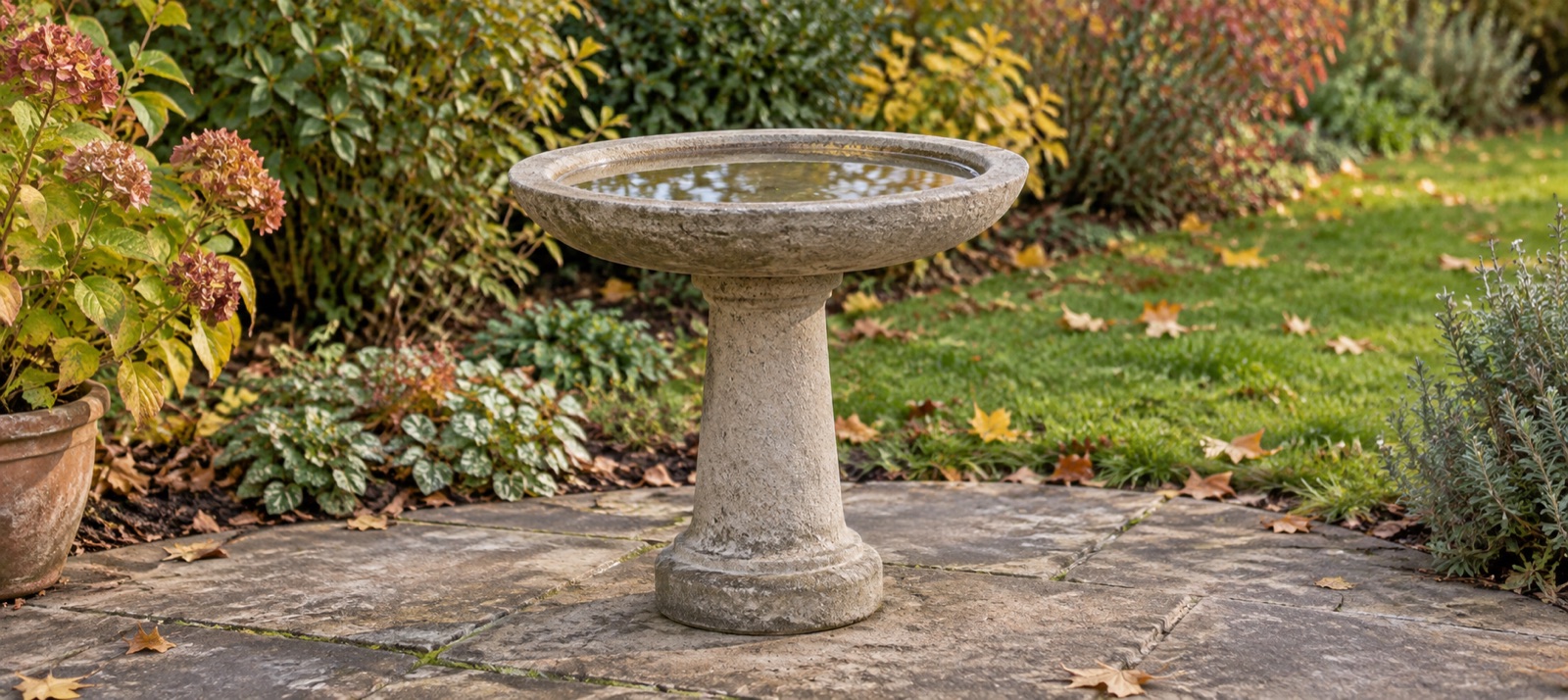
Best stone bird baths
Compare two cast-stone bird baths and understand weight, base support, bowl depth, cleaning and frost-care limits before buying.
Our recommendations
Two cast-stone options to consider
Both are cast stone. They are not carved natural-rock baths, and weight is not a substitute for proper positioning.
Defined pedestal dimensions
Primrose Selbourne cast-stone bird bath
A hand-finished cast-stone pedestal bath listed at 52cm high and 39cm wide.
For a fixed focal point on a firm level base. Cast stone is not carved natural stone, and the bowl's usable water depth needs checking.
Heavy round cast-stone bath
DGS Statues round cast-stone bird bath
A UK-produced cast-stone bath with a round bowl and a stated 23kg weight.
For a permanent position that can support a heavy bath. Plan how to empty and clean it before ordering; the listing does not establish its water depth.
A stone bird bath can become a permanent garden feature, but permanence is also its main commitment. The wrong bowl can be difficult to move, awkward to empty and surprisingly troublesome to clean.
This guide compares cast-stone products available through Amazon UK. For lighter options, see resin baths; for format rather than material, use the pedestal comparison.
Compare the practical details first
| Bath | Established listing detail | Good reason to consider it | What still needs checking |
|---|---|---|---|
| Primrose Selbourne | 52cm high; 39cm wide; cast stone | Defined size for a garden position | Bowl profile, handling and assembly instructions |
| DGS Statues round bath | Cast stone; stated 23kg weight | A heavy fixed-position option | Overall dimensions, safe emptying and water depth |
A stated weight tells you about handling. It does not establish that the base can never tip, that the bowl has suitable shallows or that the material will survive every freeze.
Primrose Selbourne: easier to size before ordering
The Selbourne gives you a useful height and width instead of relying on a styled photograph. At a listed 52cm high and 39cm wide, it is a relatively compact pedestal feature rather than a very tall column.
Its hand-finished cast-stone construction suits someone who wants the bath to stay in one considered position. Confirm how its parts are supplied and supported, and plan access to the bowl before ordering.
The bowl may look generous in a photograph, but decorative depth and useful bird access are not the same thing. Keep a shallow approach available, and do not fill a deep centre simply because it holds more water. See bird-bath depth for the checks that matter.
DGS round cast-stone bath: account for the 23kg weight
The DGS listing identifies a UK-produced hand-finished cast-stone bath with a round bowl and a stated 23kg weight. That is a meaningful handling commitment.
Choose it only once you have established the finished dimensions and how it can be cleaned in its proposed position. Ask the seller if those details are unclear. A heavy product is not a sensible purchase if you will need to lift the entire assembly every time you change water.
Although the retailer also describes feeder uses, we would keep this bowl for water. Shared flat food provision brings different hygiene concerns and should not be mixed into the bath.
Cast stone is not the same as natural stone
Cast stone is moulded, so its composition, surface and finish depend on the maker. A bath carved from natural rock is a different product. Neither label proves a particular lifespan without the manufacturer's care instructions.
Do not treat “stone effect”, “resin stone” and “cast stone” as interchangeable. Our resin guide covers lightweight moulded alternatives, while the Aristotle Oasis is a plastic-and-clay composite rather than a solid stone bath.
Buy for a stated material and useful design, not a photograph that simply looks heavy. A coating or decorative finish may also affect which cleaning tools are suitable.
Prepare the position before delivery
A heavy bath needs full stable support. Check paving for rocking, consider whether the soil settles when wet and keep the assembly out of a route where it can be knocked.
Do not carry a loose bowl balanced on its pedestal. Follow the maker's assembly and handling instructions, and obtain suitable help when necessary. The listed weight may describe the whole product, not what one removable section weighs.
Stone does not solve predator risk. The placement guide still applies: birds need clear sightlines and a workable escape route, without nearby concealed cat access.
Cleaning a bowl that stays in place
Plan an emptying method that suits the actual product before buying. You should be able to remove dirty water fully rather than dilute it repeatedly with a hose.
RSPB cleaning advice covers removing dirt and algae before rinsing. Follow the stone maker's limits for brushes and cleaning products, especially on a coloured or textured finish.
Replace water daily and clean weekly, including the rim and stones used as footholds. A porous-looking surface is not a reason to skip disinfection or use stronger mixtures without instructions. Our bath-cleaning guide covers the routine; the algae guide helps reduce repeat build-up.
Winter care depends on the product, not its weight
Ice can stress a filled bowl. Follow the supplier's frost-care directions and avoid pouring boiling water into cold stone. An alternative removable shallow dish can keep water available while a main bath is protected where its instructions require that.
Do not rely on broad seller phrases such as “all weather” or “never cracks” as proof that no winter precautions are needed. The winter-bath guide puts material claims alongside the practical refill routine.
Frequently asked questions
Are stone bird baths better for birds?
Not because they are stone. Useful depth, grip, position and fresh water matter more than the material or ornament.
Is a 23kg bath safe on a balcony?
Do not assume so. You need a suitable supported position, permission and the relevant load information. A heavy feature is not our default balcony recommendation.
Can I use cement to repair a cracked bowl?
Do not improvise a water-contact repair. Ask the manufacturer whether a suitable repair is possible, or replace the bowl if its integrity and finish cannot be restored safely.