
Buying guide
Best nest boxes for wrens: open fronts and sheltered sites
Compare open-front boxes for wrens and learn where dense cover, entrance shelter and a clear approach matter most.
Our recommendations
Three open-front choices for wrens
All three have an open entrance that can suit a sheltered wren site. The position determines whether any is worth buying.
Gardman open-front robin nest box
Best for: A quiet, well-concealed site with good rain protection
An FSC timber open-front box with a removable floor for off-season cleaning.
Best straightforward robin box. Drawback: its open front requires sheltered concealed placement and gives less physical predator protection than a hole-fronted box.
Wildlife World natural-log robin box
Best for: Deep garden cover where the bark exterior can blend in
An FSC solid-birch open-front nesting box with a natural bark exterior and access intended for cleaning and maintenance.
Best natural concealed design. Drawback: the irregular bark finish should not hide insecure fixings, damage or damp.
Durable woodcrete option
RSPB Schwegler open-front woodcrete box
Best for: A long-term sheltered site with strong fixings
A durable open-front woodcrete nest box offered for wrens, robins and pied wagtails.
Best long-lasting open-front alternative. Drawback: the heavier body needs a strong, deeply sheltered fixing point.
| Box | Format | Good fit | Watch out for |
|---|---|---|---|
| Gardman robin box | Wooden open front | A sheltered ivy or shrub site | Plain front needs deep cover |
| Wildlife World natural-log box | Solid-birch open front | Mature natural-looking cover | Irregular shape needs secure fixing |
| RSPB Schwegler open-front | Woodcrete open front | Long-term sheltered site | Heavy; check the fixing |
Do wrens use nest boxes?
Wrens can use suitable nest boxes, but do not expect one to be occupied simply because wrens visit the garden. They often nest in dense vegetation and other small cavities. A box is an additional option, not a substitute for a layered garden with safe cover.
The RSPB groups wrens among birds that may use an open-fronted box. That is different from the round-hole style used by tits and sparrows. An open front exposes more of the chamber, making concealment, weather shelter and a predator-safe approach particularly important.
Three practical box choices
Gardman open-front box: simple and accessible
The Gardman is a plain FSC timber open-front box with a removable floor for later cleaning. It is easy to understand: there is no claim that a decorative roof or novelty shape will attract wrens. Choose it if you have a quiet, protected place among climbing plants or dense shrubs where the front stays accessible to a bird but not obvious from the path.
Its limitation is the bare opening. On an exposed wall or fence, rain and predators can reach the chamber. Do not buy it until you can name the precise sheltered spot where it will go.
Wildlife World log box: for established cover
This solid-birch box has a bark exterior and open front. Among mature stems it can appear less conspicuous than a bright, flat wooden box. The material is substantial, but natural bark will weather. Inspect the roof, back and fixings outside the breeding season.
The uneven shape also makes stable mounting important. If it twists or knocks against branches, move it while it is empty rather than waiting for birds to investigate.
RSPB Schwegler open front: durable but heavy
The RSPB's open-front Schwegler box is expressly listed for wrens, robins and pied wagtails. Its woodcrete body should last longer than many thin timber boxes and offers a clear alternative if you have a reliable mounting point.
It is significantly heavier than a small wooden robin box. Check the current manufacturer's fixings and choose a wall or substantial support; deep cover is still needed around the opening. Woodcrete durability does not make an exposed open front safe from rain or predators.
Where should a wren box be positioned?
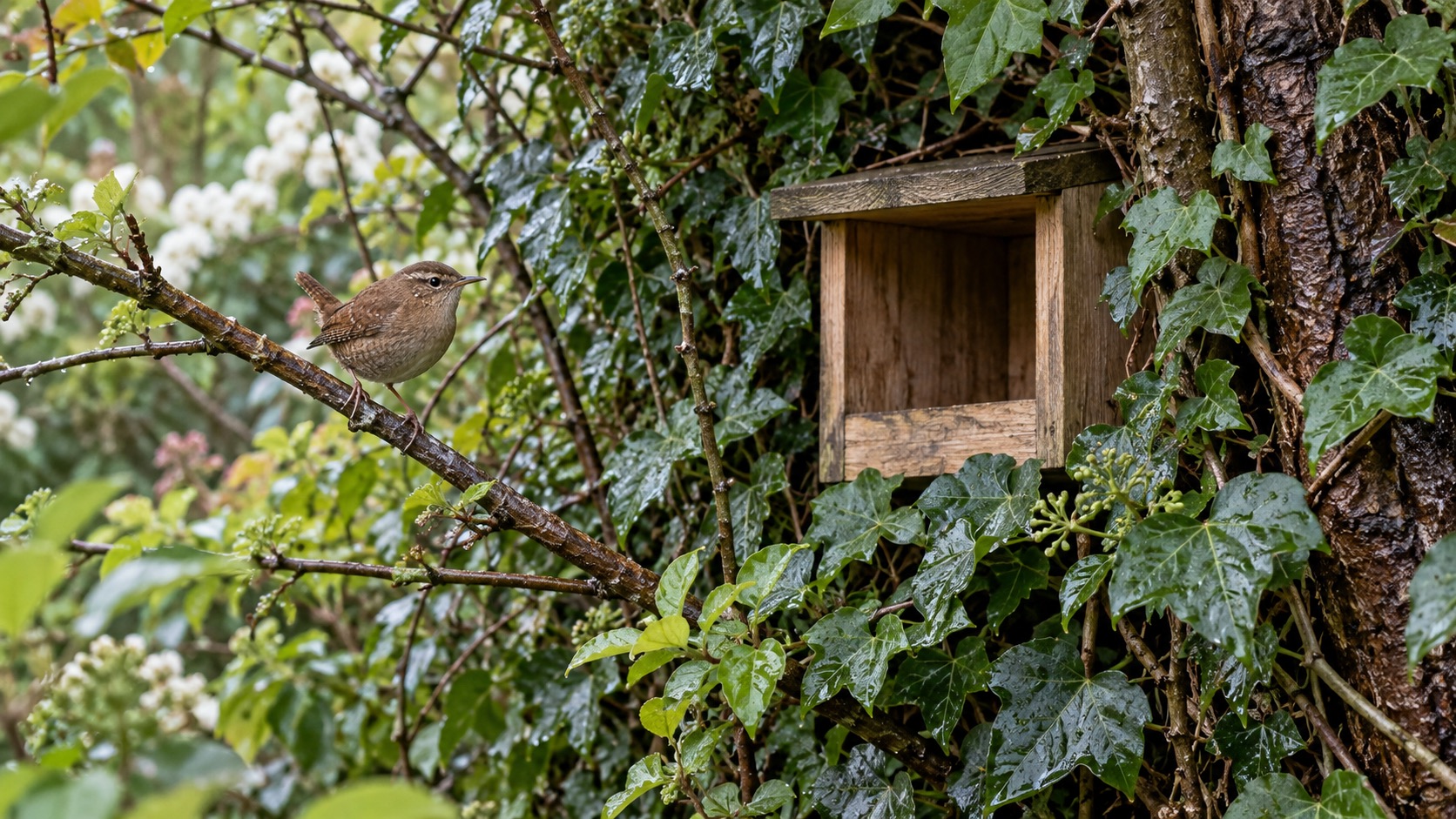
Look for deep, quiet cover at a low to moderate height: an established climber, thick shrub or open-fronted outbuilding can be more promising than a bare trunk. Do not pack foliage across the entrance. The bird needs a clean route in and out, while the roof and surroundings should deflect driving rain.
Check the site from a cat's perspective. A fence top, shed roof or sturdy branch beside the opening can make a hidden box easy to reach. Keep it away from the most active feeder and routine garden work. For wider advice, use our nest-box placement guide.
Is a wren box the same as a robin box?
Often the same open-front design can offer a possible site to either bird, but that does not mean a pair of birds will share it. Robins and wrens both use sheltered cover in different ways, and the resident bird makes the final choice. If you see a listing labelled “wren box”, inspect its actual entrance, insulation, drainage and cleaning access rather than relying on the label.
Our robin-box guide compares more open-front options. For the broader distinction between designs, read open-fronted versus hole-entrance boxes.
What makes a box unsuitable?
Avoid thin novelty cottages, metal walls, perches, untreated cracks and designs that cannot be opened for off-season maintenance. The BTO recommends insulating materials and at least 15mm timber for conventional wooden boxes. Check for safe drainage rather than a sealed, damp base.
Do not put food, bedding or loose nesting material inside. A wild wren can collect material and choose how to construct its nest. Supplying vegetation and insect-rich habitat is usually more valuable than filling a box.
When should you leave it alone?
Install or reposition the empty box before the breeding season. If a bird begins carrying material or visiting regularly, stop work nearby and observe from a distance. An active nest must not be moved, opened or obstructed for a better camera view.
After the season, establish that the box is empty before any cleaning. Our nest-box cleaning guide explains the legal and practical checks.
Frequently asked questions
Should a wren box have a tiny round hole?
Not as a default assumption. Open-front boxes are a recognised option for wrens. A specialist small-cavity design may also be sold, but the exact dimensions and placement must be appropriate; the word “wren” on a product title is not enough.
Can I hang it in a hedge?
Only if it can be fixed firmly without swinging, has a clear approach and will remain accessible for future lawful maintenance. A growing hedge should not crush or engulf the box.
Why have wrens ignored it?
They may already have natural nest sites. Review shelter, wetness, approach and disturbance after the season using our unused-box guide, but do not disturb a bird to make changes.