Buying guide
Best nest boxes for great tits in UK gardens
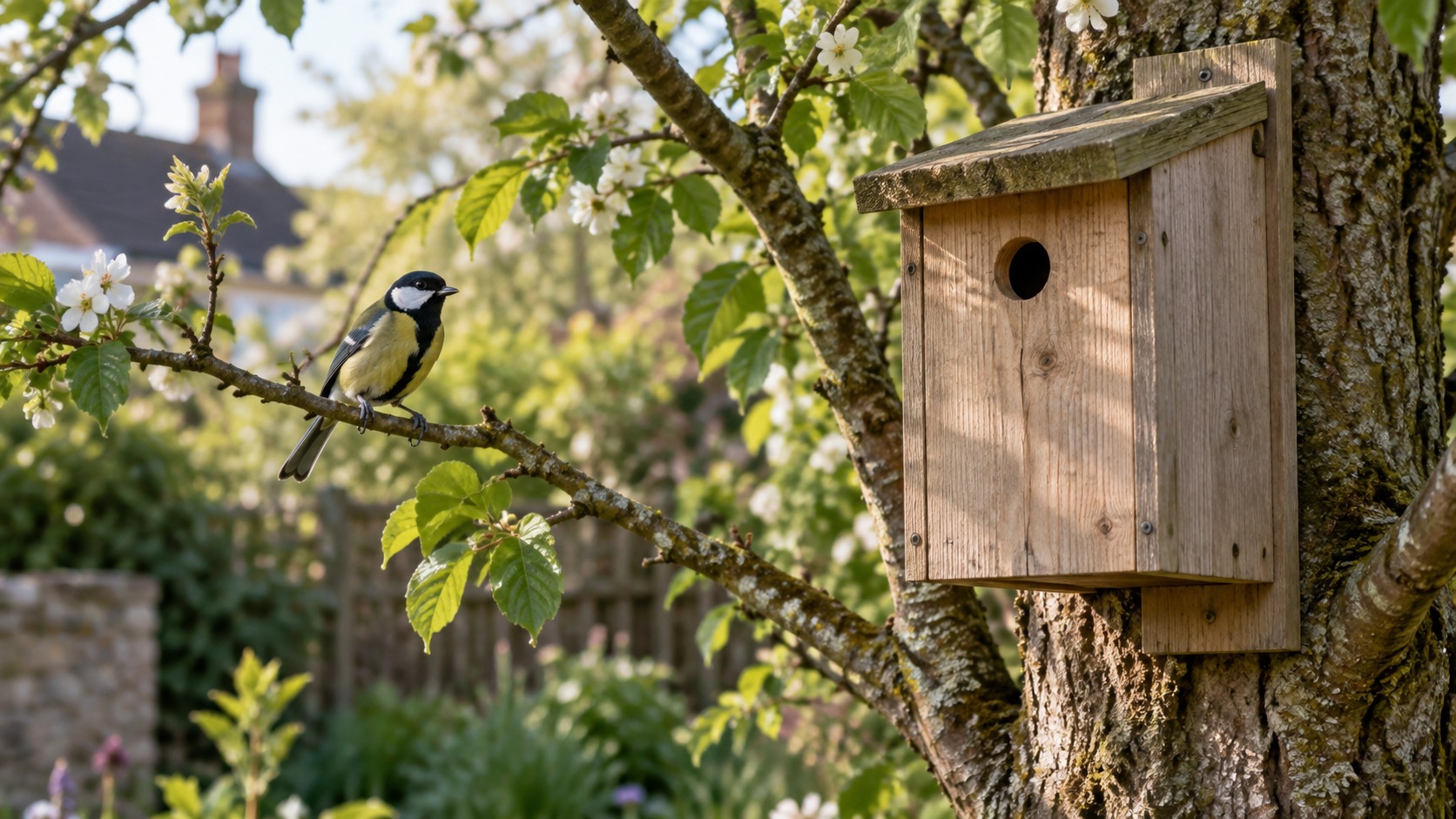
Choose a great tit nest box with a suitable 28mm or 32mm entrance, sound construction and a sheltered position.
Our recommendations
Three sensible great-tit box choices
The opening is only one part of the decision. Check the internal chamber and fixing method before ordering.
dobar 28mm FSC tit nest box
Best for: A smaller entrance for great tits where the current dimensions suit the site
A European-made FSC pine box measuring about 16 by 16 by 32cm, with a 28mm entrance and rear mounting strip.
Best straightforward 28mm option. Drawback: 28mm admits more species than a 25mm hole and the decorative print adds no welfare benefit.
CJ Wildlife birch-log 32mm nest box
Best for: A broader small-bird cavity where several species may investigate
A rustic FSC birch-log box with a 32mm entrance, rain-shedding roof and solid insulating walls.
Best natural 32mm design. Drawback: the broader entrance allows more competing species and the irregular exterior needs careful mounting.
Durable 32mm alternative
RSPB Schwegler 32mm woodcrete nest box
Best for: A long-lasting general-purpose box where the heavier body can be supported
A durable insulating woodcrete box with a 32mm entrance and supplied mounting hardware for small hole-nesting birds.
Best durable general-purpose 32mm option. Drawback: it is heavier, so check the support and fixing method before installation.
| Box | Entrance | Good fit | Main trade-off |
|---|---|---|---|
| dobar FSC tit box | 28mm | A more focused tit opening | Check the smaller chamber and mounting strip |
| CJ Wildlife birch-log box | 32mm | A wider mix of hole nesters | Other species can compete |
| RSPB Schwegler box | 32mm | Durability | Heavier and more demanding to fix |
Which entrance size suits a great tit?
The BTO's nest-box construction guide lists 28mm for great tits and tree sparrows. Its broader buying advice also recommends 32mm as an all-round opening for small hole-nesting birds. Both can be reasonable: choose 28mm when you want a more restricted opening, or 32mm when you are happy for house sparrows and other species to inspect the box. Neither size reserves a nest for great tits.
An entrance alone cannot rescue a damp, thin-walled box. Seek timber at least 15mm thick or another insulating material such as woodcrete, a rain-shedding roof, drainage, ventilation and a lid or panel that can be opened after the nesting season.
Which box would we choose?
dobar 28mm FSC box: a focused starting point
The dobar has a stated 28mm entrance and a conventional pine body with rear mounting strip. That makes it the clearest of these three choices if great tits are the intended users. Its modest size may suit a quiet garden with a sheltered tree or wall location.
The decorative finish does not add nesting value. Inspect the current dimensions and fastening arrangement before buying; a rear strip must sit firmly against the support without allowing the box to swing.
CJ Wildlife birch-log 32mm box: a broader garden option
The CJ box uses solid birch and a 32mm entrance. Its thick walls and roof shape are attractive practical features, but the entrance is deliberately more general. A great tit can use it, while a house sparrow or another hole nester may also show interest.
The log shape makes it more awkward to mount than a flat-backed box. Choose a stable fixing and check for movement in strong wind before the breeding season.
RSPB Schwegler: a durable material alternative
Woodcrete is a wood-and-concrete mixture valued for insulation and longevity. This particular RSPB Schwegler box has a documented 32mm entrance, so it belongs with the general-purpose choices rather than the more focused 28mm box. Its supplied hook and fixing hardware must still suit the support you intend to use.
The downside is weight. A flimsy fence panel or improvised hook is not a suitable support; match the fasteners to the wall or tree and the manufacturer's instructions.
Where should a great-tit box go?
The BTO recommends roughly one to three metres for a typical small-hole box. Find a quiet position with an unobstructed flight path and shelter from strong afternoon sun and driving rain. In many UK gardens a north- or east-facing aspect works, but actual shade and exposure matter more than a compass reading.
Keep the entrance clear of branches that cats or squirrels can use as a step. Move it away from busy feeders and doors. If the suitable wall is high, use competent help rather than stretching from a ladder. Our placement guide covers fixings, direction and species differences.
What should you avoid?
Avoid thin decorative boxes, metal or ceramic walls, external perches, poor drainage and designs with no cleaning access. A perch is unnecessary and may make predator access easier. Do not enlarge a box's entrance on site unless it is certainly empty and the modification is appropriate to its chamber and material.
Do not crowd several great-tit boxes into one small garden corner. These birds are territorial in the breeding season. A second box may help another species only if it has a suitable opening and a distinct quiet location. See the hole-size guide before buying multiple boxes.
When should you install and clean it?
Autumn or winter installation gives birds time to discover the box before spring. Great tits may inspect a box before serious nest building begins, so complete camera fitting, entrance protection and repair before visits turn into occupation. Once birds carry material, keep your distance and leave the box alone.
Only clean a box when you are certain no active nest is present and the timing is lawful. Our cleaning guide explains the checks. Wild birds, their eggs and active nests are protected; a better photograph is never a reason to open the lid.
Frequently asked questions
Is a 32mm hole too large for a great tit?
No. Great tits can use a 32mm opening, but it also admits other small hole nesters. A 28mm opening is the more targeted choice in BTO construction guidance.
Should I add nesting material inside?
No. Leave the box empty and dry. Birds normally build their own nest; loose material inside may retain moisture or conceal a problem. See our nesting-material advice.
Why has no bird chosen my box?
No box guarantees occupation. Check exposure, disturbance, nearby competitor boxes and the route to the entrance after the season, then use our unused nest-box checklist before buying a replacement.