Practical advice
Contains affiliate links
How to take apart a bird feeder for cleaning
A safe order for dismantling a tube or modular bird feeder, handling stuck parts and putting it back together without damaging clips or seals.
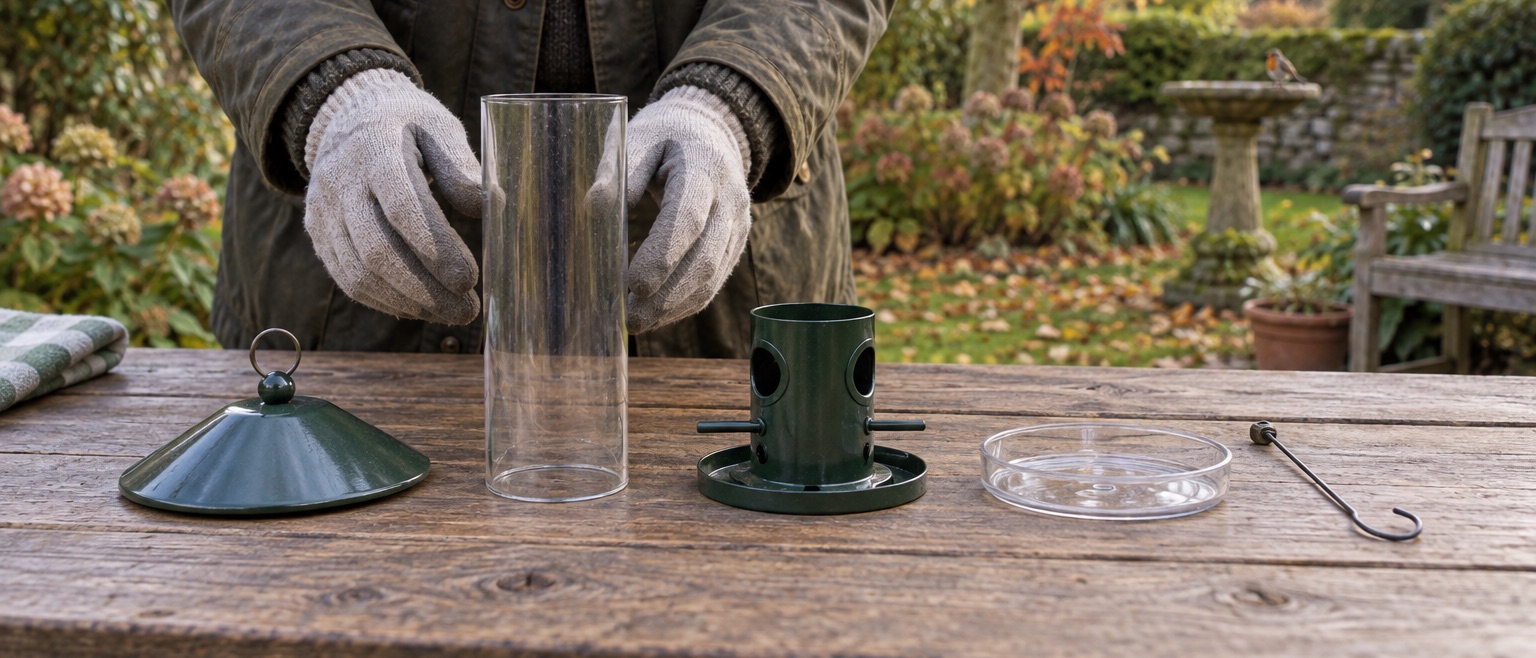
Keep clips, screws and seals in a small tray.
Wash and disinfect each washable part separately.
Rebuild only when completely dry and test the hanger before use.
The safest way to take a bird feeder apart is to empty it, find the manufacturer's release points and remove only the parts designed to come off. Many tube feeders open at the lid and base, but some also have clip-in ports; cage and weight-activated designs add another layer. Photograph the assembled feeder first so you can reverse the sequence.
The RSPB recommends dismantling feeders so hidden dirt can be washed away. If you are unsure which model you own, search the maker's name and model number before using a screwdriver or pulling a plastic fitting. A cracked clip may turn an otherwise cleanable feeder into one that cannot hang safely.
Before you release the first clip
Clear a washable outdoor surface and put down a small parts tray. Wear gloves, remove leftover food and dampen dusty debris. Check for a maker's label under the base or roof. Note how the hanger, ports, drainage holes and seals fit together.
| Part | Usually worth removing | Caution |
|---|---|---|
| Lid and hanger | Yes, if the manual shows a twist or release | Do not bend a wired hanger out of shape |
| Base or seed tray | Often the dirtiest removable piece | Support the tube while unlocking it |
| Perches and ports | Only if designed to unclip | Brittle plastic can fracture under leverage |
| Outer guardian cage | If the cage opens or detaches | Keep latch and hinge parts together |
| Fixed or sealed joint | No | Clean reachable surfaces or retire if grime remains trapped |
A practical disassembly sequence
- Remove the lid and hanger as the maker specifies. Tip all remaining food out; do not save damp seed.
- Hold the tube over the bench and release the base. On a twist-lock design, support the tube rather than twisting against a thin feeding port.
- Unclip removable perches, ports or cage panels one at a time. Place matching small parts together.
- Wash each part with a dedicated brush, then disinfect, rinse and air-dry according to the cleaner and feeder instructions. Our general cleaning guide has the full hygiene sequence.
- Reassemble in reverse order. Check that every port, base and hanger locks securely; give it a gentle empty shake over the bench before rehanging.
The RSPB Classic Easy Clean feeder is an example with removable perches and a twist-off base. Jacobi Jayne's Ring-Pull range has model-specific components and a parts catalogue. Neither design means another brand's part will fit.
If the base will not come off
Check first that you are turning or releasing it in the correct direction. Rinse away dried seed dust from the joint and allow it to soften; do not use excessive force, solvents or sharp metal tools against plastic. A swollen wooden part or corroded fastener may need a different approach. If the joint is sealed, or you cannot reach food residue inside, consider a more easy-clean feeder rather than repeatedly using a dirty tube.
Frequently asked questions
Can I put feeder parts in a dishwasher?
Only if the exact manufacturer's instructions explicitly allow it, and keep bird-feeding equipment separate from kitchen food utensils. Outdoor washing with dedicated tools is the safer default.
What if a clip breaks while cleaning?
Do not hang the feeder with an unsecured base or sharp broken edge. Find an exact maker-approved part using our replacement-parts guide, or retire the feeder.
Should I take the whole feeder apart every week?
Remove all maker-removable food-contact components for the weekly clean. If a design makes that impossible without damage, it is a poor fit for a long-term hygiene routine.
Helpful products
Designs that make dismantling easier
These are examples of feeders with published easy-clean or modular features, not universal instructions for every model. Check the exact listing and manual before buying or pulling parts free.
Jacobi Jayne Ring-Pull feeder
Its twist base and removable pin release the component parts, making the main feeding areas easier to reach during cleaning.
Best tool-free modular design. Drawback: its conventional ports do not prevent squirrel access on their own.
RSPB Classic easy-clean seed feeder (small)
A simple 500ml, two-port feeder with a polycarbonate tube and plastic fittings that come apart without tools.
Best straightforward alternative. Drawback: RSPB warns that squirrels and parakeets may damage the plastic parts.