Practical advice
How to attract swifts to a nest box
Give swifts a suitable high, shaded nest site with clear flight access, patient timing and careful use of attraction calls.
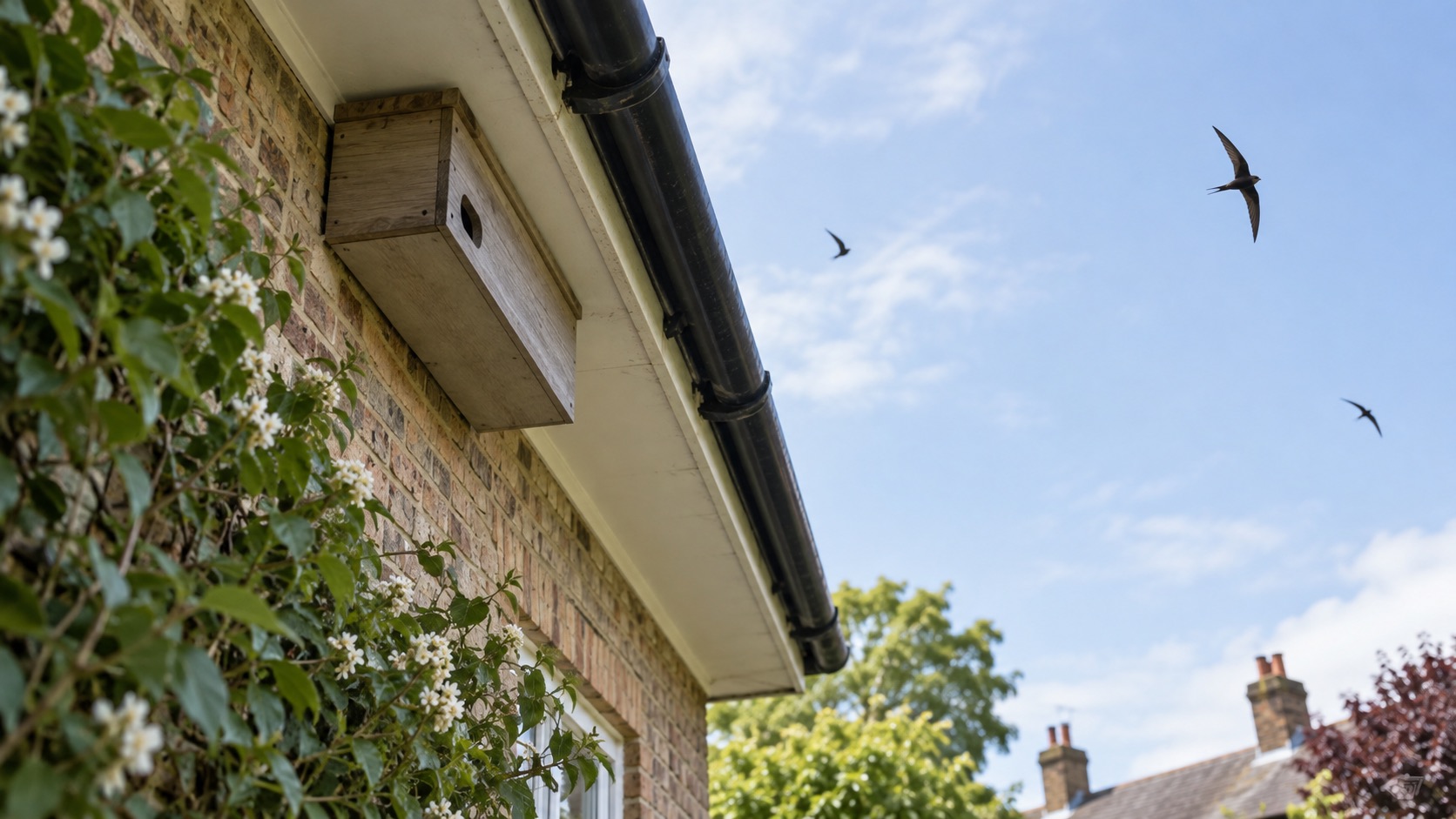
To attract swifts to a nest box, start with a building rather than a gadget. Swifts need a high, sheltered cavity and an open approach through the air. A box fixed low, in strong sun or behind a tree canopy is unlikely to become useful even if calls are played nearby.
Is your building suitable?
Look for a high external wall or eaves with clear air in front and below. Swift Conservation's nest-box advice favours sites at least about 4.5 metres up and protected from the strongest sun; our swift-box buying guide uses roughly five metres as a practical UK starting point.
Do not take a height number in isolation. A box at five metres behind dense branches has a worse flight path than one with open access. Avoid places where a roof edge, balcony, cable or downpipe obstructs a direct approach. Check that the wall is sound and fixings can carry the box in wind and rain.
Choose a purpose-made swift box
Swifts use a horizontal slot and suitable internal cavity, not an ordinary 32mm tit box or a house martin mud cup. Review entrance dimensions, insulation, access and weather protection on the current product listing. A good roof helps keep the cavity dry, but it should not create a hot enclosed space in afternoon sun.
The two boxes shown below are examples with documented swift-oriented designs. Neither is guaranteed to attract swifts. If the only feasible position requires unsafe access, ask a competent installer to assess it; do not lean out of a window or improvise with a ladder.
When should the box go up?
Install and test the complete box before swifts arrive in spring. Birds may inspect a potential site repeatedly before nesting, and a new box can remain unused for years. Keep the entrance clear and do not change its position every few weeks. Quiet consistency gives it a fairer chance.
If the building already has natural swift nest sites, protect them first. Renovation and insulation work can accidentally block established access. Do not seal a gap that birds are using or move a box that contains an active nest.
Should you play swift calls?
Recorded calls can be part of a carefully planned attraction project. Swift Conservation discusses their use where a suitable nest site and birds in the area already exist. Calls should be kept at a responsible level and schedule, with neighbours considered. A loud all-day speaker is not a shortcut to occupancy.
If you are unsure, begin with the box and observe local swift activity. The RSPB's swift-home guidance is a useful independent reference. Do not enter or open a potentially occupied box to see whether calls are working.
Why might swifts ignore a new box?
They may not be breeding nearby, the entrance may be obscured, the box may overheat, or the wall position may not resemble a safe approach. A single unused season does not prove failure. Review the site outside the breeding period, looking at shade, flight path, and whether returning swifts pass the building.
Our wider unused nest-box checklist covers common garden-box issues, but swifts are a specialist case: do not solve a poor high-wall site by swapping in a low-level tit box.
What about multiple boxes?
Swifts can nest near other swifts, so more than one well-spaced unit can make sense on a suitable building. First make sure each opening has clear access and every fixing is sound. A row of cheap boxes on an overheated south wall is not an improvement.
Coordinate with a local swift group if a larger installation or building project is planned. Their site knowledge can help with local colonies and installation choices. Avoid disturbing any established nest in the process.
Frequently asked questions
Will swifts use a box in its first year?
They might, but patience is normal. Keep the entrance available year after year rather than moving the box repeatedly.
Can I put a swift box on a tree?
Swifts are generally associated with high building cavities. A stable building wall or eaves with open air is the more appropriate standard choice.
Can a camera be added later?
Only while the box is certainly unoccupied and outside the nesting period. Plan wiring and camera compatibility before fitting the box. See when to install a bird-box camera.
Helpful products
Purpose-built swift boxes
Both examples have horizontal swift entrances. Check current dimensions, bracket requirements and the wall's suitability before buying; this is not a job for an improvised high-level fixing.
Artisan Welsh-slate swift box
Best for: A shaded high wall with safe professional access
A chemical-free wooden swift box with stainless-steel fittings, a slate roof above the entrance, two keyhole mounting points and a locking hinged front.
Best premium timber swift box. Drawback: high wall installation needs competent access and properly rated fixings.
Selections thick-timber swift box
Best for: A smaller wall position with the same clear-flight requirements
A 32 by 20 by 13cm external swift box made from 20mm timber with a horizontal entrance.
Best compact documented dimensions. Drawback: its external wall position must provide a high, completely unobstructed flight path.